The traffic police's crackdown on drivers failing to maintain a safe distance on the North-South expressway, from Phap Van to Nghi Son, which began on 27/8, has raised concerns among many drivers. They are unsure how to maintain the precise distance, what to do if another vehicle cuts in, and worry about automated fines. The Traffic Police Department has issued specific guidelines to address these concerns, highlighting the following key issues:
Safe distance regulations are not new
Vietnam's road traffic legal framework has mandated safe driving distances for many years. The most recent effective document is Circular 38/2024 from the Ministry of Transport (currently the Ministry of Construction). Earlier circulars from the Ministry of Transport that addressed this issue include 31/2019, 91/2015, and 13/2009.
Accompanying these regulations are decrees outlining penalties for drivers who violate safe driving distances. Decrees 238/2026, 168/2024, 100/2019, and 46/2016, among others, all stipulate fines for such infractions.
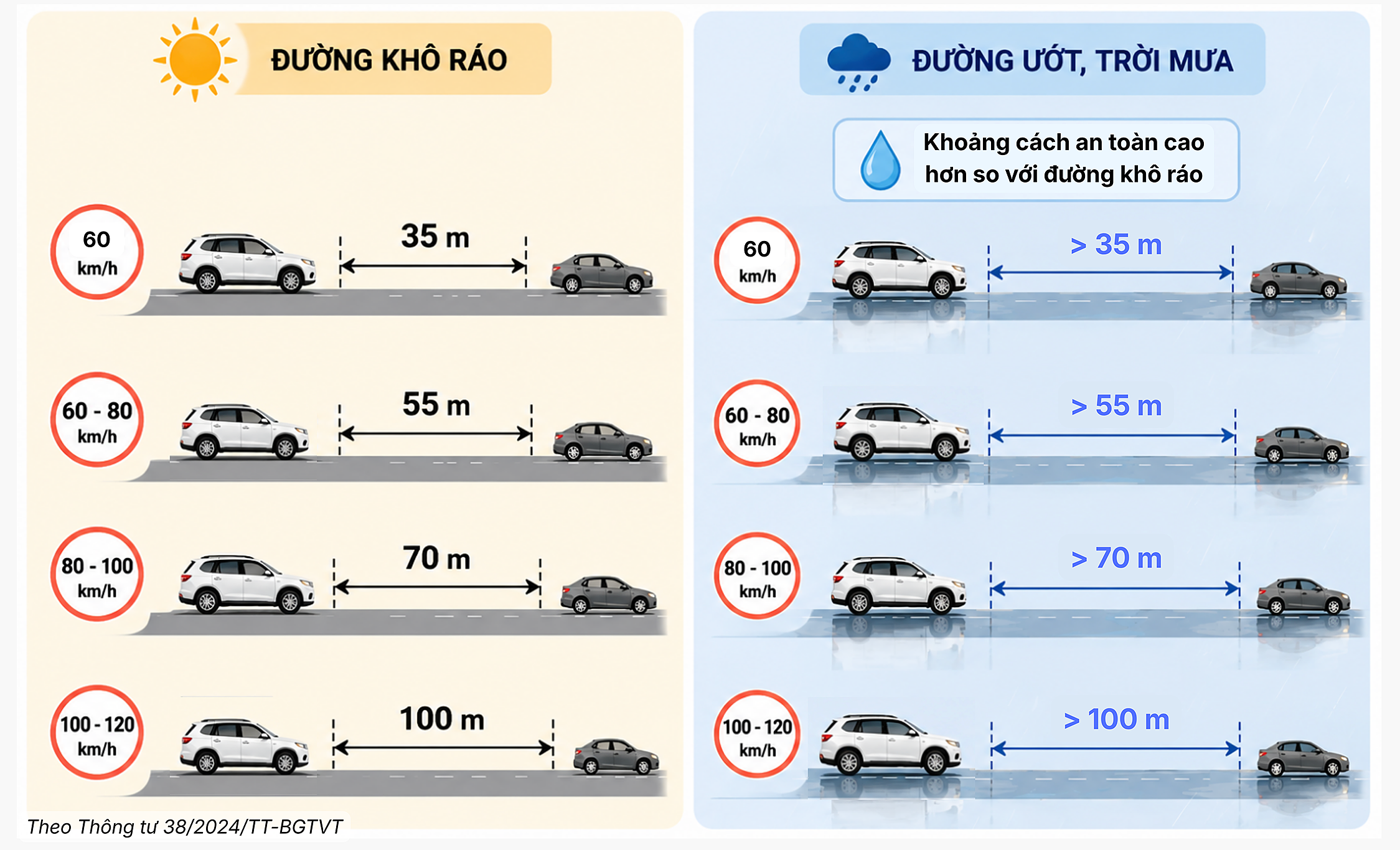 |
Regulations on safe driving distance by speed. *Graphic: Ho Tan*
This indicates that while maintaining a safe distance on expressways is not a new legal requirement, its enforcement is. Previously, due to limitations in recording technology, violations of safe driving distance were rarely penalized unless they resulted in a collision or accident. Now, with advanced camera systems—including expressway management cameras, vehicle dashcams, voluntary public recordings, and official patrol recordings—all serve as evidence for enforcement.
Why is maintaining a safe distance crucial?
A safe distance is the minimum required for a trailing vehicle to perceive a sudden situation, react by braking or changing lanes, and avoid colliding with the vehicle ahead. At higher speeds, braking distance increases due to greater vehicle inertia. Theoretically, under consistent conditions, braking distance increases proportionally to the square of the speed. For instance, if speed doubles from 60 to 120 km/h, the theoretical braking distance could increase by about four times.
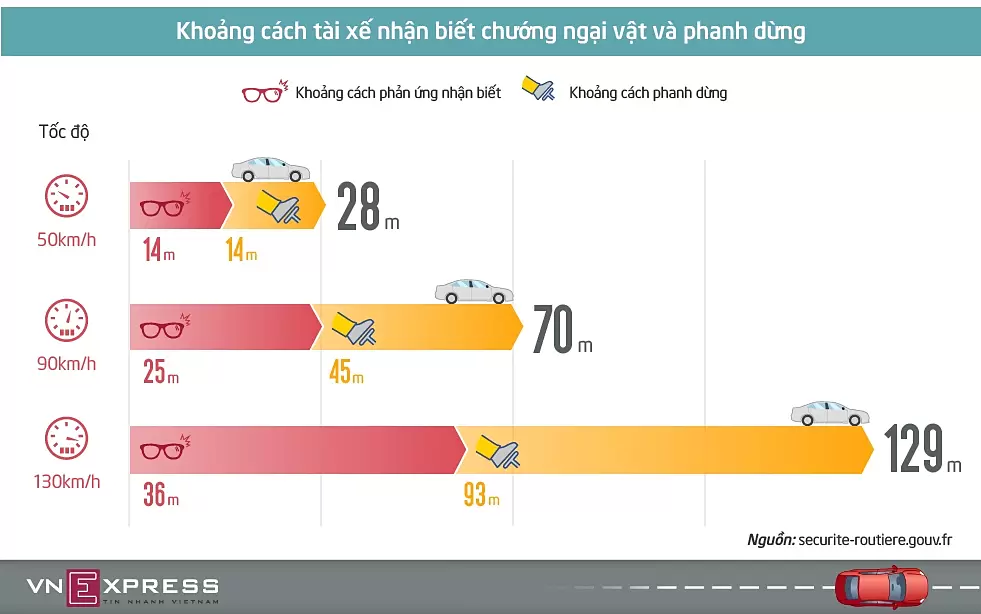 |
Basic stopping distance for a mid-size passenger car; this number varies by vehicle type. *Graphic: Viet Chung*
The necessary distance also depends on the vehicle type, load, tire and brake condition, road surface, weather, and the driver's reaction capability. For buses and heavy trucks, the distance required to decelerate and stop can be longer. Therefore, the legally mandated distance is designed to ensure safety for all types of vehicles.
Which drivers are penalized for unsafe distance?
The Traffic Police Department emphasizes that the primary objective of this enforcement campaign is not to issue a high volume of fines, but rather to issue warnings and enhance the self-awareness of road users to prevent traffic accidents. Currently, traffic police officers only record and process violations of unsafe driving distance on clearly organized expressway sections that feature marked safe distances between vehicles and are equipped with cameras to capture video and images of infractions.
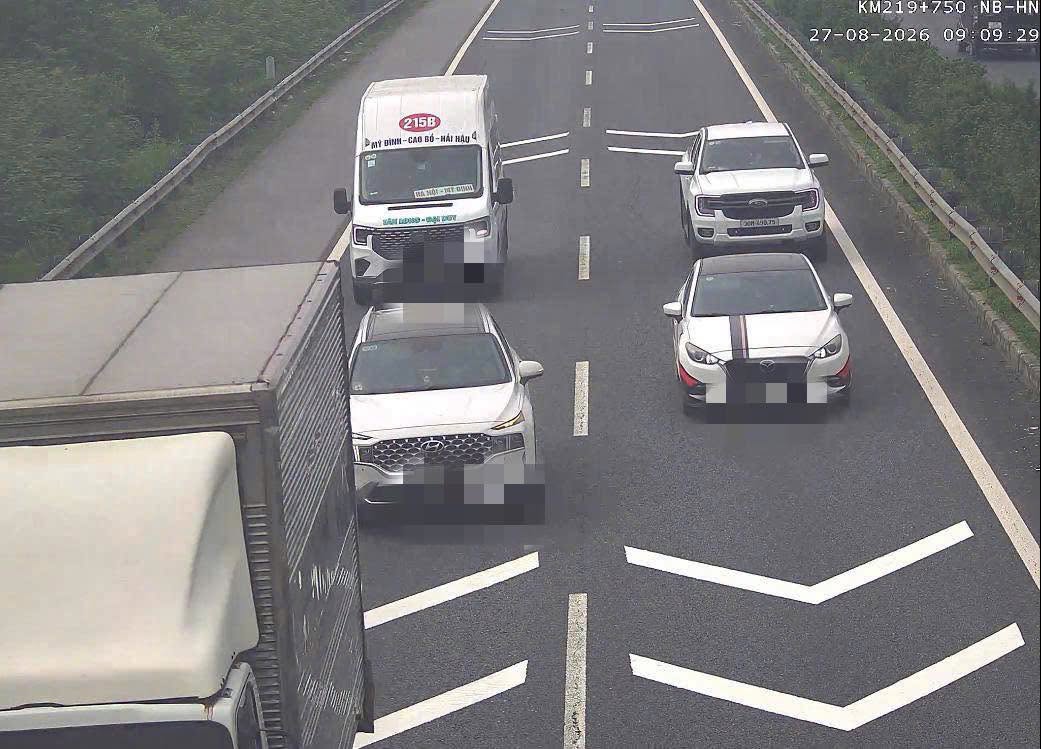 |
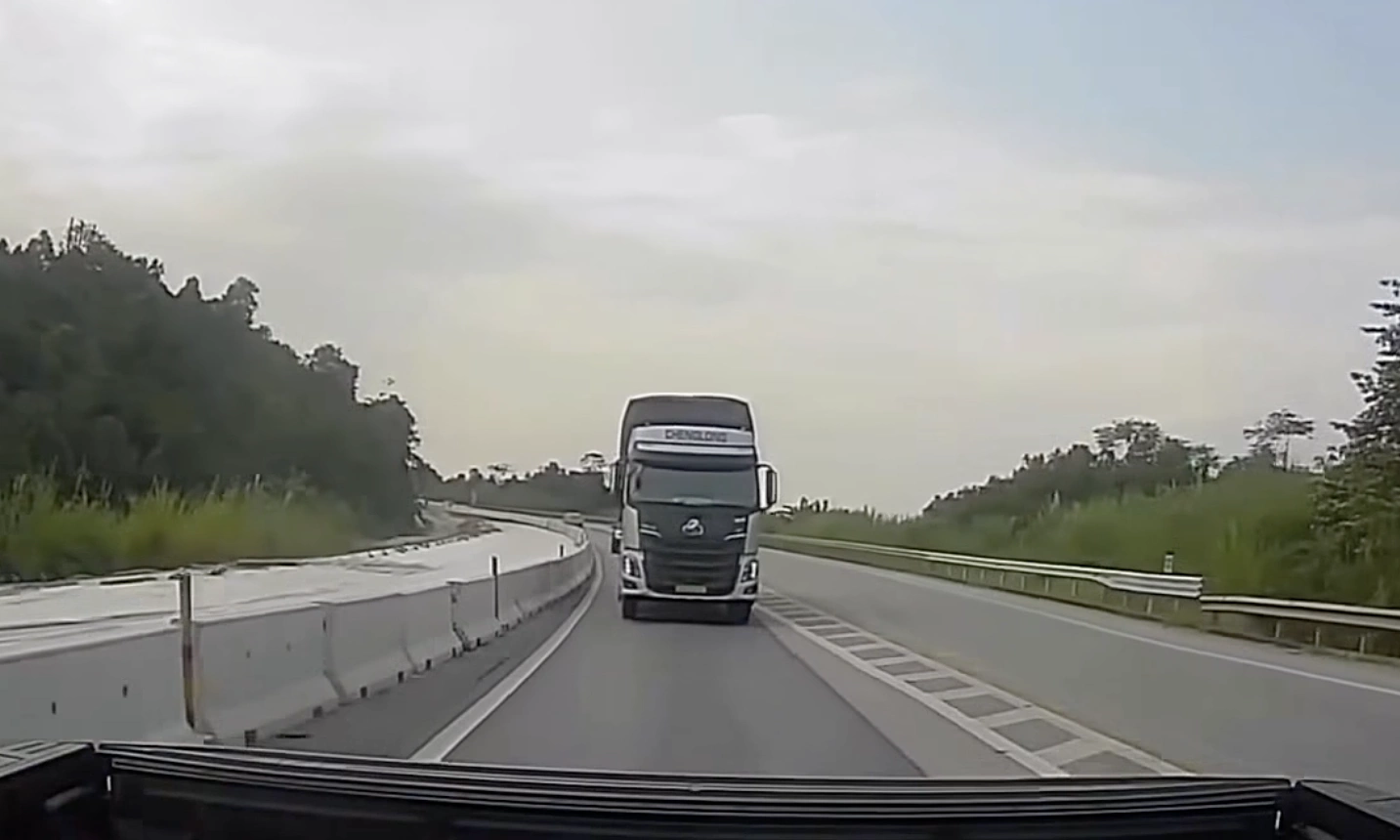
Vehicles driving too close on the Phap Van - Nghi Son expressway on 27/8. *Photo: Traffic Police Department*
On the first day of enforcement, violating vehicles were those intentionally tailgating the car ahead to overtake, maintaining a distance of only one to two car lengths (approximately 5-10 m). At high speeds, this distance is extremely dangerous, as a sudden brake by the leading vehicle leaves the trailing vehicle no opportunity to avoid a collision.
The objective of these penalties is not to enforce specific distances like 55, 70, or 100 m, but to cultivate civilized driving habits, ensuring a safe distance from the vehicle ahead, and discouraging constant tailgating to overtake. Therefore, drivers should not fixate excessively on these precise figures and risk distracted driving; instead, they can determine safe distances using simple methods.
Methods for determining safe driving distance
Currently, expressways feature sections with distance markers at 0-50-100-150-200-250 m, combined with road markings, which drivers can use as a reference to maintain distance. This distance should be maintained relatively consistently from the vehicle ahead throughout the journey.
A second method, widely adopted by drivers in many countries and even incorporated into law, is the three-second rule. This involves selecting a fixed roadside reference point, such as a tree or a pole, and beginning to count 'one-thousand one, one-thousand two, one-thousand three' as the vehicle ahead passes it. If your vehicle reaches or has not yet reached that reference point by the count of 'one-thousand three', the distance is considered safe. If your vehicle passes the reference point before then, you need to increase your following distance.
Finally, many modern vehicles are equipped with adaptive cruise control technology. Drivers can select their desired following distance from the vehicle ahead using a button on the steering wheel. The vehicle will then automatically maintain this distance by reducing speed if the lead car slows down.
All these methods aim to help drivers maintain a relatively consistent distance, rather than fixating on specific figures like 55 m being safe and 54 m leading to a penalty.
Refer to how vehicles maintain safe driving distances in the United States below:
Traffic moves at varying speeds by lane, maintaining safe distances on an expressway in California, United States. *Video: Youtube/everythingworld290 - ohndiazpainting*
Pham Hai