On the morning of 29/12/2025, on the Ha Noi - Thai Nguyen highway in the Yen Binh area of Thai Nguyen, a truck carrying corn spilled tons of kernels onto the road. This caused many cars behind to become disoriented for dozens of seconds. The layer of corn covered the entire lane, accompanied by dust and flying kernels, turning the dry road into a slippery surface.
When encountering such situations, whether it's kernels, gravel, or liquids, drivers must remain calm and follow the rules below to handle the situation safely.
Maintain tire grip and vehicle stability
When a vehicle drives into an area with spilled corn, sand, or gravel, the road loses its usual grip. Tiny particles form a rolling layer under the tires. If a driver brakes hard at this moment, the wheels lose grip, making the vehicle prone to skidding, leading to a loss of steering control, the vehicle swerving, or spinning. Therefore, drivers should release the accelerator, keep the steering wheel straight, and shift to a lower gear to allow the vehicle to decelerate naturally using engine braking. When the steering wheel feels heavier and the wheels begin to grip the road, then apply gentle braking to continue reducing speed safely.
Navigating when visibility is obscured
Additionally, when visibility is obscured by dust and flying particles, many drivers tend to swerve to avoid the dangerous area. However, on highways, surrounding vehicles are traveling at high speeds and also experiencing poor visibility. A sudden lane change can cut off other vehicles, leading to chain collisions. Therefore, staying in the current lane and decelerating is safer than swerving into an adjacent lane.
If forward visibility is completely obscured, and drivers cannot clearly see the road or lane markings, they should shift their focus to fixed landmarks on the road. These include painted lines, reflective strips, road dividers on both sides of the road, or by checking the rearview mirror. These details help drivers determine their vehicle's position and prevent disorientation from "temporary blindness" when forward visibility is covered.
Maintain a safe distance and identify truck risks
Another important consideration is that sedans, hatchbacks, or small cars with low curb weight are more likely to lose grip when driving over corn kernels, sand, or gravel. In contrast, heavier vehicles like SUVs or trucks tend to be more stable due to their greater weight pressing down on the tires. Therefore, drivers of smaller vehicles should proactively maintain a greater distance and decelerate earlier when following vehicles carrying loose cargo.
Furthermore, drivers should not rely entirely on safety technologies like anti-lock braking system or electronic stability control. These features cannot create grip when tires are gliding over a layer of loose particles; they only help stabilize the vehicle body when the tires slip. Remaining calm, releasing the accelerator, keeping the steering wheel straight, and braking at the right time are still the most important factors to avoid accidents.
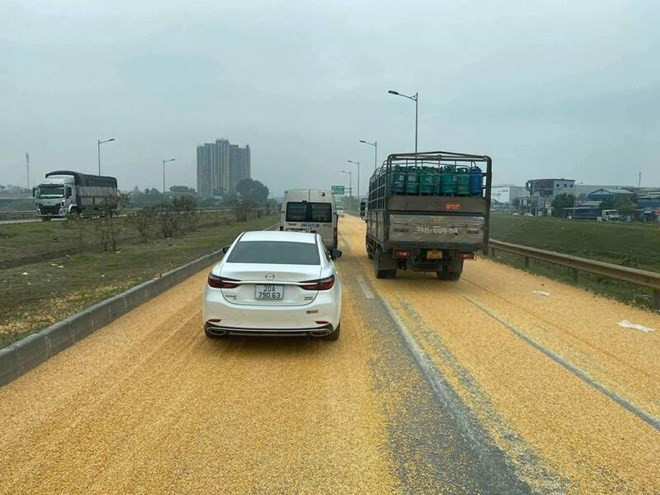 |
Scene of corn kernels spilled on the Ha Noi - Thai Nguyen highway on 29/12. Photo: Cong an Thai Nguyen |
Finally, accidents caused by spilled cargo often have warning signs. Flapping tarpaulins, open truck beds, or small objects sporadically falling onto the road signal a high risk. When observing these signs, drivers should increase their distance, or proactively and decisively overtake when safe to do so, instead of tailgating or driving parallel.
Ho Tan