On the drive mode menu of a modern car, the "sport" option is often visible. Some vehicles activate it with a button, others hide it within a touchscreen menu, or it might be indicated by a small checkered flag. Engaging this function significantly enhances the driving feel.
What changes when sport mode is activated?
Sport mode does not transform a car into a true sports car. Instead, it adjusts a series of settings to make the vehicle respond more dynamically to driver inputs. The specific tuning formula varies by manufacturer but typically involves the engine, transmission, steering system, throttle, and sometimes the suspension or electronic stability control.
In some vehicles, sport mode modifies the exhaust sound or uses simulation technology to make the engine sound louder and more aggressive. Other manufacturers alter the digital display interface, transforming the standard instrument cluster into a sportier version.
One of the most critical adjustments is throttle response. In normal mode, the accelerator pedal is tuned for smooth operation, which is useful for slow movements in parking lots or traffic. In contrast, sport mode makes the throttle more sensitive. Even a slight movement of the pedal can elicit a stronger response from the engine, making the car feel more potent, even if maximum power remains unchanged.
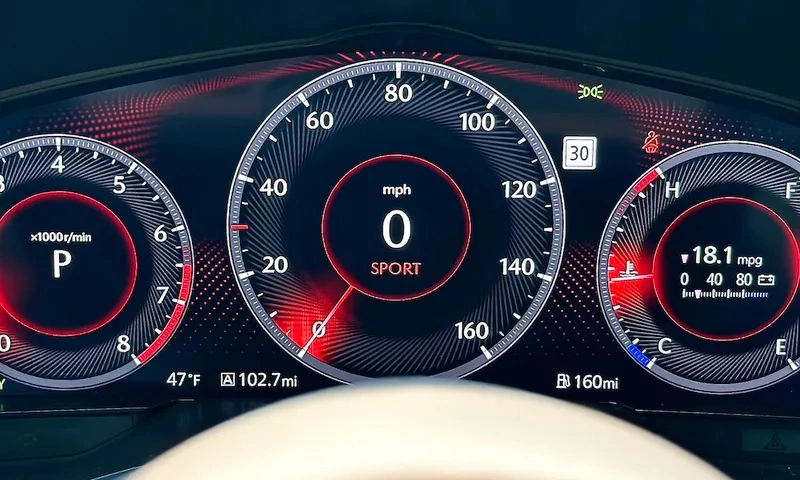 |
Sport mode displayed on a car's instrument cluster. Photo: The Manual |
The transmission also plays a significant role in sport mode. An automatic transmission may hold lower gears longer to achieve higher engine revolutions per minute, making downshifts easier and preventing shifts to the highest gear too quickly. This ensures the engine operates within its optimal responsive revolution range. As a result, the car is always ready for flexible acceleration whenever the driver presses the accelerator.
Additionally, other components may be adjusted: the steering wheel gains more heft, adaptive or air suspension systems stiffen automatically, and the electronic stability control allows for more wheel slip. All-wheel drive (AWD) vehicles may also see changes in torque distribution between the axles. However, not all cars modify these settings; some only adjust the transmission and throttle, while high-performance models can fine-tune nearly everything at once.
Why this mode is rarely used
Engaging sport mode can sometimes make the daily driving experience less comfortable. The car might accelerate faster, the transmission maintains high engine revolutions, and a stiffer suspension can lead to a bumpy ride over speed bumps or rough roads.
Fuel consumption is another core factor. Keeping engine revolutions high and encouraging harder acceleration can increase fuel usage. For many drivers, this is a sufficient reason not to use the mode regularly.
Situations where sport mode proves valuable
When driving on winding mountain roads, keeping the transmission in a lower gear helps the car accelerate faster out of corners, while a more responsive throttle can create a greater sense of connection between the driver and the car.
Some drivers use sport mode when merging onto highways or overtaking other vehicles. In these situations, the transmission reacts more quickly to strong throttle inputs, allowing for faster merging and overtaking maneuvers.
However, sport mode does not replace safe driving skills. A car does not inherently corner better just because a button is pressed. Instead, factors such as tires, suspension, brakes, road conditions, and driver skill remain the decisive elements.
Sport mode is more about emotion than performance
The most interesting aspect of sport mode lies in its ability to completely transform the driving feel without necessarily changing the car's actual performance capabilities significantly.
A car might accelerate slightly faster but delivers an exhilarating cabin experience, simply because the transmission constantly maintains high engine revolutions and the throttle responds more quickly. This is not a drawback, as cars are designed for driving, and part of a high-performance car's appeal is how the machine communicates with the person behind the wheel. Sport mode amplifies these emotions.
Nevertheless, for daily commuting needs, most car owners are content to keep their vehicles in normal mode. This is why sport mode is often the most overlooked feature in modern cars, even though pressing the button can reveal a completely different personality of both the driver and the vehicle.
Minh Quan (according to Motor1)