


No longer cautious trials, many ride-hailing drivers in Vietnam now consider electric vehicles their main livelihood. Lower operating costs and faster return on investment are the attractions of electric vehicles, causing a group of customers who spend hours in cars and drive hundreds of kilometers daily to gradually abandon habits formed over many years with gasoline and diesel vehicles.
Migration to electric vehicles
Prioritizing stability, minimal breakdowns, and good resale value, Thach Hoa (Hai Phong), owner of a ride-hailing company, said he was once a devotee of Japanese gasoline cars. His rental fleet, comprising about 5-7 vehicles depending on the period, consisted entirely of cars from Japanese brands.
According to Hoa, after deducting a driver's fee of about 600,000 VND and fuel costs of 500,000-600,000 VND, each vehicle driving 300-400 km (two trips) brought in a net profit of about one million VND per day. After approximately 2,5 years, he could recover both principal and interest for a B-segment car costing around 600-700 million VND.
The turning point for the man, born in 1971, came after a trip to Europe. Hoa observed many electric vehicles on the streets. After experiencing a BYD M6 MPV as a passenger, he questioned why he shouldn't choose an electric vehicle if Europeans, known for being demanding and practical consumers, had already done so.
Upon returning to Vietnam, Thach Hoa decided to purchase two M6 vehicles for his ride-hailing service. This marked his shift to electric vehicles after many years of prioritizing only Japanese gasoline cars.
Applying the same calculation, he estimated that the on-road cost of a BYD M6 was less than 800 million VND. Instead of gasoline costs, charging the electric vehicle cost just over 200,000 VND, increasing his profit to about 1,3-1,4 million VND per day. This meant he could recover the cost of purchasing an M6 in approximately two years.
Currently, the profits from Hoa's two electric vehicles are supporting the revenue of three other gasoline and diesel vehicles that are operating at a reduced capacity or temporarily suspended due to high and inefficient operating costs. "As gasoline and diesel prices have continuously risen in recent months, I see that the decision to switch to electric vehicles brings many benefits," Hoa stated.
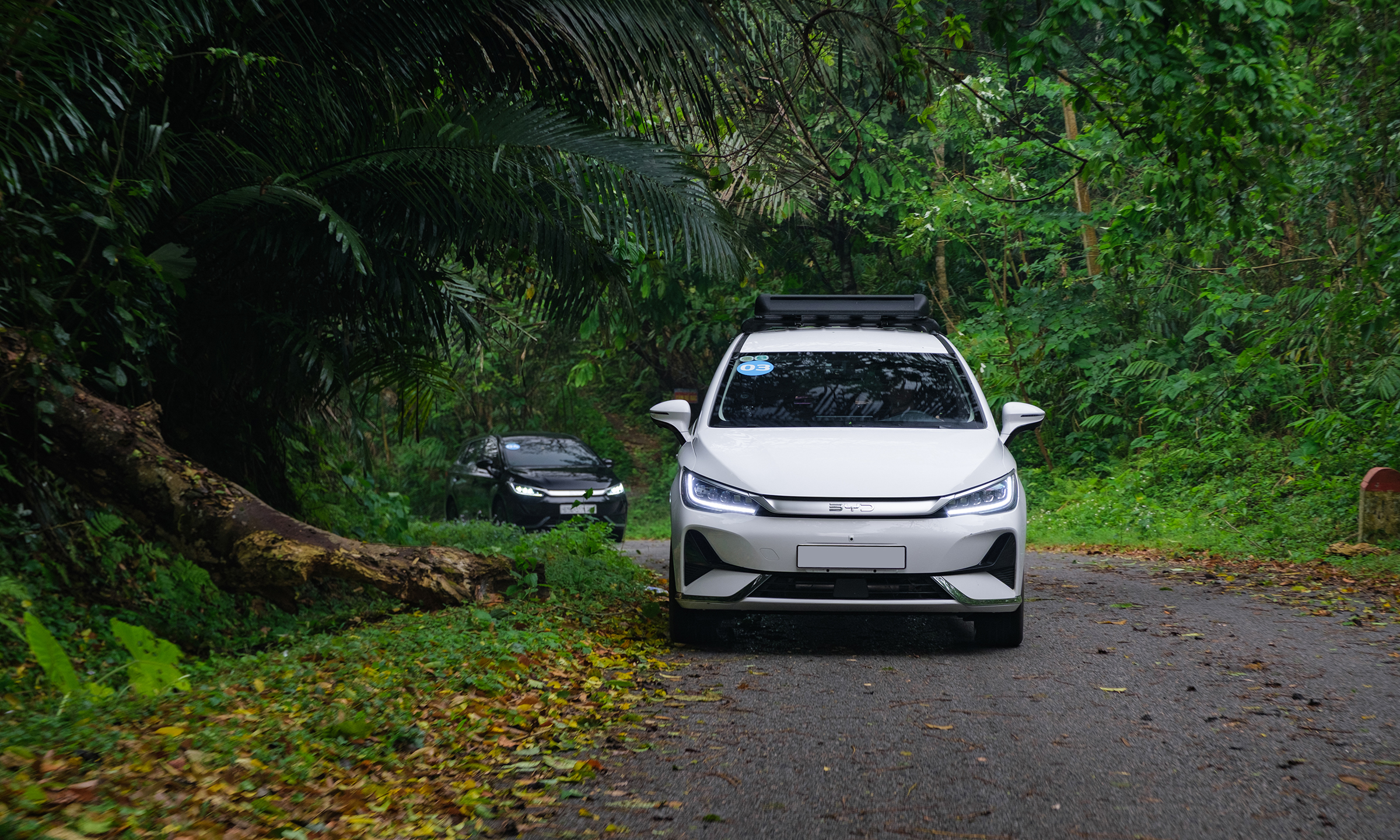 |
BYD M6 driving in Bac Kan. Photo: BYD |
Similar to Thach Hoa, lower operating costs compared to gasoline vehicles also led Dam Han (Hanoi) to switch to electric vehicles. He bought his first electric vehicle, a VinFast Limo Green, in late 2025 for his ride-hailing business.
Dam Han regularly drives the Hanoi - Bac Giang route, completing two trips each day. The average profit generated is about 1,2-1,5 million VND per vehicle per day after deducting expenses. Recognizing the business opportunity in electric vehicles, he purchased an additional BYD M6 in 3/2026 and hired another driver to operate it.
"Electricity costs are clearly much lower than refueling for the same distance, which is very suitable for business," Han said. "What also interests me is how far an electric vehicle can go compared to what the manufacturer advertises."
During a recent trip, Dam Han tested the route from Hanoi to Bac Kan, approximately 200 km with many passes and curves, using the BYD M6. He reported completing the 206,6 km distance with 46% battery remaining. This means the actual ratio was 4,49 km per 1% battery, higher than the manufacturer's stated 4 km per 1% battery. With this power consumption, he said it was sufficient to return to the city without needing an additional charge.
Openness to electric vehicles
The cases of Thach Hoa and Dam Han are among many examples demonstrating that electric vehicles are more readily accepted by the ride-hailing business sector. For individual users, however, inconveniences such as charging time, waiting for charging, or inadequate charging station infrastructure remain immediate barriers.
"If more profit can be earned, vehicle owners may accept the disadvantages of electric vehicles, such as waiting to charge or spending more time finding charging stations," assessed Vo Quoc Binh, an expert with many years of experience in the automotive business in TP HCM.
According to Binh, if only considering operating costs, electric vehicles are always more optimal than gasoline vehicles for ride-hailing services, especially in short-distance urban environments with many charging stations. For customers prioritizing long-term strategies, such as inter-provincial routes requiring continuous operation, gasoline or hybrid vehicles remain a more reasonable choice.
Industry experts indicate that lower operating costs provide a significant advantage for electric vehicles. The emergence of this type of vehicle is transforming the landscape of the transport and passenger service business in Vietnam over the past three years.
Green SM (established in 2023), a company within the Vingroup ecosystem, is leading the four-wheel ride-hailing segment with a market share exceeding 50% (Q4/2025) based on total transaction value, surpassing major players like Grab and Be, according to market research firm Mordor Intelligence. Green SM's entire fleet consists of VinFast products. The brand's best-selling models, designed for ride-hailing services, include the Limo Green and Minio Green.
For BYD, the M6 model, targeting families and ride-hailing businesses, is currently the Chinese manufacturer's main sales driver. Cumulative sales of the BYD M6 have reached approximately 2,000 vehicles to date.
Nguyen Vu - Pham Trung



