During holiday periods, expressways are the preferred routes for many drivers traveling between provinces and cities. However, as vehicle traffic surges dramatically, the risk of accidents also increases. On one day early in the year, two separate chain collisions involving 7 automobiles on the Phan Thiet - Dau Giay Expressway and 11 automobiles on the La Son - Hoa Lien Expressway caused prolonged traffic congestion.
These incidents highlight that chain collisions rarely stem from a single cause, but rather from a combination of objective and subjective factors.
Reasons for increased traffic accidents during holiday periods
During holiday periods, expressway traffic becomes not only heavier but also more complex. The flow of vehicles includes family cars less accustomed to long-distance travel, passenger buses, trucks, and containers, all moving at varying speeds. Differences in acceleration, braking capabilities, and driving skills destabilize the traffic flow. When one vehicle is forced to decelerate suddenly, vehicles behind it can easily get caught in a chain reaction.
Thus, if just one vehicle reduces speed due to an obstacle or makes a sudden lane change, following vehicles are forced into a chain reaction. The disparity in braking and acceleration capabilities among different vehicle types heightens the risk of successive collisions, especially when traffic volume exceeds the expressway's stable capacity.
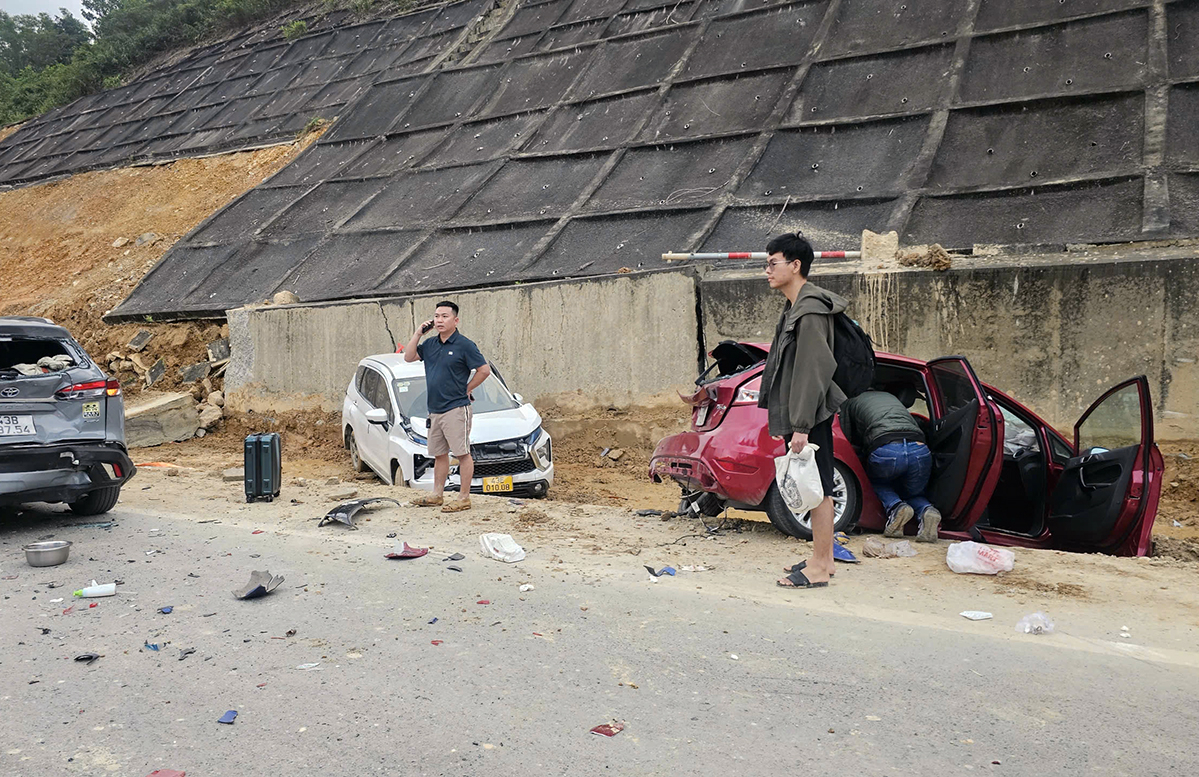 |
11 automobiles involved in a chain collision on the La Son - Hoa Lien Expressway on 4/1. Photo: Hoang Lich |
11 automobiles involved in a chain collision on the La Son - Hoa Lien Expressway on 4/1. Photo: Hoang Lich
A subjective cause stemming from drivers is the habit of urban driving, such as tailgating or sudden braking, that drivers bring onto expressways, particularly those with limited expressway experience. At speeds of 80-100 km/h, a vehicle travels tens of meters in just one second, while human reaction time remains constant. Despite this, many drivers maintain similar following distances as they would in urban areas, where speeds only reach 40-50 km/h.
This discrepancy significantly narrows the time available to react to unexpected situations. When the vehicle ahead brakes suddenly, the driver behind is forced to brake hard or steer abruptly, increasing the risk of losing control or colliding.
Furthermore, chain collisions on expressways often originate from minor incidents, such as sudden deceleration, abrupt lane changes, or obstacles appearing on the road. The braking signal then transmits down the line of vehicles. Each driver reacts slightly slower than the vehicle in front, and after a few responses, this delayed processing accumulates, leaving drivers in the trailing vehicles insufficient time to brake and avoid a collision.
Finally, holiday periods, with their heavy traffic and prolonged congestion, also make drivers more prone to stress and fatigue. Fatigue diminishes concentration, reaction time, and situational assessment. Coupled with the desire to arrive quickly and avoid traffic jams, many drivers maintain high speeds even when traffic conditions do not permit it. These factors inadvertently increase accident risks if vehicles ahead encounter an issue.
How to drive more safely during holiday periods
First, drivers must maintain a longer safe following distance than usual. A common rule is to keep at least 3-4 seconds behind the vehicle ahead, increasing to 5-6 seconds in rain, fog, or dense traffic. This buffer provides drivers with enough time to observe and react if the vehicle in front brakes suddenly.
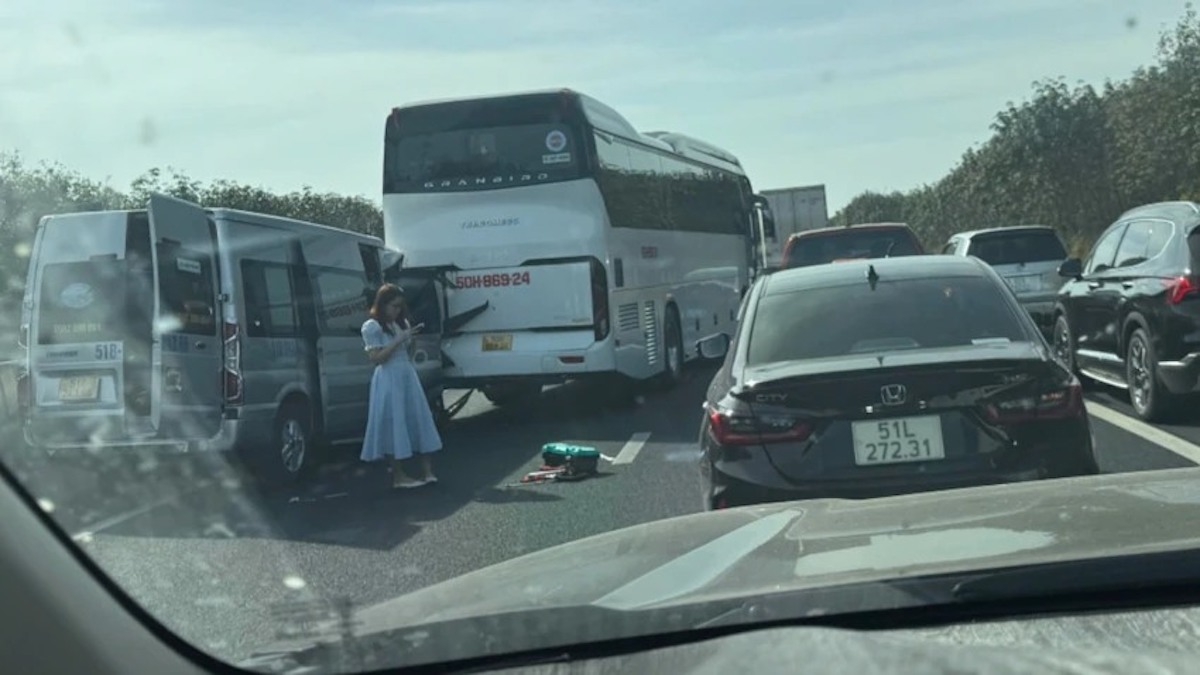 |
The scene of a 7-automobile chain collision on the Phan Thiet - Dau Giay Expressway on 4/1. Photo: Thai Ha |
The scene of a 7-automobile chain collision on the Phan Thiet - Dau Giay Expressway on 4/1. Photo: Thai Ha
Next, drivers should reduce speed when traffic becomes dense. Expressways are not always suitable for driving at the maximum permitted speed. When vehicle density increases, maintaining a lower speed is safer than attempting to sustain high speeds and then having to brake suddenly and repeatedly. Moving at the same speed as the traffic flow will help minimize accidents on expressways.
Additionally, drivers should observe further and wider, not just focusing on the vehicle immediately ahead. Monitoring 3-4 vehicles in front, while regularly checking rearview mirrors, helps drivers detect unusual situations early, such as numerous brake lights or sudden steering. Reacting early by easing off the accelerator and lightly applying the brakes is far more effective than waiting until the situation becomes critical. Furthermore, limiting lane changes and avoiding sudden braking are crucial to prevent disrupting the flow of traffic behind.
Ultimately, drivers need to maintain a refreshed physical and mental state for long journeys, and pull over to rest when tired, accepting a slightly slower journey in exchange for safety for themselves and others.
Ho Tan