Vietnam's banking system has experienced periods of stress following the 2008 global financial crisis and during 2022-2023. These fluctuations, according to credit rating agency FiinRatings, show that risks at some credit institutions can accumulate over time, then spread quickly, requiring regulatory intervention.
Bank events nearing or experiencing illiquidity rarely deteriorate suddenly, despite diverse economic contexts.
Before significant credit events or regulatory intervention, warning signs typically emerged through declines in asset quality, profitability, liquidity, capital adequacy, funding structure, or governance quality.
FiinRatings' study of 15 Vietnamese banks that previously experienced or neared illiquidity identified 11 early warning signs: 5 quantitative and 6 qualitative factors.
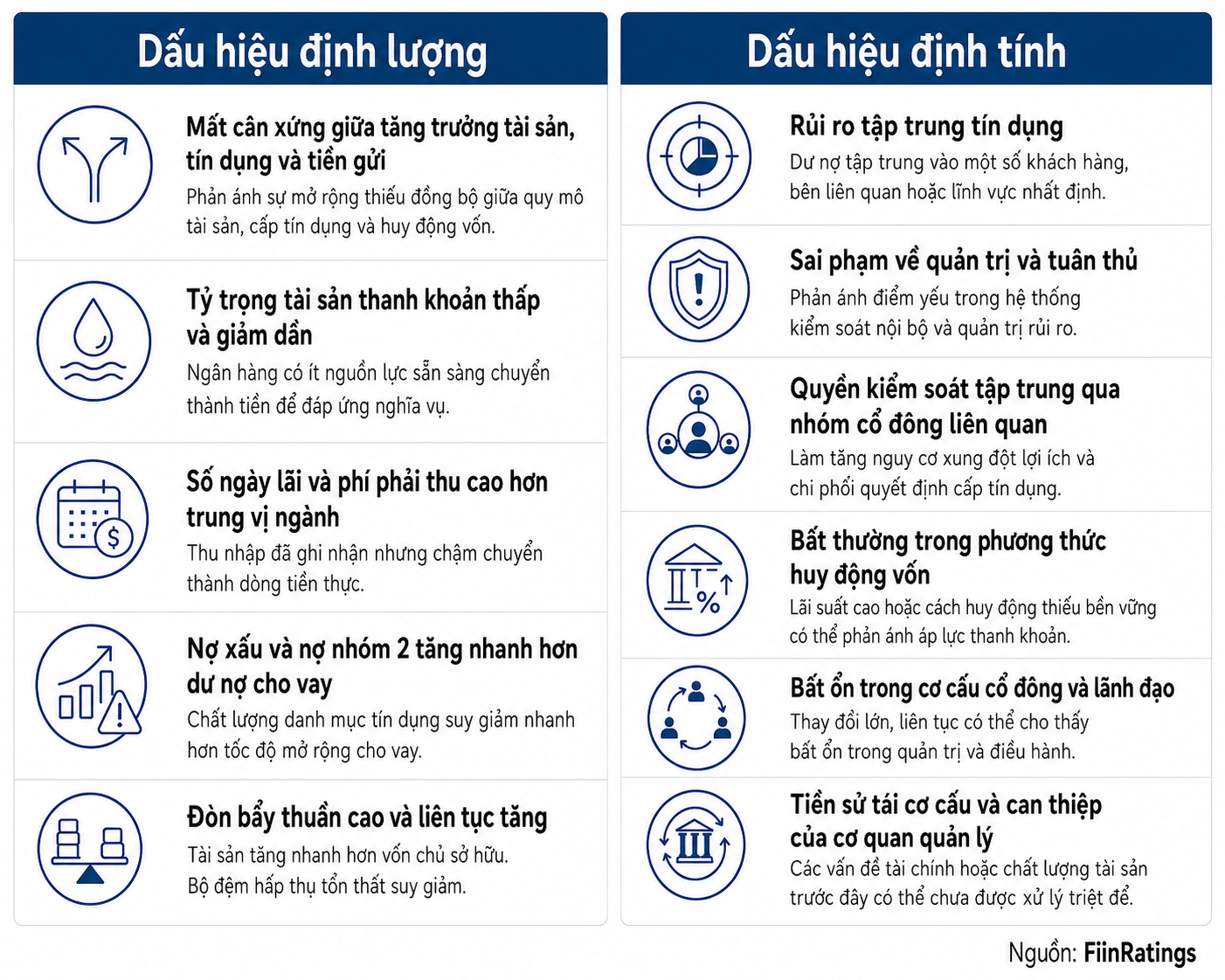 |
Quantitative signs reflect anomalies in banks' business models, asset-liability structures, capital buffers, asset quality, and liquidity.
The most common quantitative sign, observed in all 15 banks that experienced or neared illiquidity, was an imbalance between total asset growth, loan balances, and customer deposits.
For example, one bank's total assets increased by 288% in 2009, primarily due to deposits and loans from other credit institutions, while customer loan balances grew by only 31%. One year later, total assets decreased by 9%, but customer loans increased by 122%. This bank continued rapid expansion, concentrating credit on related customer groups, before a forced merger in 2013.
A sustained disparity between loan and deposit growth also indicates an imbalance in capital mobilization and utilization. If credit grows faster than deposits, banks may need to compensate with unstable funding sources, increasing liquidity and refinancing risks. Conversely, deposits significantly outpacing loans might indicate underutilized capital or allocation to riskier assets.
FiinRatings cited another case where loan balances increased by 9% in 2011 while customer deposits decreased by the same amount. By 2012, credit further increased by 37%, markedly higher than the 12% deposit growth. This bank also focused on lending to related businesses and had to mobilize funds at high costs before becoming illiquid.
Qualitative signs observed in distressed banks reflect their risk appetite, funding methods, ownership structure, and governance.
The most consistent signs included credit concentration risk, a history of governance and compliance violations, and control concentrated among related individual shareholder groups.
While quantitative indicators primarily reflect the consequences of accumulated risk, qualitative factors can reveal the internal causes of risk formation. These signs may appear earlier but are difficult to identify as they do not appear directly on financial statements.
When testing this indicator set on 12 operational banks using data from 2020-2025, highly-rated groups recorded few warning signs. Their frequency of appearance increased markedly in banks with lower ratings.
However, FiinRatings noted that the presence of one or a few signs does not directly prove a bank is at risk of illiquidity. Analysts must evaluate the indicators in relation to each credit institution's financial situation, operating model, and specific context.
Quynh Trang