The European Union (EU) has asked China to "voluntarily" limit its hybrid vehicle exports to Europe, aiming to avert a trade dispute. This request comes as Chinese automakers rapidly expand their presence in the European market, a phenomenon described by research firm Rhodium Group as penetration at "light speed". The EU hopes China will reduce its hybrid market share in Europe to 15%, down from its current one-third. Germany, in particular, is advocating for the EU to impose tariffs on Beijing's plug-in hybrid electric vehicles (PHEVs) and tighten localization requirements.
This move by the EU is a direct response to the unprecedented influx of Chinese-made cars into Europe. Mid-last week, German Deputy Chancellor Lars Klingbeil visited Volkswagen, Europe's largest car manufacturer, which is currently facing a crisis, and warned Brussels about the competition from Chinese cars. Just five years ago, Chinese manufacturers sold only tens of thousands of vehicles in Europe, but they are projected to reach one million units this year. In 2021, China sold approximately 66,000 vehicles in the European market, a number that has steadily climbed. By the end of 2025, Chinese cars are expected to account for 9,3% of the total automobile market share in Europe.
The surge in Chinese car sales has been inadvertently bolstered by Europe's own green vehicle incentive policies, which aim to eliminate 90% of emissions by 2035. For example, Italy offers up to 10,000 euro (approximately 11,650 USD) for citizens switching to electric vehicles. Emerging Chinese EV manufacturer Leapmotor capitalized on this subsidy, introducing thousands of inexpensive T03 small electric cars into the market. After the subsidy, a T03 could be purchased for around 5,000 euro, significantly undercutting many of its rivals' cheapest models.
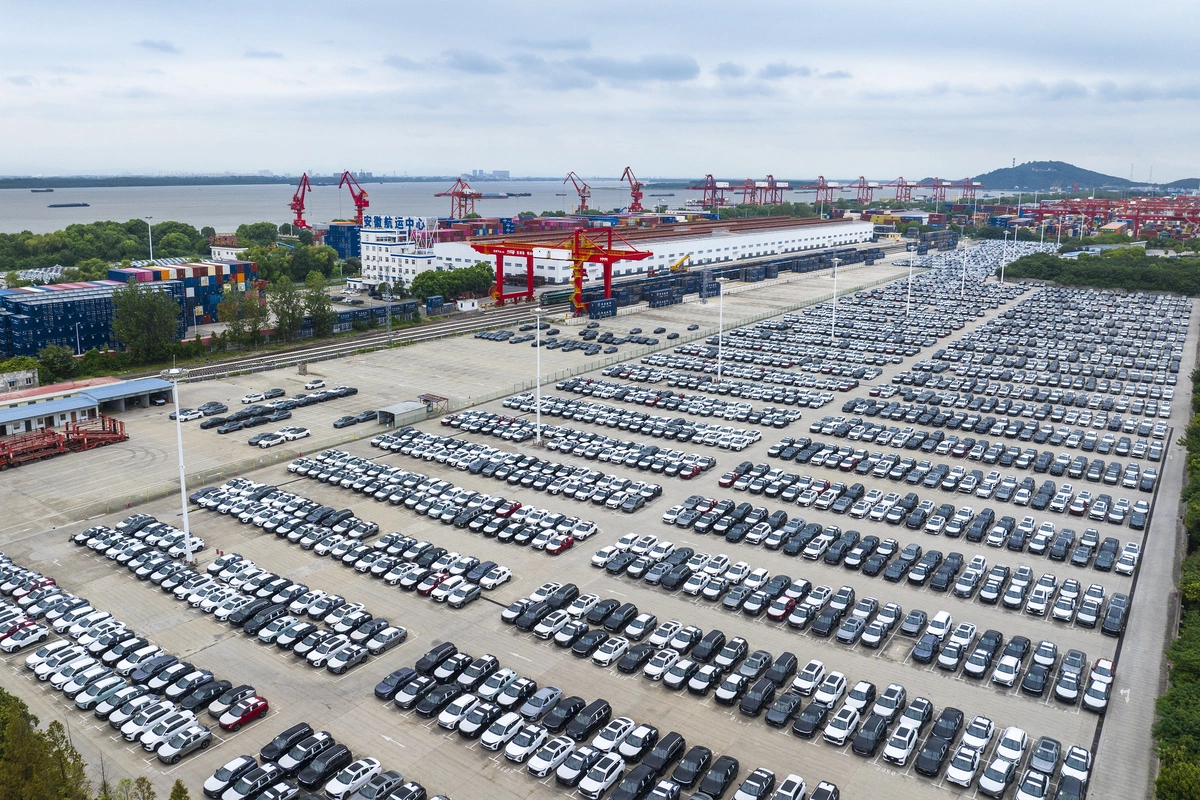 |
Chinese cars waiting to be loaded for export at a port in Anhui province, China, 18/9/2025. Photo: China Daily |
According to Rhodium Group, the speed at which Chinese automakers are gaining market share in Europe surpasses the achievements of Japanese and Korean manufacturers in the 1970s and 1990s. This rapid expansion is attributed to China's significantly larger production capacity. Moreover, Chinese companies face immense pressure to export due to an overcrowded domestic market with oversupply and restrictive tariffs in the United States, leaving them "no way back".
The EU previously attempted to curb this inflow by proposing a 45% tariff on battery electric vehicles (BEVs) by late 2024. However, Chinese manufacturers quickly found a "loophole" by exporting large volumes of hybrid and PHEV models, which are subject to a much lower tariff rate of 10%. The United Kingdom, notably, does not impose tariffs on Chinese BEVs and plans to phase out petrol and diesel cars by 2030. In the UK market, "made in China" cars commanded 20,6% of the market share by the end of last year.
In 2025, BYD's sales increased to 51,000 units, a six-fold rise, while Chery's sales grew 13 times compared to the previous year. MG sold 85,000 units, though this was lower than Mercedes-Benz's sales. The increased competition from Chinese vehicles is severely impacting major European automakers. Volkswagen, which owns brands like Audi, Porsche, Lamborghini, and Ducati, is reportedly planning to cut up to 50,000 jobs. Other significant German and European brands, including Mercedes-Benz and BMW, are facing similar difficulties. Daniela Cavallo, head of Volkswagen's union, stated, "We are facing extremely fierce, difficult, and unfair competition from Chinese cars." Volkswagen is caught in a "pincer movement", losing ground in China, facing challenges at home, and affected by US reciprocal tariffs. Between 2021 and 2025, its profit margin decreased from 7,7% to 2,8%, with profits in the Chinese market alone plummeting 80% over the past decade.
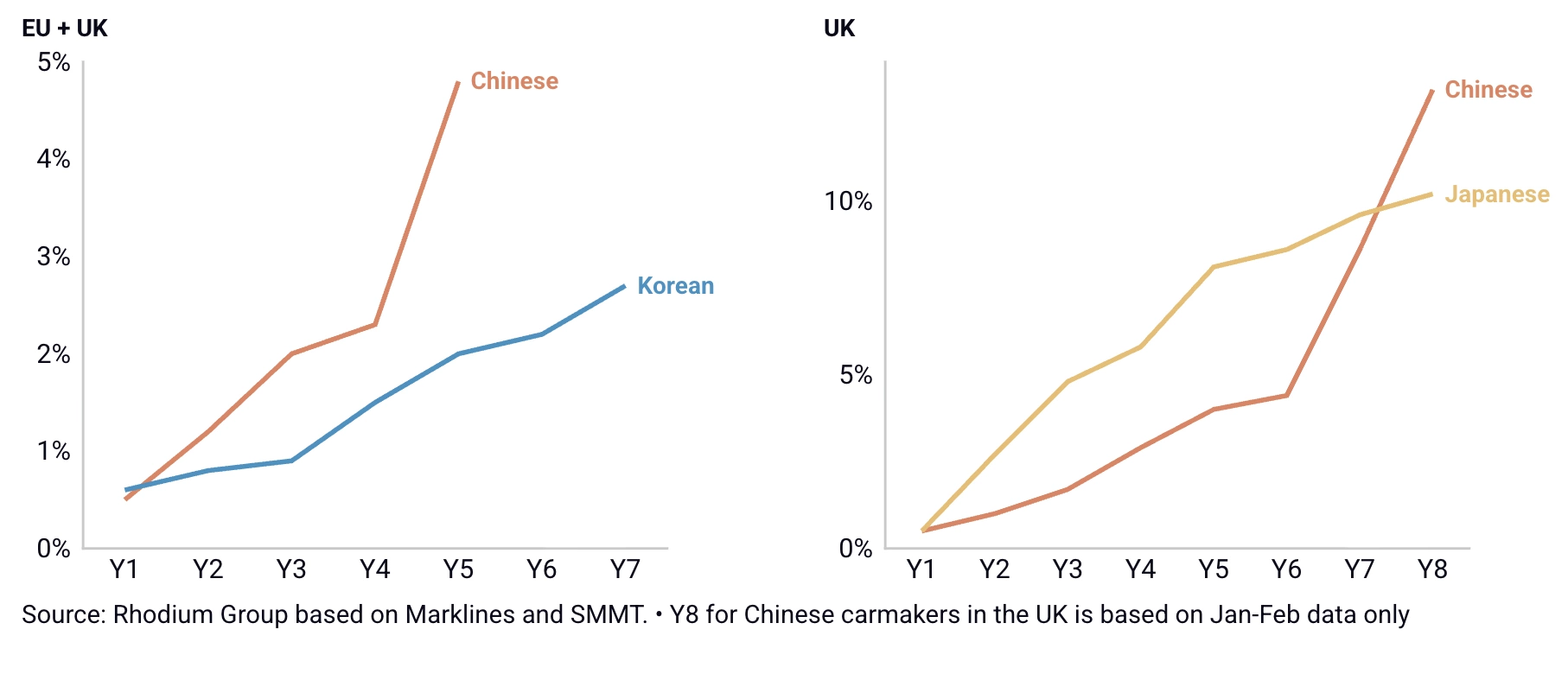 |
The rate of market share acquisition by China-made cars compared to competitors in the EU and UK markets, with Y1 being the first year foreign cars exceeded 0,5% market share. Source: Rhodium Group |
Beijing has rejected the EU's request for "voluntary export reduction," arguing that limiting export ceilings would "seriously violate" World Trade Organization (WTO) rules. The Chinese Foreign Ministry announced that China is closely monitoring the EU's actions concerning its electric vehicle industry and will take measures to safeguard the rights and interests of Chinese enterprises.
China Daily suggests that the challenges faced by the EU's automotive industry stem not from China's competitive strength, but from Europe's own weaknesses. Chinese manufacturers have invested years in developing scale in battery technology, software, supply chains, and electric vehicle platforms. In contrast, Europe contends with high energy prices, elevated production costs, inconsistent regulations, and a challenging transition from traditional internal combustion engine vehicles to electric models.
Chinese media also points out that EU carmakers significantly benefited from the Chinese market for decades, selling vehicles and earning substantial profits. "China has never asked European companies to 'voluntarily' surrender a portion of their market share to protect its domestic industry," China Daily reported.
By Bao Bao (compiled)