The State Bank of Vietnam (SBV) recently announced a significant policy adjustment that will prevent additional outstanding balances for tourism-related real estate loans from counting towards the general real estate credit growth ceiling. This move, announced on 16/9, aims to provide more flexibility for credit institutions and enhance capital access for tourism businesses, a sector with outstanding loans totaling 30 trillion VND in Ho Chi Minh City.
As of late August, the scale of lending to restaurants, hotels, and resorts in Ho Chi Minh City accounted for approximately 1,9% of the total outstanding real estate credit. This outstanding balance, equivalent to about 30 trillion VND, marks an increase of 12% year-on-year. Of this, capital for constructing, renovating, purchasing, or leasing restaurants and hotels reached 18,4 trillion VND, accounting for over 60% of the total outstanding balance in this segment.
Nguyen Duc Lenh, Deputy Director of the State Bank of Vietnam, Area 2, noted that with the outstanding balance ratio for this segment below 2%, excluding the additional outstanding balance from the usual calculation will allow credit institutions greater flexibility in allocating capital to the tourism sector. This policy also provides tourism businesses and households better access to capital to expand operations. The tourism sector is becoming an economic growth driver and a key economic sector, as outlined in Resolution 26 of the Politburo.
Under the new directive, credit institutions will not have to classify the additional outstanding balance (compared to the end of 2025) for restaurants, hotels, tourist areas, and resorts as real estate debt. Consequently, the additional credit for this group will not count towards the real estate credit growth "ceiling," though it will still be within the general credit limit allocated to each bank.
Commenting on the State Bank of Vietnam's new move, Dinh Duc Quang, Director of Treasury & Markets at UOB Vietnam, assessed that this does not imply an overall loosening of credit limits or a relaxation of real estate speculative lending. According to Quang, the essence of the adjustment is to reclassify some loans within the real estate credit limit, separating activities directly serving tourism from the general real estate group. While separating these loans might complicate supervision, he believes this is a necessary direction to support capital for tourism infrastructure and services.
The State Bank of Vietnam, Area 2, believes the policy's impact extends beyond accommodation investment. Tourism development also stimulates consumer demand, shopping, banking services, and cashless payments at entertainment venues, restaurants, and hotels.
 |
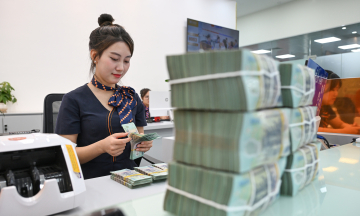
Transactions at a commercial bank. Photo: Giang Huy |
By Quynh Trang