Newly released data from China Real Estate Information indicates that sales among China's top 100 property developers fell by 36% in value in November compared to the same period in 2024. Overall, housing sales for the 11 months declined by 19%, partly demonstrating that the country's real estate crisis has not yet reached its lowest point, Reuters reported.
Concurrently, the price of secondary homes in 100 surveyed cities dropped by 7,95% last month, a steeper decline than in October, according to the China Index Academy. The organization attributes this to high housing supply and weak buyer sentiment.
"The deteriorating real estate data is real and concerning," commented Hui Shan, chief China economist at Goldman Sachs. Morgan Stanley estimates that the average sales of 25 major Chinese developers decreased by 42% in November year-on-year. This bleak situation could persist until next spring.
William Wu, a real estate analyst at Daiwa Capital Market, stated that Beijing's objective to "halt the decline of the housing market" appears "increasingly unrealistic." He highlighted "new chaos" in the sector during Quarter IV, characterized by rapidly falling home prices and "the re-emergence of major defaults."
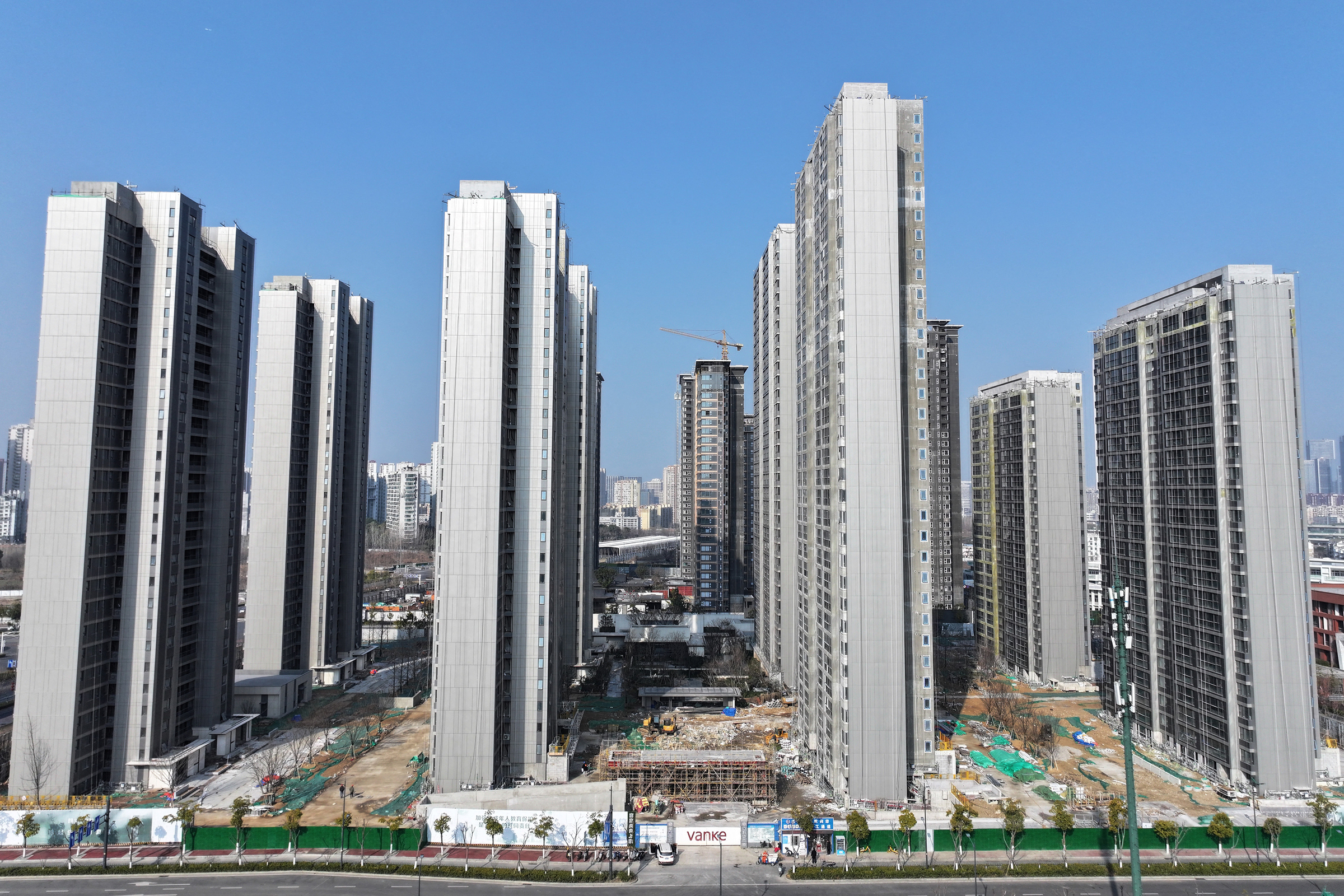 |
A China Vanke housing complex in Nanjing, Jiangsu, China on 13/2. Photo: AFP
Recently, the real estate group China Vanke requested creditor approval for a one-year payment deferral on a bond tranche due on 15/12, sparking new concerns about the industry's liquidity. In early November, Shenzhen authorities announced they would require Vanke to provide collateral for loans totaling approximately 20 billion yuan that previously did not require it.
Cathy Lu, a credit analyst at Octus, evaluated this move as "reflecting a liquidity crisis that could lead to comprehensive restructuring." S&P Global consequently downgraded Vanke's long-term credit rating to "CCC-" from "CCC," citing a high risk of "distressed restructuring" within the next six months.
China's real estate industry has been in decline for the past five years, beginning with the "three red lines" policy that tightened borrowing for developers. Authorities subsequently introduced various solutions to revive the sector. In 5/2024, Beijing allocated 300 billion yuan to financial institutions, enabling local state-owned enterprises to borrow and acquire completed but unsold apartments.
However, that amount proved insufficient for the industry's recovery, as high inventory remains a primary factor suppressing home prices. According to S&P Global, the volume of completed but unsold homes by the end of 8/2025 was approximately 762 million square meters, an increase from 753 million square meters at the end of 2024.
In parallel, falling home prices and low sales have further strained developers' cash flow, compelling banks to foreclose on more properties. This dynamic increases market supply and drives down prices, creating a "negative feedback loop" that policymakers need to break, according to Hui Shan of Goldman Sachs.
Morgan Stanley suggests that authorities should "subsidize interest rates" for homebuyers. The bank estimates that a one percentage point cut in loan interest in Quarter II/2026 could stimulate new home sales, helping prices bottom out sooner in major cities.
Meanwhile, the Economist Intelligence Unit anticipates that if measures to restrict land supply to developers prove effective, thereby reducing apartment inventory, home prices could bottom out as early as Half 1 2027.
By Anh Ky (according to CNBC, Reuters)