A glacial lake outburst flood on the Nepal-China border left nearly 800 dead and 2,500 missing, confirmed by Nepali and Chinese officials on the morning of 29/8.
According to the United States Geological Survey (USGS), this flash flood originated from a glacier collapse. The natural disaster was powerful enough to generate energy equivalent to a 5,2-magnitude earthquake, triggering numerous landslides.
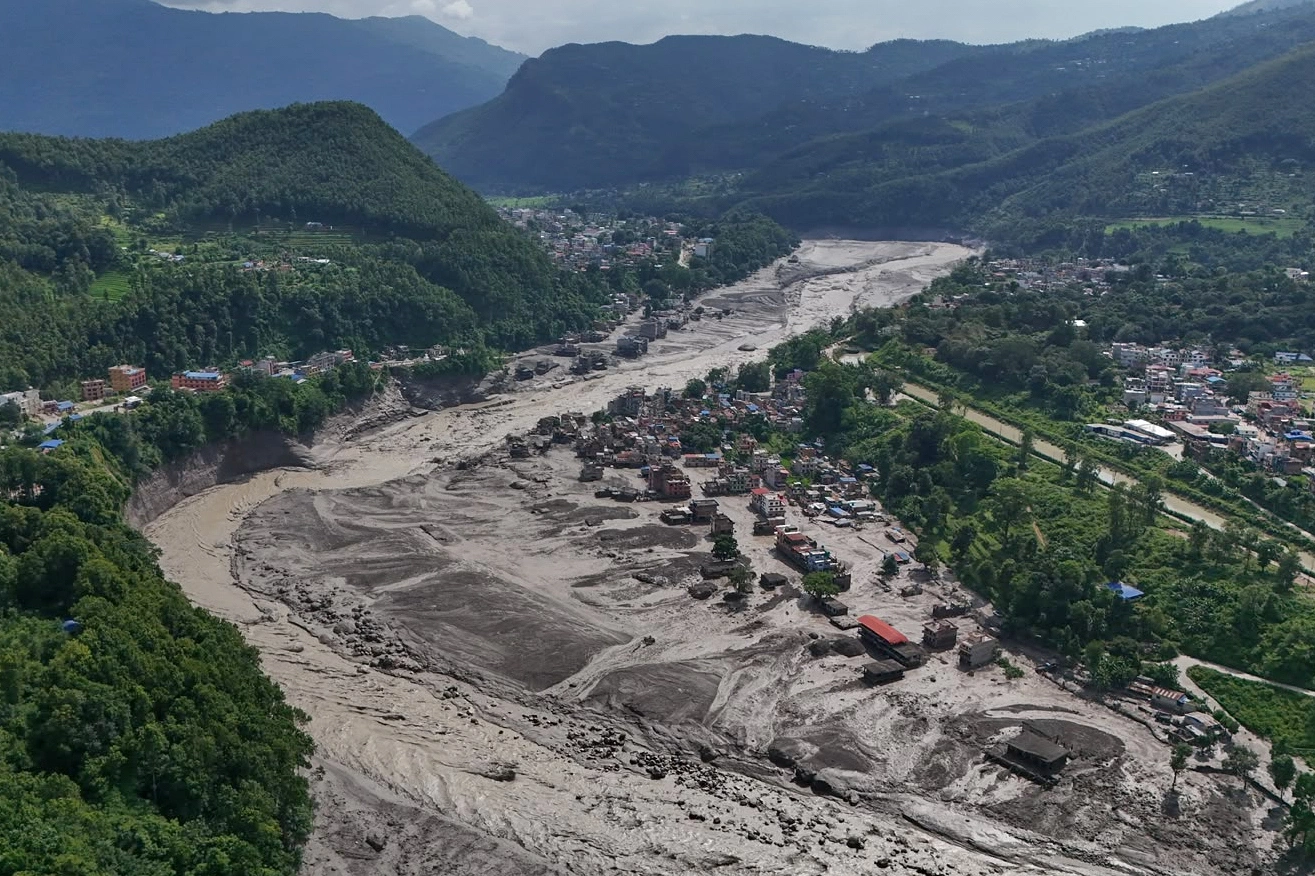 |
Nuwakot area in Nepal after the flash flood on 26/8. Photo: AP. |
The increasing frequency of glacier collapses is a global concern. Speaking to AFP, Etienne Berthier, a glacier research specialist at the French National Center for Scientific Research (CNRS), warned of similar occurrences at other glaciers. Tristram Hales, a professor of environmental hazards at Cardiff University (UK), noted a rising number of glacier collapse disasters worldwide over the past decade.
Several recent incidents highlight this growing danger. Three months ago, a glacier collapse near Blatten village, Thuy Si, caused a landslide that buried the entire Alpine village. Local authorities had issued an early warning and evacuated about 300 residents and all livestock, limiting human casualties. Over 200 km away, the municipal government of Randa – home to 400 people – is concerned about the risk of glacier collapse, as large chunks of the hanging Weisshorn East glacier broke off three times on 24/8.
In Italy, in 2022, an ice block equivalent to an apartment building from the Marmolada glacier (Dolomite mountains) detached during a summer heatwave, causing landslides and rockfalls in a climbing area, killing 11 people.
In 2016, a glacier in the Aru mountains of Tay Tang (Trung Quoc) unexpectedly collapsed, killing 9 people. A similar incident occurred there just a few months later.
Scientists warn that the probability of landslides and rockfalls due to melting permafrost is increasing because of climate change. Lonnie Thompson, a glacier expert at Ohio State University (My), noted that glacier collapses can sometimes be "astonishingly fast". He added, "The instability of these glaciers is becoming more severe, endangering thousands of people."
Previously, glacier melt was often associated with the risk of rising sea levels. However, scientists now emphasize that terrestrial dangers also need proper recognition, as they severely impact local populations, sweeping through towns, roads, and tourist sites in the region.
In some cases, these events can be predicted. Experts from CNRS explain that partially melted glaciers form lakes downstream. Combined with icefalls from above, the lake at the base of the glacier accumulates energy, releasing it entirely through a torrent of floodwater, similar to a dam breach. This phenomenon is also known as a glacial lake outburst flood (GLOF).
In the Alps, Bernard Francou, former research director at the French National Research Institute for Sustainable Development (IRD), stated that researchers are well-equipped and regularly monitor these lakes to check for overflow risks or sudden drainage.
Analysts suggest that burning fossil fuels has caused global warming severe enough to destroy many glaciers worldwide. Glaciers in the Alps have lost 50% of their area since 1950, and the rate of ice melt is accelerating. Many forecasts indicate that all glaciers in the Alps could disappear this century.
Switzerland, the European nation with the most glaciers, lost 4% of its total glacier volume in 2023. The previous year, it lost up to 6%.
Peru has also lost more than half of its glacier area over the past six decades. Specifically, between 2016 and 2020, it lost 175 glaciers due to increasing global average temperatures.
According to research published by Science magazine, even if global temperatures remain stable at current levels, 40% of the world's glaciers will still disappear. Glacier volume could be preserved if the global average temperature increase is kept at 1,5 degrees C above pre-industrial levels, as nations committed to in the Paris Climate Agreement in 2015.
Bao Bao (according to AFP, AP)