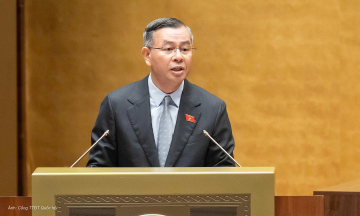
Dominic Scriven, chairman of Dragon Capital Vietnam, presented this information at the national conference on studying, learning, thoroughly understanding, and implementing the Politburo's Resolution No. 10-NQ/TW on developing the foreign-invested economy on 30/6.
According to Dominic Scriven, Resolution No. 10-NQ/TW holds significant importance as it affirms the foreign-invested economic sector as an integral part of Vietnam's economy. The resolution also emphasizes the need to attract high-quality capital flows, linked with innovation, technology transfer, sustainable development, and an enhanced role for the capital market.
However, building a truly effective capital market still faces many challenges. Most notably, the cost of capital mobilization for businesses remains high. Many companies must still raise capital at interest rates of 10-12% annually, even for three-year terms. Therefore, reducing capital mobilization costs would give businesses a stronger foundation to enhance competitiveness, foster economic growth, and support long-term growth objectives.
To achieve this goal, the chairman of Dragon Capital Vietnam put forth several proposals.
First, a mechanism should be created to encourage foreign direct investment (FDI) businesses to retain foreign currency in Vietnam, rather than transferring it abroad. Currently, FDI firms generate approximately 20% of the gross domestic product (GDP). If the profits of these companies are retained within domestic financial institutions and circulate more domestically, the market would gain additional capital at reasonable costs.
Additionally, accelerating the roadmap to upgrade Vietnam's stock market to an emerging market status according to MSCI standards before 2030 is essential. This upgrade would provide Vietnam with more opportunities to attract international investment funds, increasing access to capital for businesses.
 |
Investors monitor the stock market. Photo: Quynh Tran |
Investors monitor the stock market. Photo: Quynh Tran
The next proposal involves reviewing and adjusting listing conditions for science and technology businesses, especially those in emerging sectors such as digital technology and artificial intelligence. Currently, regulations require listed companies to have no accumulated losses and to be profitable in the immediate preceding year. Many technology companies require several years of investment in research and development before generating profits. Applying the same listing conditions as traditional businesses could cause many startups to miss opportunities to raise capital from the market.
"Studying appropriate mechanisms will contribute to fostering innovation and developing Vietnamese technology businesses", he said.
He also emphasized the importance of establishing international financial centers in TP HCM and Da Nang. These centers could pilot new mechanisms to attract foreign capital, adhering to international "rules of the game".
Furthermore, Dominic Scriven believes it is necessary to continue developing the domestic investor system to establish long-term capital sources, increase capital market stability, and reduce reliance on short-term capital flows.
 |
The central area of TP HCM developing into an international financial center. Photo: Quynh Tran |
The central area of TP HCM developing into an international financial center. Photo: Quynh Tran
Concluding his speech, Dominic Scriven stated that over more than 30 years of operation in Vietnam, the firm has placed its trust in the long-term growth prospects of the economy. The company indicated it would prioritize capital allocation to businesses with strong governance foundations, transparency, effective risk management, and development aligned with ESG standards.
Dragon Capital is the first company specializing in domestic fund management in Vietnam, established in 2003. Its core business involves managing securities investment funds and investment portfolios. The company has led the implementation of various fund certificate products, including closed-end funds, open-ended funds, and exchange-traded funds (ETF). Additionally, the firm has invested in the private sector, participating in the equitization of state-owned enterprises.
Late last year, the company advised on and managed approximately 140 trillion VND (5.4 billion USD). Dragon Capital is also one of the leading public fund management companies in the market, both in terms of the number of funds and the total net asset value (NAV) mobilized.
Hoai Phuong