


Earth's average temperature in 2025 remained high, making the three recent years the hottest on record since data collection began, according to the European Centre for Medium-Range Weather Forecasts (ECMWF). This data aligns with findings from the UK Met Office, Britain's national meteorological service.
The ECMWF, a center under the European Union, started recording Earth's average temperature data in 1850. The organization reported that the planet's average temperature over three years has exceeded the 1,5 degrees Celsius threshold compared to pre-industrial times. Annually, Earth surpassed this threshold in 2024.
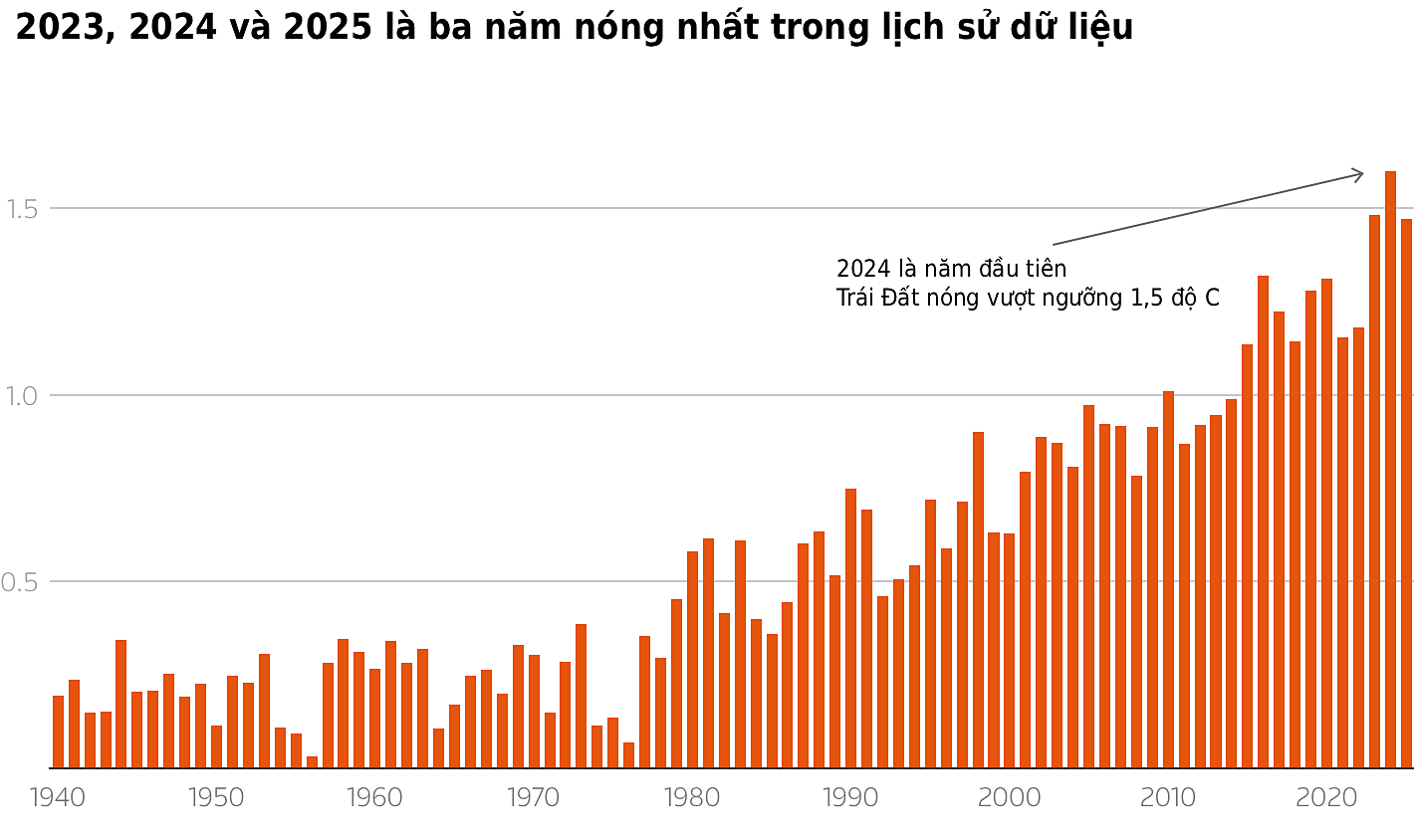 |
Annual average temperature increase compared to pre-industrial levels. Source: ECMWF |
Limiting global warming to 1,5 degrees Celsius above pre-industrial levels is a core objective of the Paris Agreement, aiming to prevent a climate crisis. Scientists warn that sustained temperatures above this threshold lead to extreme weather events such as prolonged heatwaves and more intense storms. This situation increases fatalities and impacts biodiversity as glaciers melt, causing sea levels to rise.
The 1,5 degrees Celsius benchmark in the Paris Agreement is measured by the average temperature over a decade. By this metric, the planet's overall temperature increase is currently 1,4 degrees Celsius above pre-industrial levels. However, nations have not reduced greenhouse gas emissions as pledged 10 years ago. This failure could lead to Earth's decadal average temperature surpassing the threshold before 2030. According to ECMWF, this milestone is a decade earlier than scientists predicted when the Paris Agreement was signed in 2015.
Carlo Buontempo, Director of the Copernicus Climate Change Service, stated that Earth's temperature exceeding the safety threshold is inevitable. "Our only option is to find ways to curb the temperature increase as much as possible and minimize its consequences on natural ecosystems and society," he said.
 |
A firefighter attempts to extinguish a wildfire in Vilar de Condes, Ourense province, Spain, on 15/8/2025. Photo: Reuters |
The effects of climate change are already evident globally. In Europe alone, wildfires last year generated the highest total emissions on record. In Asia and the US, extreme weather events caused by climate change resulted in over 1.000 fatalities from floods.
Scientists primarily attribute climate change to human activity, and it is worsening. The main cause is greenhouse gas emissions from burning fossil fuels like coal, oil, and natural gas, which trap heat in the atmosphere.
As climate change impacts worsen, the scientific community faces increasing political opposition. US President Donald Trump, who called climate change the "biggest hoax," withdrew from 66 United Nations organizations last week, including the Intergovernmental Panel on Climate Change (IPCC) and the United Nations Framework Convention on Climate Change (UNFCCC).
Bao Bao (according to Reuters)


