Demand for taxis and ride-hailing services is surging across Chinese cities. In May, residents made approximately 3 billion trips. Government data indicates that the number of rides increased by 6% from March to May compared to the same period last year, following the outbreak of the Middle East conflict.
Taxi fares are even declining despite rising gasoline prices. Analysts attribute this drop to a wave of new drivers seeking employment amidst slowing economic growth, coupled with the affordability of electric vehicles. This trend is attracting passengers looking to save money as fuel costs remain high.
Li, a part-time ride-hailing driver in Beijing, noted that fares have fallen by 10-15% since he started working six months ago. "Competition is fierce", the 36-year-old driver told Reuters at a charging station.
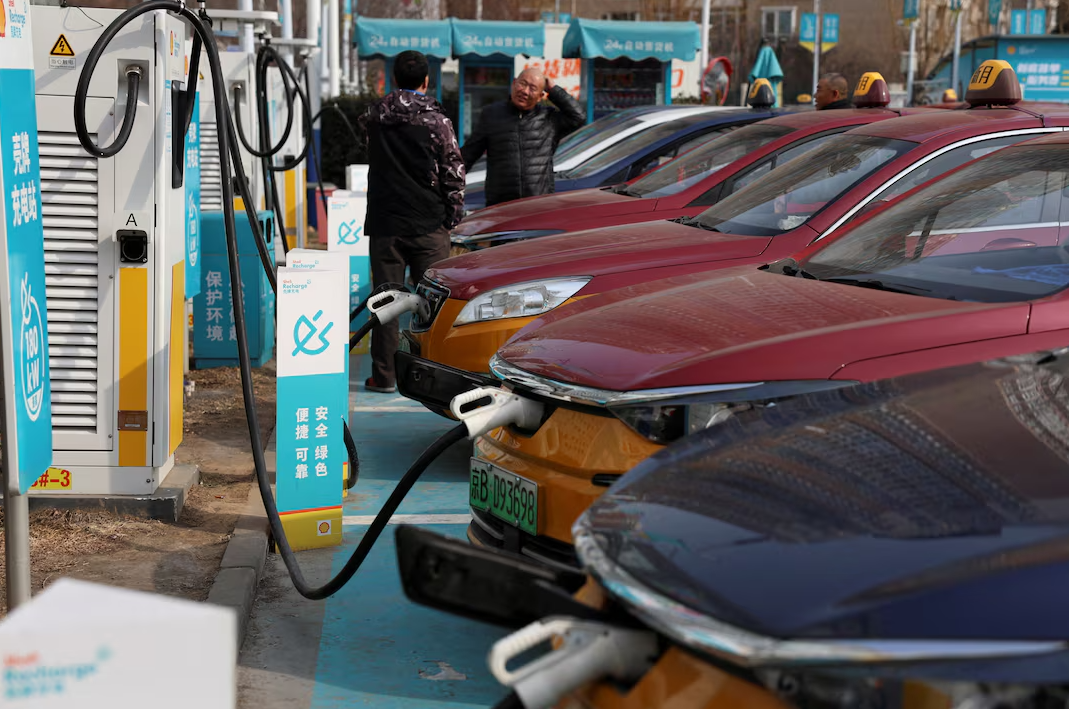 |
Taxis at a charging station in China, 2/2024. Photo: Reuters |
Taxis at a charging station in China, 2/2024. Photo: Reuters
Hundreds of posts on Chinese social media confirm that since gasoline prices began rising in March, taking a taxi or using a ride-hailing service has become cheaper than driving one's own car. "When gasoline prices are high, I take a taxi for longer distances. That way, I don't have to find parking or pay for gas", said Yang, 45.
China's Ministry of Transport reports that about half of the nation's 1.3 million taxis are now electric vehicles. In major cities, this proportion is nearly 100%.
The electrification of the taxi fleet, combined with the boom in ride-hailing services, demonstrates China's decreasing reliance on oil in its transportation sector. This enhances the country's resilience against supply shocks, such as a blockade of the Hormuz Strait.
Didi, China's largest ride-hailing application, announced that 2 million new hybrid or electric vehicles registered on its platform last year, bringing the total number of non-fossil fuel vehicles to 8 million. Electric vehicles now account for 75% of all travel distances on the platform.
Consequently, in May, China's gasoline and diesel consumption decreased by 10% and 14% respectively compared to the same period last year. This occurred even as road freight transport increased by 2% and travel during the International Labor Day holiday reached a record high.
Greenpeace projects that by 2035, 90% of all taxi and ride-hailing trips in China will be made using electric vehicles. "When fuel prices rise, people reduce their use of personal gasoline cars. However, travel demand continues to grow, so more trips are shifting to public transport options like taxis and subways", stated Daizong Liu, East Asia Regional Director at the Institute for Transportation and Development Policy (ITDP) China.
This flexibility partly explains why China managed to sharply reduce oil imports by 41% in June compared to last year, without extensively tapping into its strategic reserves. This eased pressure on the global oil market during the conflict, helping to curb the rise in crude oil prices.
"The conflict may have accelerated pre-existing changes, making China less dependent on oil than market assessments suggested", commented Natasha Kaneva, an analyst at JP Morgan.
This hypothesis will be tested when fuel prices in China return to pre-conflict levels. JP Morgan forecasts that gasoline demand in the world's second-largest economy will continue to decline in 2027, albeit at a slower rate than this year.
Zhang, 45, owns both an electric vehicle and a hybrid. She mentioned that she often uses the electric mode on her hybrid when gasoline prices are high. "Recently, as gasoline prices dropped, I filled up my hybrid's tank", she said.
Ha Thu (according to Reuters)