Leading enterprises are large-scale businesses with international competitiveness and the ability to create widespread impact across economic sectors through technological innovation, value chains, and partner ecosystems. Beyond contributing to growth, these enterprises invest heavily in research and development (R&D), core technology, branding, and human resources.
The World Development Report 2020 by the World Bank suggests that rapidly growing economies leverage the development of large-scale enterprises and participation in global value chains to boost productivity and income. The World Bank also views multinational corporations as drivers of global value chains, creating spillover effects in technology, management skills, and production capabilities for domestic businesses.
Meanwhile, the Organisation for Economic Co-operation and Development (OECD) notes that the productivity gap between nations significantly depends on the ability of leading enterprises to disseminate technology throughout the economy. Consequently, many countries consider developing these "locomotive" enterprises fundamental to fostering innovation and improving competitiveness.
South Korea stands as a prime example. After the war, the nation possessed almost no natural resource advantages. Yet, within a few decades, South Korea rose to become one of Asia's largest economies. This transformation is closely linked to the growth of industrial conglomerates like Samsung and Hyundai.
 |
Samsung's headquarters in South Korea. *Photo: Samsung*
From an electronics company, Samsung has grown into a hub for semiconductors, materials, components, logistics, and services. Annually, the conglomerate invests tens of billions of USD in R&D, creating jobs for hundreds of thousands of workers and forming a network of thousands of partner enterprises.
Samsung's growth generates revenue and export turnover, while also driving the technological upgrade of South Korea's entire industry. Small businesses participating in its supply chain gain access to technology, production standards, and international markets, thereby enhancing their competitiveness.
In Japan, Toyota also exerts influence beyond the oto industry. The Toyota Production System has become a lean management benchmark adopted by many businesses worldwide. Through a network of tens of thousands of suppliers, Toyota helps establish a high-productivity industrial ecosystem and encourages continuous innovation among businesses to meet global standards.
 |
Woven City - Toyota's experimental city. *Photo: Toyota*
In the United States, Apple demonstrates that the value of a leading enterprise extends beyond mere revenue size. Alongside its renowned technology products, Apple has built an ecosystem comprising app developers, chip manufacturers, software companies, logistics firms, and thousands of global partners. This ecosystem generates economic value far beyond the scope of a single company, fostering innovation across various sectors.
 |
Apple logo at an Apple Store in California, United States, 5/2026. *Photo: Luu Quy, Thanh Xuan*
Even Singapore, an economy of modest size, has developed globally influential enterprises such as DBS and Singapore Airlines. DBS, in particular, is considered a prime example of transitioning from a traditional bank to a technology company.
DBS invests heavily in cloud computing, big data, artificial intelligence, and digital platforms to enhance operational efficiency and expand access to financial services. As a result, businesses, especially small and medium-sized enterprises, can access banking services faster and at lower costs, supporting the development of the digital economy.
Meanwhile, in China, Alibaba, Huawei, and Tencent play a crucial role in upgrading the economy's technological capabilities. From telecommunications and semiconductors to electric vehicles and energy batteries, these companies invest significantly in research, thereby helping China move closer to its goal of technological self-reliance.
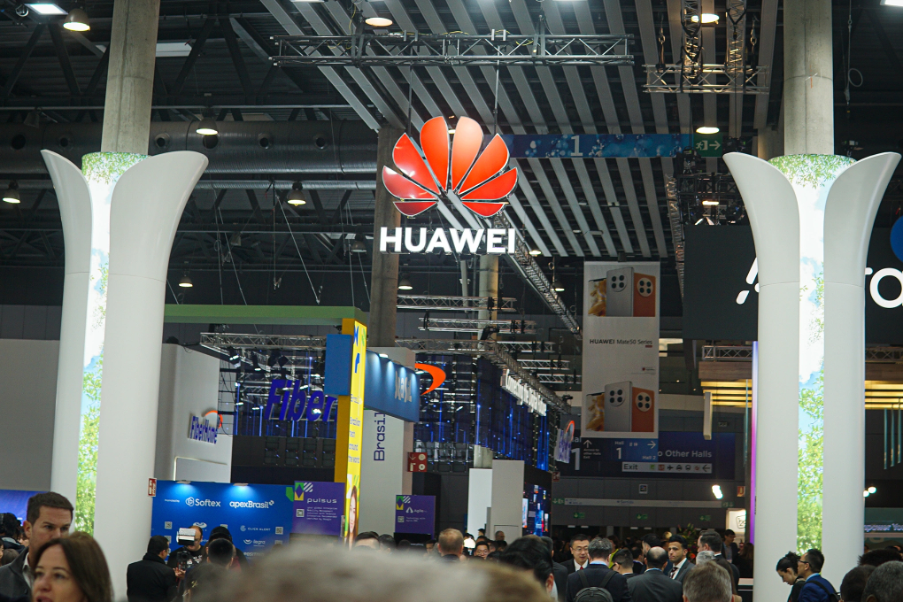 |
Huawei's booth at the MWC exhibition in 2/2023. *Photo: Luu Quy*
Despite operating in diverse sectors, these enterprises share a common trait: long-term investment in innovation and creating ripple effects across many economic sectors. They may belong to either the state or private sector, but all play a leading role in value chains, helping nations enhance competitiveness and drive economic development.
Economist Michael Porter, a professor at Harvard University, argues that the competitiveness of these "locomotive" enterprises creates a nation's competitive advantage. This is because these businesses not only generate growth for themselves but also drive the development of entire industry ecosystems, supply chains, and high-quality human resources.
Amid increasingly fierce global competition, many nations opt to develop National Champions as a long-term strategy. This aims to foster "locomotive" enterprises capable of leading key economic sectors, attracting resources, expanding value chains, and enhancing national competitiveness.
Minh Ngoc