Domestic fuel prices have fluctuated sharply since the escalation of the Middle East conflict late last month. Currently, gasoline and oil prices are 52-73% higher than before the tensions. To stabilize the market, over the past two weeks, regulators have utilized the fuel price stabilization fund six times, disbursing over 3,060 billion dong.
According to Doctor Nguyen Quoc Viet from the National Economics University, in the face of the current oil price shock, the early use of the stabilization fund by regulatory bodies, combined with measures to ensure supply, is crucial for market stability and to mitigate immediate impacts on citizens and businesses.
However, the stabilization fund's balance of nearly 5,670 billion dong as of late February, before the Middle East conflict escalated, is merely a drop in the ocean amid continuously rising prices. Tran Huu Linh, Director of the Domestic Market Management and Development Department at the Ministry of Industry and Trade, stated that the fund could only support stabilization for about 15 days if current spending levels persist (3,000-4,000 dong for gasoline, kerosene, and mazut, and 4,000-5,000 dong for diesel).
Doctor Viet believes that relying on a single stabilization tool is insufficient during the current fuel crisis. Instead, regulators should flexibly coordinate various policies to extend their room for maneuver against price shocks.
"Other tools, such as adjusting taxes and fees, will provide a longer buffer, helping stabilize the market," he said.
The retail price of each liter of fuel for consumers is composed of several elements: the CIF import price of refined petroleum products (pegged to Platts Singapore prices), a special consumption tax (10% for RON95 gasoline, 8% for E5 RON92 bio-gasoline, not applied to oil), a 10% import tax, an 8% value-added tax (VAT), and an environmental protection tax of 1,000-2,000 dong.
After preferential import taxes were reduced to 0% from 9/3, taxes account for approximately 24-25% of the price per liter of gasoline. Including other standard costs and profit margins, taxes and fees are estimated to constitute about 30% of each liter of gasoline.
However, the calculation structure for retail fuel prices still exhibits a "tax on tax" phenomenon. For example, VAT is calculated on the final price, which already includes import tax, special consumption tax, and environmental protection tax.
This structure causes domestic fuel prices to be significantly affected by various taxes, even when world prices fall. Therefore, Doctor Nguyen Quoc Viet suggests that regulators could adjust these taxes at appropriate times to alleviate cost pressures.
The Ministry of Finance is currently submitting a proposal to the government to reduce the environmental protection tax on fuel to 0 dong. Currently, this tax is 2,000 dong for gasoline (excluding ethanol) and 1,000 dong for oil. Bringing this tax to 0 dong would reduce gasoline prices by a corresponding 1,000-2,000 dong per liter.
Previously, the Ministry of Construction recommended that the government consider reducing the special consumption tax, environmental protection tax, and VAT on fuel to lower costs for transport businesses. Fuel accounts for 30-40% of operating costs, and according to the Ministry of Construction, a significant reduction in taxes and fees could decrease fuel prices by approximately 28-30%.
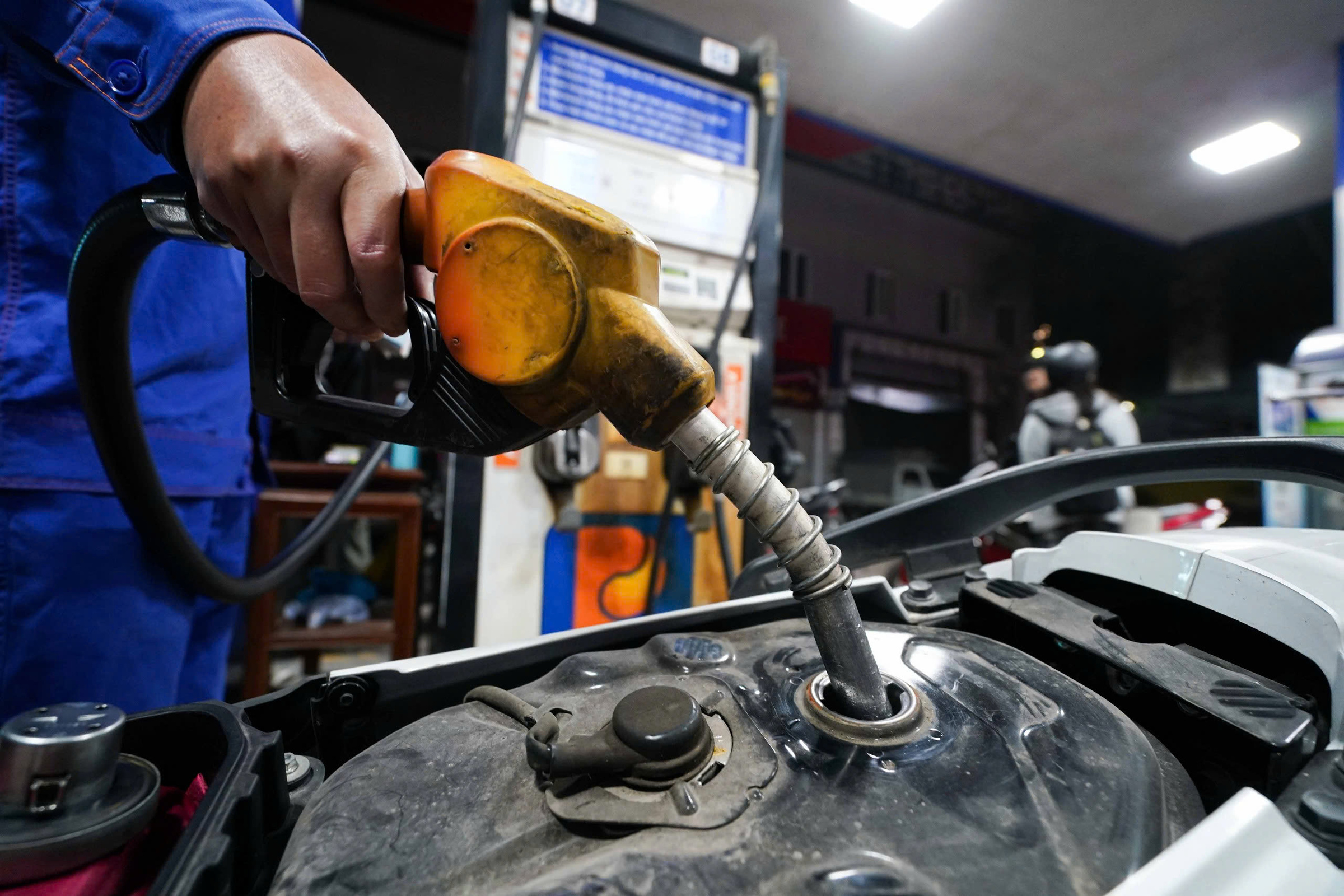 |
An employee at a gas station on Xuan Thuy street in Cau Giay, Hanoi, fuels a customer on 16/3. Photo: Hoang Giang |
Additionally, experts and businesses have raised the issue of changing the fuel price management mechanism. Currently, Nghi Son and Dung Quat refineries meet approximately 70-75% of domestic fuel demand.
According to economist Vu Dinh Anh, in principle, regulators could design a separate pricing mechanism for domestically produced fuel, rather than solely adhering to world refined product prices. This approach could lead to more stable fuel input prices and less fluctuation according to world prices, thereby reducing pressure on domestic retail price increases.
In the long term, experts suggest that besides flexible tax and fee policies, Vietnam needs to promptly establish a national strategic fuel reserve system. Doctor Nguyen Quoc Viet stated that this is a critical intervention tool for the State to regulate supply, demand, and prices. He emphasized the importance of developing centralized energy reserve infrastructure for fuel, liquefied natural gas (LNG), and other energy sources.
"Energy should be viewed as a strategic infrastructure for the economy, similar to transportation or logistics," he said. The expert stressed that the State needs to play an investment and development role in these infrastructures to enable the economy to be more proactive in the face of geopolitical shocks and global market fluctuations.
To achieve this goal, Bui Ngoc Bao, Chairman of the Petroleum Association, suggested that the State does not necessarily need to build all national fuel storage facilities using the state budget. Instead, the State could sign contracts with businesses from all economic sectors to invest, then lease these facilities. This approach could help reduce initial investment costs and leverage existing business infrastructure.
In this regard, Tran Huu Linh noted that ministries and sectors are developing plans to increase the scale of strategic reserves and tighten mandatory reserve regulations for key distributors.
According to regulations, Vietnam's fuel reserve structure comes from three sources: commercial reserves at key fuel distributors (20 days), distribution traders (five days), production reserves at two refineries, and national reserves. The national reserve (currently leased from businesses) accounts for about seven days of use. Overall, the total system reserve in Vietnam is only equivalent to approximately 30-50 days.
Vietnam aims to increase its total crude oil and petroleum product reserves nationwide to 75-80 days of net imports, striving to reach 90 days of net imports. Under Decision 861/2023 on the planning of fuel and gas reserve and supply infrastructure, Vietnam will build dedicated fuel storage facilities to enhance its reserve capacity.
Phuong Dung - Thi Ha