Saint-Gobain Vietnam has announced that six of its factories, across four key production clusters, have achieved "zero carbon" status for scope one and scope two emissions. This significant accomplishment, independently verified by Deloitte, positions the French construction materials giant among the industry's leaders in Vietnam.
According to Nguyen Truong Hai, General Director of Saint-Gobain Vietnam, this milestone reflects the company's commitment to supporting the nation's green transition. It also contributes to the sustainable building solutions ecosystem, a growing area of interest for contractors, investors, and end-users alike.
These six factories, strategically located in Hung Yen, Quang Tri, and TP HCM, specialize in producing framing systems, fiber cement boards, and construction mortar. These products constitute a substantial portion of Saint-Gobain Vietnam's main building material supply.
The "zero carbon" achievement specifically targets scope one and scope two emissions, as defined by the Greenhouse Gas Protocol (GHG Protocol). Scope one emissions are direct emissions from a company's owned or controlled sources, while scope two emissions are indirect emissions from the generation of purchased energy.
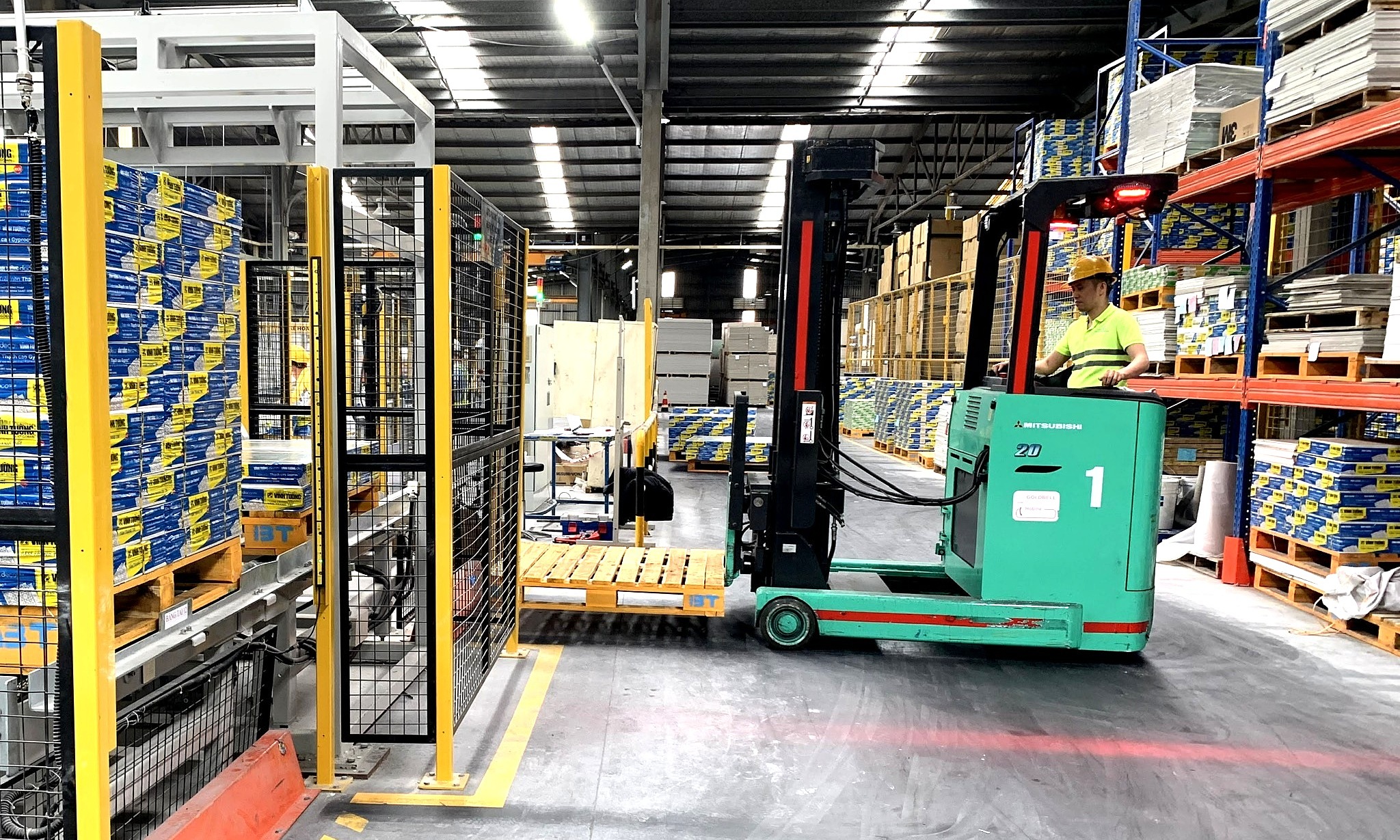 |
Electric forklifts at the Weber North factory in Hung Yen. Photo: Saint-Gobain |
Electric forklifts at the Weber North factory in Hung Yen. Photo: Saint-Gobain
To eliminate scope one emissions, all six factories underwent a complete transition. Diesel-powered forklifts were replaced with electric models, and all fossil fuels used in internal transportation operations were removed.
Achieving zero carbon for scope two involved a flexible approach tailored to each facility's conditions. The Vinh Tuong Hiep Phuoc factory in TP HCM, along with the clusters in Hung Yen and Quang Tri, now utilize 100% renewable electricity, validated by International Renewable Energy Certificates (IREC).
The Weber Hiep Phuoc factory, for instance, meets 36.5% of its electricity demand through an on-site rooftop solar power system, with the remaining 63.5% procured via IREC. These efforts across the six factories are projected to reduce 7,900 tons of CO₂ annually by eliminating scope one and scope two emissions.
Founded 361 years ago in France, Saint-Gobain is a global leader operating in 80 countries. The group reported revenues of 46.6 billion EUR in 2025 and has set a target for net zero carbon emissions by 2050. In Vietnam, Saint-Gobain currently operates 11 factories.
"This advance in zero carbon production not only marks a significant milestone for Vietnam's development journey but also contributes to shaping the future of sustainable construction across Asia," stated Ludovic Weber, General Director of Saint-Gobain Asia.
Vien Thong