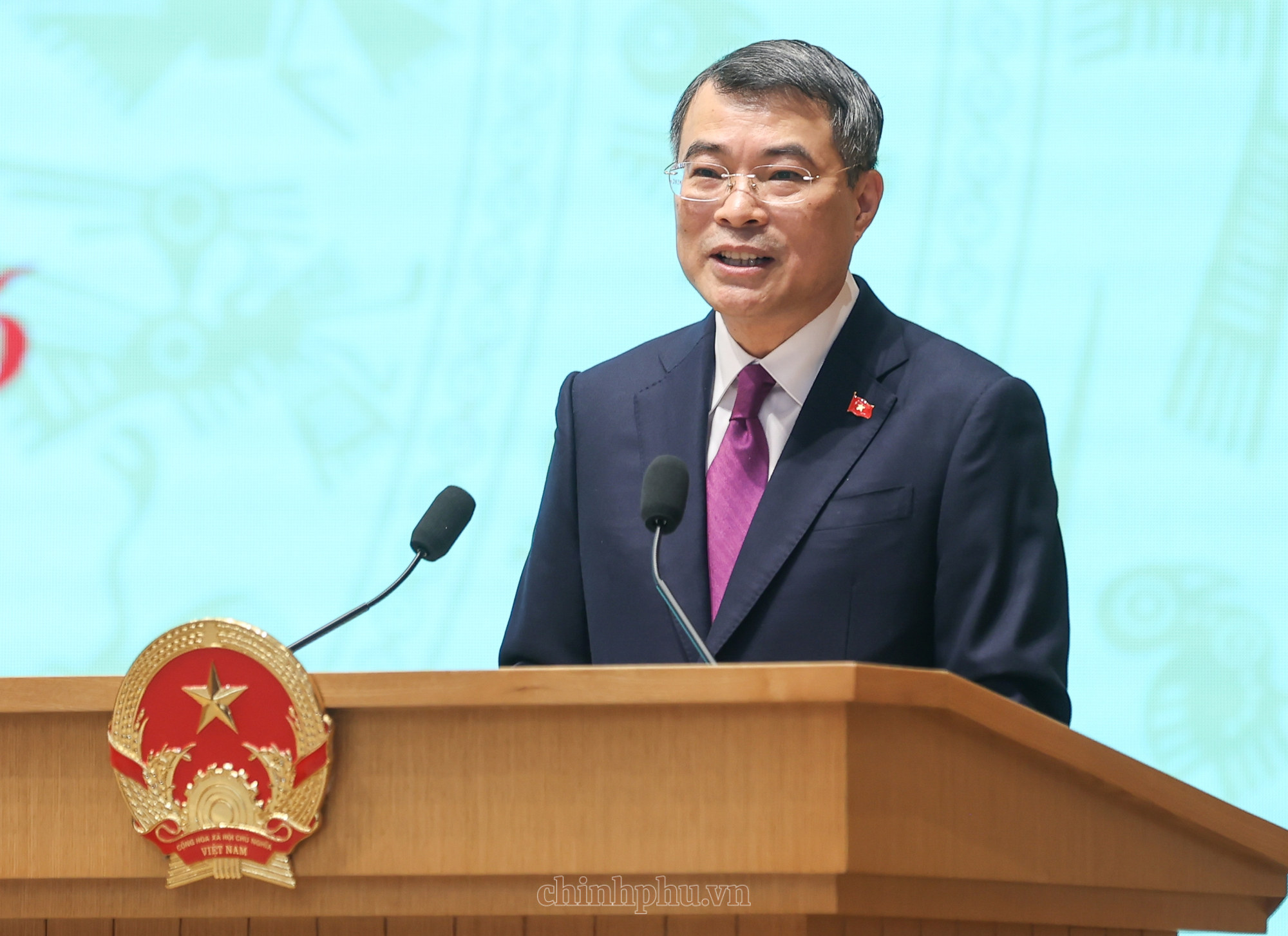
Prime Minister Le Minh Hung made this commitment during his concluding remarks at a conference with the business community on the morning of 18/7. This conference marked the first meeting between the new government's standing committee and the business community, aiming to remove bottlenecks, unlock resources, and drive two-digit growth.
During the conference, the Prime Minister noted that businesses often receive responses that merely cite legal provisions, decrees, or circulars, instructing them to implement regulations themselves.
"While that approach has merit, it lacks effectiveness and fails to see issues through to the end. Transparency is the best method for both oversight and evaluating effectiveness. Ministries and localities cannot provide vague answers and must take responsibility for resolving matters conclusively," the Prime Minister stated.
Consequently, he concluded that ministries and localities must immediately resolve issues within their authority and legal basis. For matters related to mechanisms or beyond their jurisdiction, agencies must promptly propose solutions and report to higher authorities for consideration.
Furthermore, he mandated that all responses to business feedback and recommendations must be publicly accessible on the Government e-portal, as well as the websites of ministries and the Vietnam Chamber of Commerce and Industry (VCCI). This ensures that the business community and the public can monitor and assess whether resolutions are satisfactory.
 |
Chairman of the Korean Chamber of Commerce in Vietnam (KoCham) Ko Tea Yeon. Photo: VGPThe Prime Minister emphasized that the government considers enterprise development and support for production and business activities a national strategic requirement. He stated that all policies should aim to foster an open, stable, and transparent investment and business environment, ensuring freedom of business, equal access to resources, and encouraging innovation, digital transformation, and green transformation.The head of government underscored that the focus in the coming period is to shift from identifying and resolving issues to perfecting a development-creating foundation; from dialogue to action; and from commitment to concrete, measurable results with clear timelines to achieve two-digit growth."While institutions are no longer a primary bottleneck, further improvements are needed to transform them into a stronger foundation for development," he said.Regarding solutions, the Prime Minister urged ministries and localities to continue removing obstacles, improving institutions, and implementing substantive and stronger administrative procedure reforms. This includes comprehensively reviewing regulations concerning: investment, land, planning, construction, environment, bidding, tax, customs, and specialized inspections. They must also immediately resolve issues within their authority, eliminating overlapping regulations and unreasonable administrative procedures.Additionally, he called for solutions to unlock capital, land, and investment resources, ensuring cash flow for production and business activities. Ministries and agencies must continue to review and reduce logistics costs, specialized inspection fees, and unnecessary compliance expenses.The Prime Minister affirmed that the government views the business community as a trusted partner and a vanguard force in the nation's development. He encouraged businesses to proactively improve governance capacity, technology, product quality, capital efficiency, and competitiveness. Simultaneously, businesses must strictly comply with laws, uphold social responsibility, and foster a strong business culture. They also need to actively participate in production and supply chains, prioritizing the use of domestic raw materials, components, services, and technology.He expressed confidence that Vietnam will achieve its two-digit economic growth target this year, establishing a solid foundation for rapid and sustainable development in the next phase, thanks to the consensus of the entire political system, the proactive responsibility of ministries and localities, and the innovative spirit and aspiration to excel within the business community.In the first half of the year, Vietnam had over one million operating businesses, with a total registered capital exceeding 30 quadrillion VND. These businesses contribute over 60% of GDP, employ over 17.6 million workers, and have affirmed their role as a primary force in economic development, contributing 55% of total state budget revenue, ensuring social welfare, and enhancing national competitiveness.Phuong Dung |
The head of government also tasked VCCI with continuing to compile unresolved feedback and recommendations for ministries and agencies to address. VCCI is responsible for establishing a mechanism to collect recommendations monthly or on an ad hoc basis as needed. Concurrently, the Government Office will incorporate the resolution of business recommendations into the agenda of the monthly regular government meeting.
According to the Prime Minister, the ultimate outcome should be tangible for businesses, evidenced by reduced time and compliance costs, strengthened confidence in the business environment, and a direct contribution to economic growth.
Representing foreign direct investment (FDI) businesses, Ko Tea Yeon, Chairman of the Korean Chamber of Commerce in Vietnam (KoCham), expressed support for the government's vision of building a dynamic, innovative, and internationally competitive economy. He highlighted that FDI businesses seek a truly transparent, stable, and consistently enforced business environment to confidently invest and make Vietnam a favorable destination.
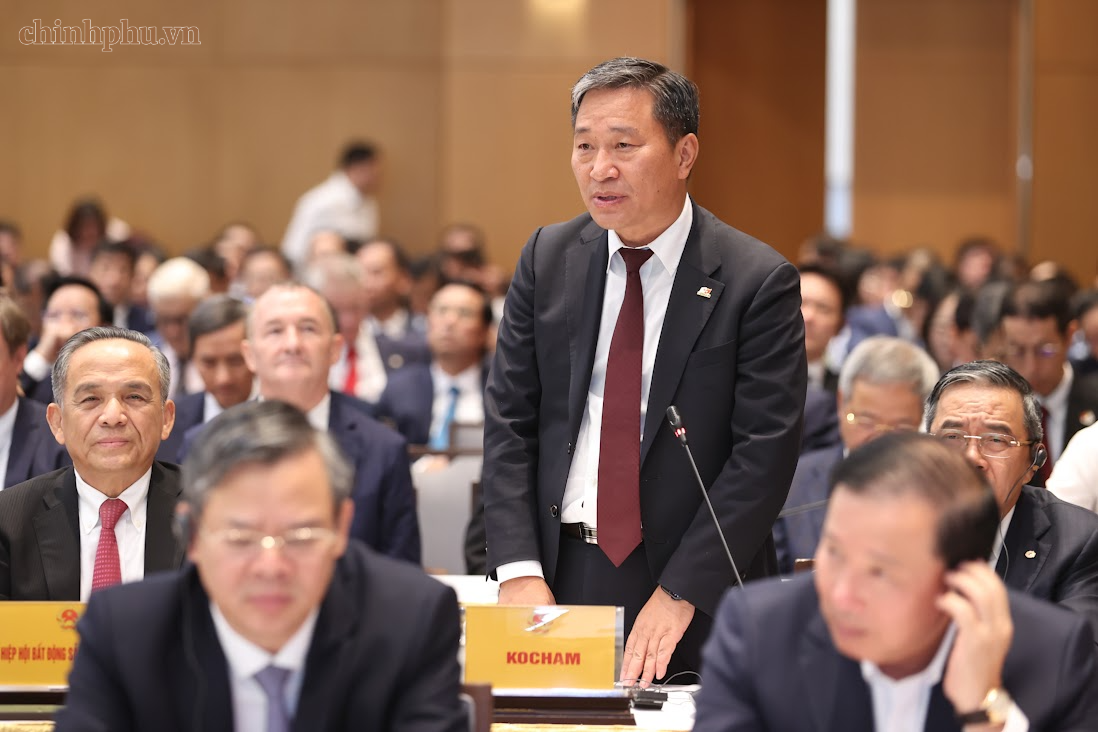 |
Chairman of the Korean Chamber of Commerce in Vietnam (KoCham) Ko Tea Yeon. Photo: VGP
The Prime Minister emphasized that the government considers enterprise development and support for production and business activities a national strategic requirement. He stated that all policies should aim to foster an open, stable, and transparent investment and business environment, ensuring freedom of business, equal access to resources, and encouraging innovation, digital transformation, and green transformation.
The head of government underscored that the focus in the coming period is to shift from identifying and resolving issues to perfecting a development-creating foundation; from dialogue to action; and from commitment to concrete, measurable results with clear timelines to achieve two-digit growth.
"While institutions are no longer a primary bottleneck, further improvements are needed to transform them into a stronger foundation for development," he said.
Regarding solutions, the Prime Minister urged ministries and localities to continue removing obstacles, improving institutions, and implementing substantive and stronger administrative procedure reforms. This includes comprehensively reviewing regulations concerning: investment, land, planning, construction, environment, bidding, tax, customs, and specialized inspections. They must also immediately resolve issues within their authority, eliminating overlapping regulations and unreasonable administrative procedures.
Additionally, he called for solutions to unlock capital, land, and investment resources, ensuring cash flow for production and business activities. Ministries and agencies must continue to review and reduce logistics costs, specialized inspection fees, and unnecessary compliance expenses.
The Prime Minister affirmed that the government views the business community as a trusted partner and a vanguard force in the nation's development. He encouraged businesses to proactively improve governance capacity, technology, product quality, capital efficiency, and competitiveness. Simultaneously, businesses must strictly comply with laws, uphold social responsibility, and foster a strong business culture. They also need to actively participate in production and supply chains, prioritizing the use of domestic raw materials, components, services, and technology.
He expressed confidence that Vietnam will achieve its two-digit economic growth target this year, establishing a solid foundation for rapid and sustainable development in the next phase, thanks to the consensus of the entire political system, the proactive responsibility of ministries and localities, and the innovative spirit and aspiration to excel within the business community.
In the first half of the year, Vietnam had over one million operating businesses, with a total registered capital exceeding 30 quadrillion VND. These businesses contribute over 60% of GDP, employ over 17.6 million workers, and have affirmed their role as a primary force in economic development, contributing 55% of total state budget revenue, ensuring social welfare, and enhancing national competitiveness.
Phuong Dung