On 30/6, General Secretary and President To Lam attended and delivered a keynote speech at the national conference to study, comprehend, and implement Politburo’s Resolution 10 on developing the foreign-invested economy. VnExpress presents the content of the General Secretary and President’s speech at the event.
We have heard the Deputy Prime Minister introduce the core contents of Resolution 10 and the discussion papers. I highly appreciate the meticulous preparation by agencies in drafting the Resolution. I also acknowledge the dedicated and responsible opinions shared at today’s conference and the keen interest shown by a large number of cadres, Party members, the business community, investors, and the public.
Resolution 10, issued by the Politburo on 8/6/2026, on developing the foreign-invested economy, is based on a review of nearly 40 years of implementing the Party's policy of opening up and attracting foreign investment. This Resolution reflects a shift in development thinking, moving beyond merely opening doors to capital flows to proactively selecting and utilizing international resources to build national competitiveness.
Listening to feedback from localities, sectors, and international partners, it became clear that while capital is crucial, foreign technology is equally vital, a point also emphasized in the Resolution.
 |
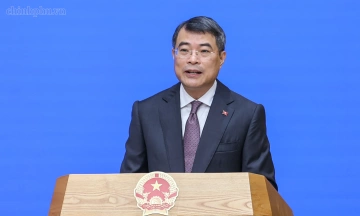
General Secretary and President To Lam delivered a keynote speech at the conference implementing Resolution 10 on developing the foreign-invested economy, 30/6. *Photo: VGP*
From the 1987 Law on Foreign Investment, through multiple amendments, consolidations, and refinements of investment laws, Vietnam has gradually perfected its market economic institutions, expanded integration, and built an increasingly open, transparent, and stable investment environment. This process has transformed Vietnam from a closed economy, lacking capital and heavily reliant on international aid, into a highly open economy deeply integrated with the region and the world. From international trade accounting for a small proportion in the late 1980s, Vietnam has now become an important link in the global production and trade network (total import-export turnover accounts for over 180% of GDP, with FDI contributing about 75%). The foreign-invested economic sector has contributed positively to growth, exports, industrialization, job creation, and the adoption of modern technology and management methods.
Today, Vietnam is in a different position. We no longer ask how to attract more foreign capital; instead, we must answer a more challenging question: how to effectively use foreign resources to enhance the economy's internal strength, technological capabilities, competitiveness, and autonomy.
We must directly confront the limitations in attracting foreign direct investment (FDI):
: The localization rate remains low, and links with domestic enterprises, technology transfer, research and development, and high-quality human resource training have not met expectations.
: Many foreign investment projects primarily involve processing and assembly, using significant land, unskilled labor, cheap energy, low environmental standards, or relying heavily on incentives, without creating new capabilities for the economy.
: Some localities compete to attract investment based on the number of projects, relying on land, tax, and fee incentives, rather than focusing on efficient land use, energy saving, budget contributions, technology transfer, domestic enterprise development, and ensuring environmental and economic security. Many regions remain underserved in attracting foreign investment, such as the Mekong Delta, Central Highlands, and northern mountainous areas.
To overcome these limitations, Resolution 10 sets much higher goals and requirements: the development of the foreign-invested economy must be linked with enhancing the economy's strategic autonomy, production capacity, technology, and competitiveness.
By 2030, Vietnam aims to be among the leading ASEAN countries in terms of business investment environment, competitiveness, innovation, quality of public services, and ability to attract high-quality foreign investment projects. The resolution also sets numerous other specific targets.
Achieving these high goals requires a deep understanding of the entire Resolution to act more decisively, quickly, and substantively in our approach to foreign investment. This involves:
: Proactively approaching, selecting, guiding, and effectively utilizing international capital flows to build national capacity.
: Evaluating attraction efficiency based on capital productivity and quality, the level of technology used, the number of high-quality jobs, the training of Vietnamese engineers and managers, connecting domestic enterprises into supply chains, creating additional added value, and participating in innovation activities in Vietnam.
: Attracting investment not only by administrative boundaries but also by organizing it into industry clusters, value chains, industrial ecosystems, innovation, and inter-regional spaces.
: Competing not by lowering standards or trading off the environment, resources, social welfare, and economic security for immediate growth, but by competing with institutional quality, modern infrastructure, high-quality human resources, low compliance costs, professional public services, and a stable, predictable business environment.
: An important point to note is that the implementation of Resolution 10 is closely linked with the Party's 14th Congress Resolution and other strategic resolutions of the Politburo, especially Resolution 68 on private economic development and Resolution 79 on state economic development. The goal of attracting foreign investment in the current period is to transform these resources into capabilities for the Vietnamese economy. To achieve this, domestic private enterprises must have the conditions to participate, learn, and gradually advance in the value chain. The state economy must invest and lead in fundamental, strategic sectors, creating infrastructure and development space for other sectors. All three economic sectors must not develop in isolation but must cooperate and synergize within a common strategy.
The global minimum tax (GMT) policy no longer allows countries to be generous with tax incentives, especially when we want to attract global multinational corporations. Some ASEAN countries are actively attracting projects in semiconductors, data, artificial intelligence, electronics, clean energy, and international finance, and are succeeding, such as Singapore, Indonesia, Malaysia, and Thailand.
Vietnam needs to invest effectively in infrastructure, clean energy, upgrade institutional quality, build policy reliability, train skilled labor, protect intellectual property rights, develop capital markets, and improve the quality of the supplier ecosystem.
In this spirit, I propose that all levels, sectors, and localities focus on thoroughly understanding and effectively implementing 8 key tasks.
First, we must unify our perceptions and strongly renew our thinking on foreign investment. The foreign-invested economy is an important component of the national economy, cooperating, competing fairly, and developing alongside the state economy, private economy, and cooperative economy. We create all favorable conditions for investors with capability, technology, responsibility, and long-term commitment to invest and do business successfully in Vietnam. At the same time, we must rigorously screen and not accept projects with outdated technology, high energy consumption, inefficient land use, potential for pollution, transfer pricing, tax evasion, origin fraud, or risks to national defense, security, data, and critical infrastructure.
Second, we must improve institutions to be stable, transparent, predictable, and consistent with international practices. Ministries and sectors must review and synchronize regulations related to investment, business, and markets. We must decisively address overlaps, conflicts, cumbersome procedures, and inconsistent interpretations among agencies and localities. Investors should not have to navigate too many hurdles, spending excessive time and cost to implement a legitimate project. State agencies must shift from a management mindset to one of development creation, modern governance, and serving businesses. We must not only expedite procedures but also help investors predict policies, clearly see prospects, and feel secure in long-term investments.
Third, we must abandon the mindset of input-based incentives, replacing it with output-based support linked to the level of commitment fulfillment. Projects with advanced technology, investment in research and development, contributions to green and digital transformation, training of Vietnamese labor, use of domestic suppliers, technology transfer, land and energy saving, and emission reduction must receive commensurate support. Conversely, projects that are slow to implement, waste land, cause pollution, engage in transfer pricing, violate laws, or fail to fulfill commitments must be strictly handled. Depending on the severity of the violation, incentives or land may be revoked, or projects terminated if necessary.
Fourth, we must strongly develop the domestic industrial ecosystem and foster substantive linkages between FDI enterprises and Vietnamese enterprises. This is a central task of the Resolution. Ministries, sectors, and localities must not only invite foreign corporations but also simultaneously enhance the capacity of Vietnamese enterprises to become their suppliers. We need to build a database of suppliers, strengthen connections between FDI and domestic enterprises, and support Vietnamese enterprises in upgrading management, technical standards, financial capacity, traceability, intellectual property, and digital transformation. FDI enterprises need to disclose their procurement needs, technical standards, localization roadmaps, and cooperation opportunities. Large corporations investing in Vietnam must collaborate to develop supporting industries, train suppliers, share standards, transfer knowledge, and create conditions for domestic enterprises to participate more deeply in value chains.
Fifth, developing high-quality human resources is a decisive condition. Without a team of skilled engineers, experts, technicians, and managers, it is impossible to attract and retain high-tech projects, nor can we transition from processing and assembly to designing, researching, and manufacturing high-value-added products and services. Localities with industrial parks, economic zones, and high-tech zones must proactively link with educational institutions, research institutes, and businesses to train according to the needs of the industry, linked clusters, and strategic projects. Conditions must be created for Vietnamese people to gradually assume technical, managerial, research, design, and supply chain operation positions in FDI enterprises.
Sixth, we must invest more heavily in strategic infrastructure and infrastructure serving the new economy. To attract large-scale, high-tech projects, data centers, research centers, financial centers, free trade zones, or modern factories, there must be stable electricity, clean energy, seaports, airports, expressways, railways, digital infrastructure, ecological industrial parks, and a good living environment for experts and workers. Infrastructure must be considered the foundation of national competitiveness. Localities cannot continue to develop fragmented, dispersed industrial parks lacking connectivity, worker housing, social services, vocational training, and links with domestic enterprises.
Seventh, we must fundamentally innovate investment promotion efforts. Instead of a broad approach, we must pursue targeted meetings, meticulously preparing to work with individual corporations or groups of corporations, investment funds, and strategic partners. This means clearly identifying partners to invite, sectors to attract, project locations, and necessary preparations regarding land, electricity, infrastructure, human resources, policies, and suppliers. We must accompany investors from the initial research phase through implementation, operation, and expansion. Support after licensing, resolving issues for existing projects, and creating conditions and incentives for investors to expand investment, retaining profits for reinvestment instead of repatriating them.
It is necessary to restructure and enhance the capacity of investment promotion agencies at both central and local levels.
Eighth, we must develop a modern capital market to attract long-term, stable, and responsible indirect investment capital flows. Resolution 10 not only addresses FDI but also calls for developing the capital market, upgrading the stock market, investment funds, international financial centers, and free trade zones. Vietnam must not only be a place for factories but also a place for mobilizing and allocating capital and providing financial, technological, and innovation services for the region. This process must be linked with financial security, system safety, information transparency, investor protection, and risk control regarding capital flows, money laundering, speculation, and market manipulation.
Comrades and friends,
Resolution 10 will only come to life when implemented decisively and substantively, with results as the measure. Each ministry and sector must have a specific action program with clear tasks, deadlines, and responsibilities. Each locality must develop an investment attraction strategy suitable for its planning, advantages, development conditions, and regional linkage capabilities. No locality should pursue the same type of project, with every place wanting to build a seaport, airport, data center, or high-tech zone without considering planning, resources, infrastructure, and comparative advantages.
Overall planning, clear assignment of responsibilities, and effective coordination are essential. The central government sets strategic directions, refines institutions, coordinates inter-regionally, screens large projects, and monitors implementation. Localities must be proactive and creative but must not compete by disrupting planning, lowering standards, or trading off long-term benefits. A set of criteria for evaluating the effectiveness of the foreign-invested economic sector should be developed for each industry and locality. Attention must be paid to statistics on foreign investment projects regarding: technological level, added value, linkages with domestic enterprises, land use status, budget contributions, human resource training, environment, and so on. The evaluation of cadres, agencies, and localities in attracting investment must also be based on these criteria.
To foreign investors in Vietnam,
Thank you for choosing Vietnam as your second home, for living and working in Vietnam, and for investing in Vietnam. You have responded very positively to our Resolution 10, even though it was only issued on 8/6/2026, just 22 days ago, and officially launched today. I have listened to the speeches, and I know many other investors have not yet spoken. But I feel that this Resolution has met your needs and addressed some of the proposals from foreign investors in Vietnam. Thank you for your practical suggestions for implementation. I propose that the Government, the Ministry of Finance, the Ministry of Industry and Trade, the Ministry of Agriculture and Natural Resources, the Ministry of Science and Technology, and localities develop programs to coordinate, research, and implement the proposals and recommendations of foreign investors. We warmly welcome your continued investment in Vietnam, cooperating for mutual development, with harmonized shared benefits. We ensure the most favorable environment for foreign investors to do business, work, and live safely and successfully in Vietnam.
Comrades and friends,
We are entering a new generation of development with a new mindset. Vietnam does not attract investment at any cost but must be a nation with a strategy, with choices, with the capacity to screen, and to partner with good investors to create new value together. We welcome foreign investors to Vietnam for long-term business, to comply with laws, respect the legitimate interests of workers, the community, and the country, and to share technology, train human resources, develop domestic enterprises, and enhance Vietnam's position in global value chains.
The spirit of Resolution 10 is clear: attracting foreign investment is not to replace internal strength but to strengthen it and enhance autonomy; not just for rapid growth but for sustainable, inclusive, and high-quality development.
I call on the entire political system, the business community, and domestic and foreign investors to maximize their sense of responsibility, innovation, and determination to bring the Resolution to life, transforming sound policies into good projects, strong enterprises, new value chains, high-quality jobs, and new capabilities for the country.
This is the most practical way to continue writing a new chapter in the cause of Doi Moi (Renovation), integration, and development; moving Vietnam rapidly and steadily on the path to becoming a developed, high-income country by 2045.
Thank you!
General Secretary and President To Lam