The Hanoi Department of Science and Technology is organizing a call for proposals to tackle science, technology, and innovation challenges arising from the practical needs of businesses. According to a plan announced on 15/9, the session is scheduled for 25/9 at the Hanoi Department of Science and Technology auditorium. The department will compile and review business proposals to shape the agenda for the working session.
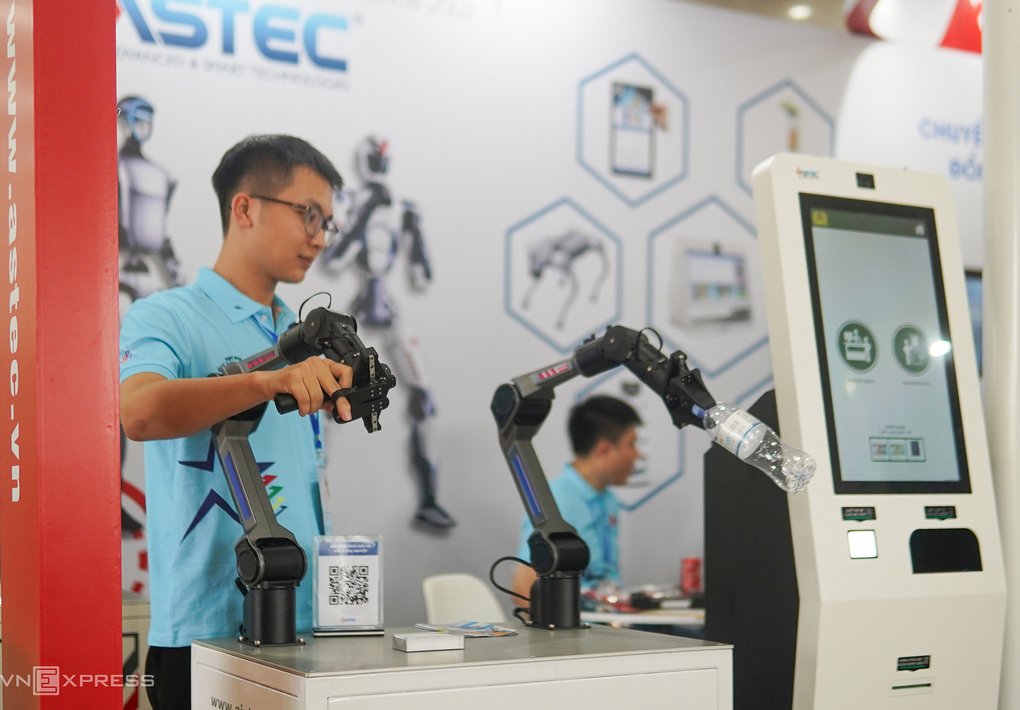 |
Robot at the VIIE 2025 Innovation Exhibition, October 2025. Photo: Luu Quy, Nguyen Thanh
Unlike traditional approaches where research tasks are predefined, the city is establishing a mechanism that allows businesses to identify bottlenecks in their production and operations, then propose corresponding scientific and technological solutions. Proposals are prioritized if they demonstrate the potential for deployment, leading to practical products or applicable solutions.
Businesses must clearly define the problem to be solved and its root causes, the affected parties, expected products, potential for widespread impact, and the reasons why the market has not effectively resolved the issue independently. Proposals must also specify the extent to which city budget allocation is necessary.
Hanoi has categorized the 30 challenges into four main groups: urban bottlenecks; urban space; fostering economic growth and technology mastery; and security, social welfare, and sustainable development. These are large-scale, interdisciplinary issues designed to encourage organizations, businesses, and researchers to collaborate on solutions.
Specifically, the urban bottlenecks group addresses problems such as traffic congestion, pollution, flooding, and food safety. The city aims to apply solutions like smart transportation, AI, real-time forecasting, traceability, and automatic monitoring to these areas.
The group focused on fostering economic growth and technology mastery encompasses 16 of the 30 challenges. Key areas identified include: developing the data economy, creating "make in Hanoi" platforms, reducing logistics costs, promoting smart manufacturing and core technology, advancing fintech, enhancing small and medium-sized enterprise productivity through AI and automation, and nurturing an innovative startup ecosystem.
Presenting these challenges as strategic questions represents a new approach by Hanoi to science and technology development. Instead of primarily evaluating efforts based on the number of proposals or workshops, the city now prioritizes connecting tasks with pilot products, operational models, practical applicability, technology transfer contracts, and the resulting socio-economic value.
The list of 30 challenges was officially announced by the Hanoi People's Committee via Decision 1193/QD-UBND on 18/3. The city views this list as the foundation for developing science and technology, innovation, and digital transformation initiatives and projects, some of which will utilize the city's budget.
Soliciting proposals directly from businesses helps integrate market demands into the task formulation process. As required by the Department of Science and Technology, businesses must explain why the market has not independently resolved the problem and justify the necessity of using public funds. This approach ensures that science and technology resources are directed towards problems with clear application addresses and concrete outputs.
Yen Chi