The low-emission rice farming model, a collaboration with Ca Mau Fertilizer, is being implemented in Tan Dien commune, Dong Thap province, for the Summer-Autumn 2026 crop. This initiative involves over 100 households cultivating 100 hectares, focusing on reduced seed usage, balanced fertilizer application, optimized water management, and integrated pest control. Ca Mau Fertilizer supports farmers with materials, technical guidance, and 50% of the required fertilizer.
On the farm of Le Pham Hoang, changes in cultivation practices are evident. Seed quantities are reduced following recommendations from the Sub-Department of Crop Production and Plant Protection. Fertilizer application is adjusted according to each growth stage, as advised by Ca Mau Fertilizer. Water management employs an alternate wetting and drying method instead of continuous flooding.
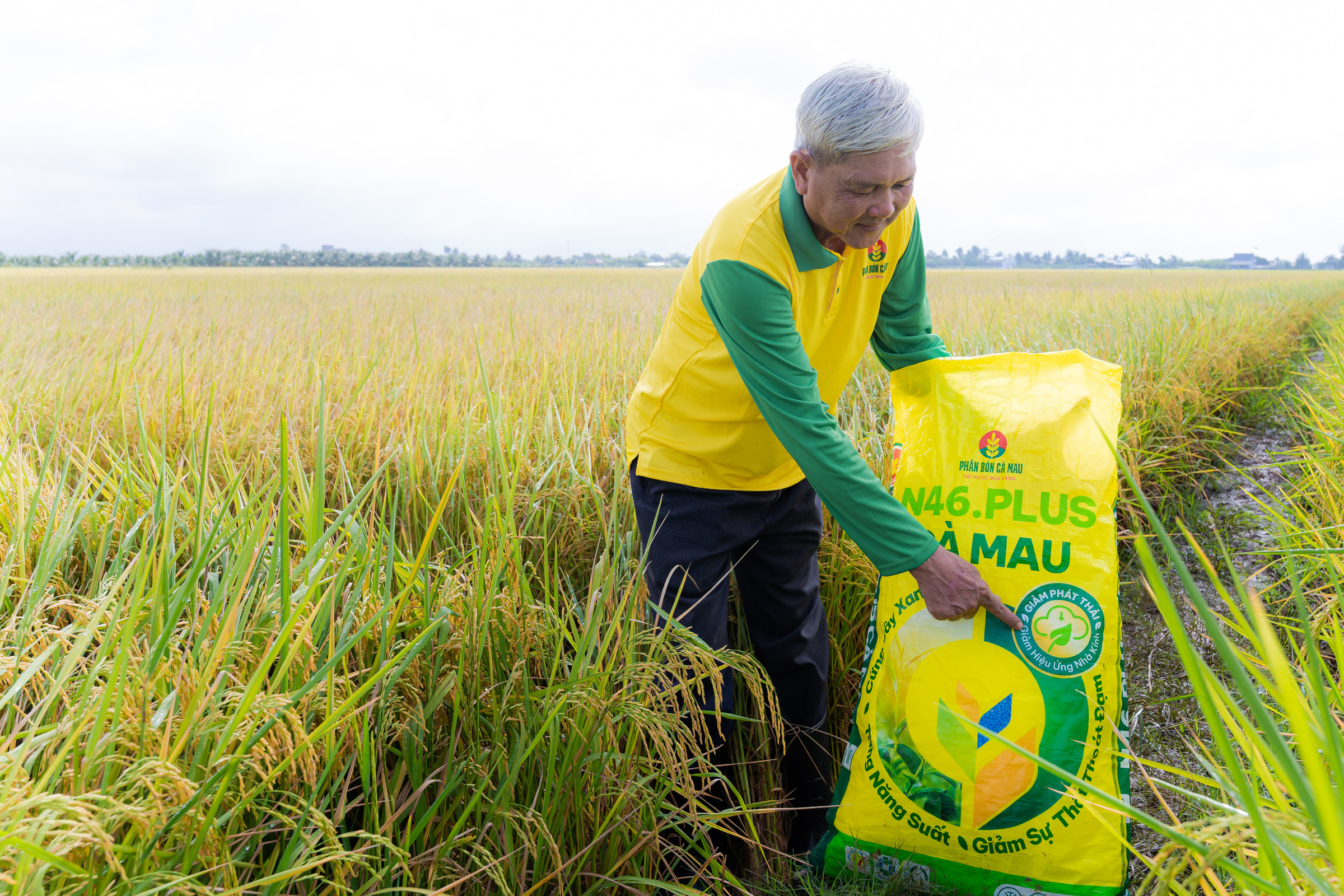 |
N46.Plus Ca Mau, Ca Mau NPK Gold 20-15-8, and Ca Mau NPK 18-6-18 are used throughout the model. Photo: PVCFC
Fields adopting the model sow 100 to 130 kg of seeds per hectare, a reduction of 20 to 30 kg per hectare compared to control fields. By using the ST25 rice variety and planting at the same time, this reduced seed rate promotes better tillering and plant development, leading to fewer pests and diseases.
Beyond seed reduction, fertilizer application is precisely calculated for each growth stage. The product line, including N46.Plus Ca Mau, Ca Mau NPK Gold 20-15-8, and Ca Mau NPK 18-6-18, is applied in four doses during the crop cycle. Per hectare, the amount of pure nitrogen is reduced by approximately 33 kg, and pure phosphorus by 16.5 kg, compared to control fields.
According to Ca Mau Fertilizer, despite reduced seed and nutrient inputs, the rice plants exhibit strong growth. Starting with 381 tillers per square meter at 7 days after sowing, model fields achieved 715 tillers per square meter at 40 days after sowing. By the end of the season, these fields produced 430 panicles per square meter, exceeding control fields by 62 panicles per square meter.
Thanks to sparse sowing, balanced fertilization, and integrated pest management, the rice plants grow robustly, and the fields remain airy, leading to a higher population of natural enemies. Monitoring revealed lower incidences of pests like stem borers and planthoppers, as well as diseases such as blast and bacterial leaf blight, compared to control fields.
These reductions directly translate into lower production costs. Seed costs decreased by nearly 1.3 million dong per hectare, fertilizer costs by over 2.13 million dong per hectare, and plant protection product costs by 500,000 dong per hectare. The total production cost for the model fields was 22.306 million dong per hectare, which is over 4.2 million dong less than the control fields.
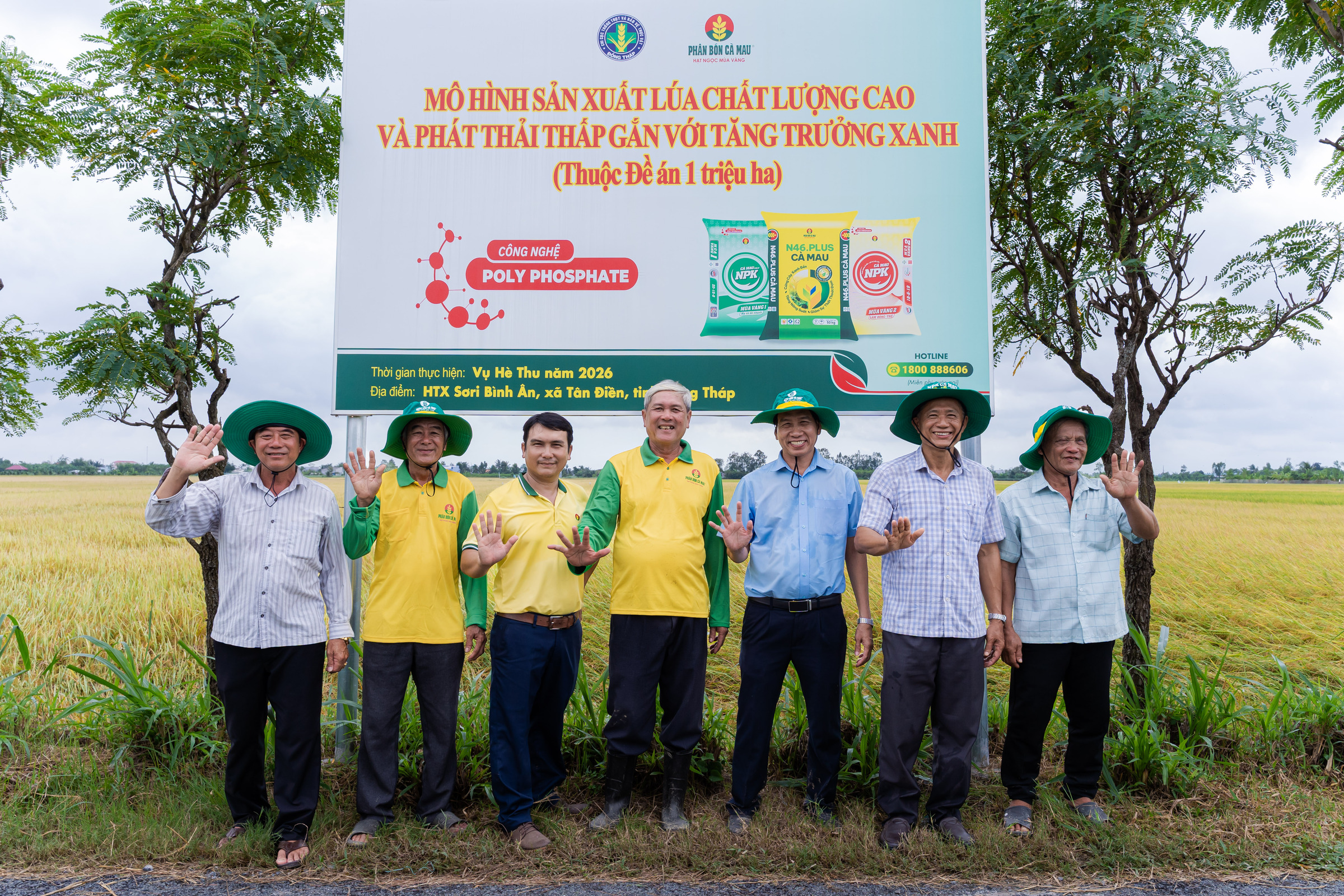 |
Le Van Chan, Deputy Head of the Sub-Department of Crop Production and Plant Protection of Dong Thap province, attends the model review (third from right). Photo: PVCFC
In addition to input materials, the model alters water usage in the fields. Farmers implement three periods of water drainage during the crop cycle, following an alternate wetting and drying principle. At times, water levels dropped to between -12 cm and -16.5 cm. In contrast, control areas largely maintained continuous flooding.
This management approach reduces the duration of field submergence, allowing for deeper root development. Calculations indicate that emissions from the model fields are nearly one ton of CO2e lower per hectare per crop. When measured per kilogram of rice, emissions decrease from 0.6 kg to 0.3 kg of CO2e.
These results were also presented by Le Van Chan, Deputy Head of the Sub-Department of Crop Production and Plant Protection of Dong Thap province, in a specialized report on the model. A notable finding is that reducing inputs did not decrease yield; instead, all end-of-season yield indicators improved compared to the control fields.
Sample yields reached 6.4 tons per hectare, 1.1 tons higher than control areas. With a consistent fresh rice selling price of 6,900 dong per kilogram, total revenue amounted to 44.16 million dong per hectare. After deducting costs, profits exceeded 21.85 million dong per hectare, nearly 11.8 million dong higher than the control. Consequently, the production cost decreased from 5,003 dong to 3,485 dong per kilogram.
According to Ca Mau Fertilizer, after a crop cycle, farmers ultimately seek ways to reduce costs while maintaining yield. The results from the Dong Thap rice farming model demonstrate that this challenge can be met by recalculating cultivation steps from the outset, rather than adhering to traditional practices of dense sowing, heavy fertilization, and continuous field submergence.
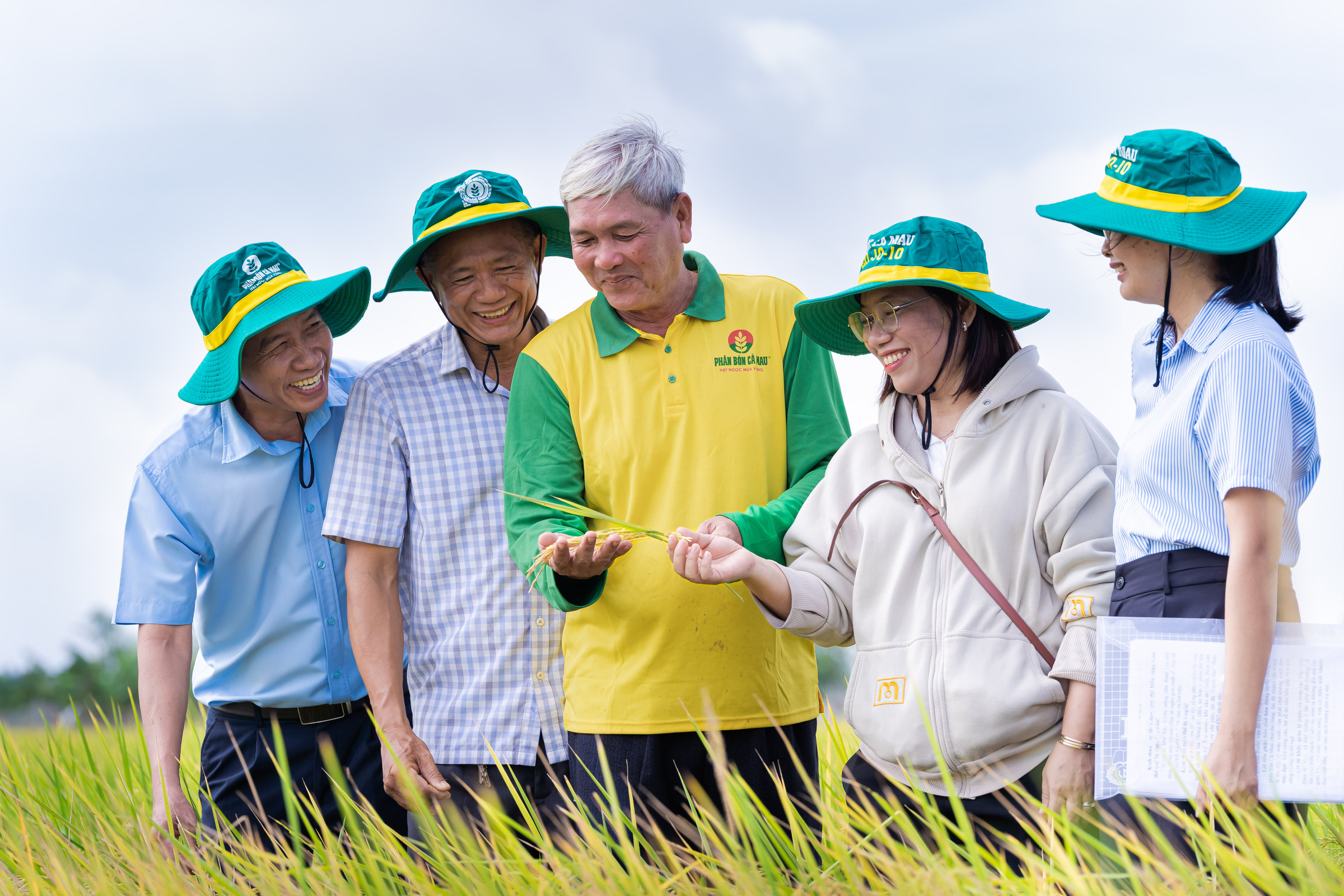 |
Farmers participate in the model. Photo: PVCFC
In this approach, fertilizer application is one of the steps that clearly shows the effectiveness of using the right amount at the right time. Produced with advanced technology, Ca Mau Fertilizer products feature uniform granule quality, enabling efficient nutrient uptake by plants.
When the correct type and quantity of fertilizer are applied at each growth stage, fertilizer costs decrease while significantly improving yield and profit. For farmers, this is the decisive factor for a technical process to be adopted and sustained. The "three reductions, two increases" model in Dong Thap illustrates a clear direction for rice production in the Mekong Delta. Here, yield, profit, and emission reduction goals are no longer separate challenges but can be addressed concurrently in the fields.
Hoang Dan