The Hanoi People's Council is currently seeking public feedback on a draft resolution proposing a support policy for households installing self-produced, self-consumed rooftop solar power and battery energy storage systems, effective from 2026 to 2030.
Under the draft policy, households installing only rooftop solar will receive one million dong per kilowatt-peak (kWp) of photovoltaic panel capacity, with a maximum of three million dong per household. The system must have a total capacity of one kWp or more.
For those who also install a battery energy storage system (BESS), households will receive an additional one million dong per kilowatt-hour (kWh) of storage capacity, up to a maximum of three million dong. The BESS must have a minimum capacity of 2 kWh and be installed in conjunction with the solar power system.
Thus, a household installing both rooftop solar and a BESS could receive a total maximum support of 6 million dong.
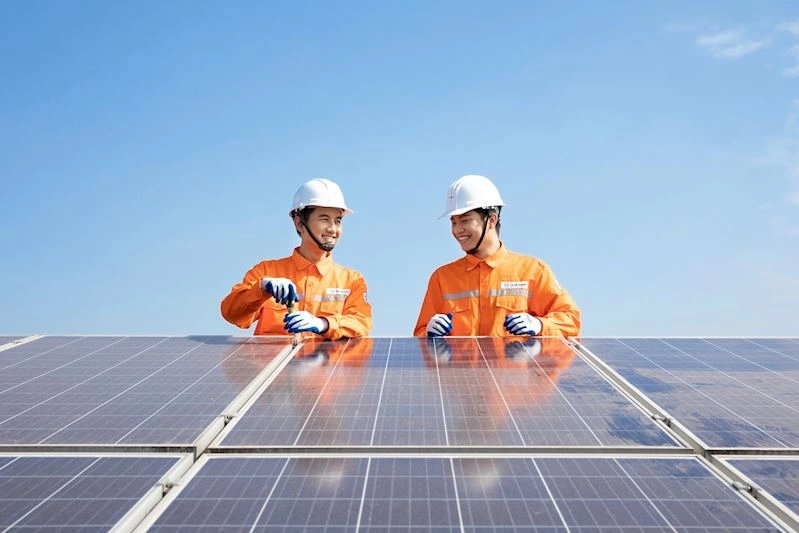 |
A rooftop solar power system installed at a household in Hanoi. Photo: EVNHanoi |
The actual support amount will not exceed the costs paid by the household, after deducting any other State subsidies. Funding is expected to come from the city's budget and will be supplemented to commune-level budgets.
To qualify for support, the rooftop solar system must complete the necessary notification or registration procedures for power source development. Households must also commit to operating and using the system for its intended purpose for at least three years from the date of receiving funds. Additionally, households are responsible for electrical safety, fire prevention, the structural integrity of the building, and environmental protection.
The residence where the system is installed must be the household's legal dwelling. Each individual residence, identified by the address on its land use rights certificate and property ownership documents, is eligible for support only once.
If the applicant is not the sole homeowner or if the property is co-owned, the household must provide a written authorization or collectively agree to appoint a representative to complete the necessary procedures.
Hanoi's support proposal comes as the regulatory framework for self-produced, self-consumed rooftop solar power has recently been relaxed under Decree 243/2026.
Effective from 26/6, the sale of surplus electricity is permitted, including output directly from rooftop solar sources and electricity stored in a BESS from these sources. The volume of surplus electricity bought and sold will be determined by agreement between parties, typically not exceeding 50% of the system's output, an increase from the previous 20% limit.
By the end of 2030, the percentage of surplus electricity allowed for purchase may exceed 50% if the local grid infrastructure can adequately accommodate it and ensure system safety.
Nationwide, more than 130,800 rooftop solar power systems are currently installed and operational. Among these, 28,254 systems are for self-production and self-consumption, totaling approximately 1,614 MWp. Almost all of these (27,967 systems) do not sell surplus electricity back to the grid.
Phuong Dung