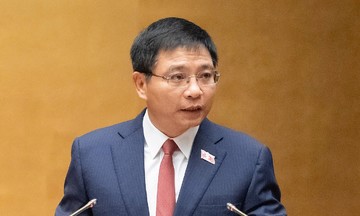
On the afternoon of 8/12, the National Assembly discussed the draft Resolution on mechanisms and policies for national energy development from 2026-2030. In the draft, the government proposed adding regulations to encourage enterprises and the private sector to participate in researching, investing in, and developing small modular nuclear power (SMR).
Ms. Trinh Thi Tu Anh, a member of the Science, Technology, and Environment Committee, believes that developing SMR nuclear power is a suitable direction for Vietnam. The draft resolution introduces a more flexible mechanism compared to the traditional approach, where nuclear power was almost exclusively the responsibility of the State.
However, she emphasized that SMR nuclear power development must be accompanied by conditions for safety, responsibility, and transparency. Ms. Tu Anh proposed that the government needs to establish a separate legal framework for SMRs, including design licensing, technology appraisal, operational supervision, and control of radioactive waste. Enterprises wishing to participate must meet financial capacity, technological capability, and environmental responsibility, with the State retaining a supervisory role.
She also proposed implementing SMRs cautiously, with a clear roadmap: research, testing, and project demonstration, alongside thorough assessment of social and environmental impacts. "Encouragement does not mean laxity; it means creating a corridor for truly capable entities to develop new technologies, while the State maintains its role in regulation and supervision," Ms. Tu Anh stated.
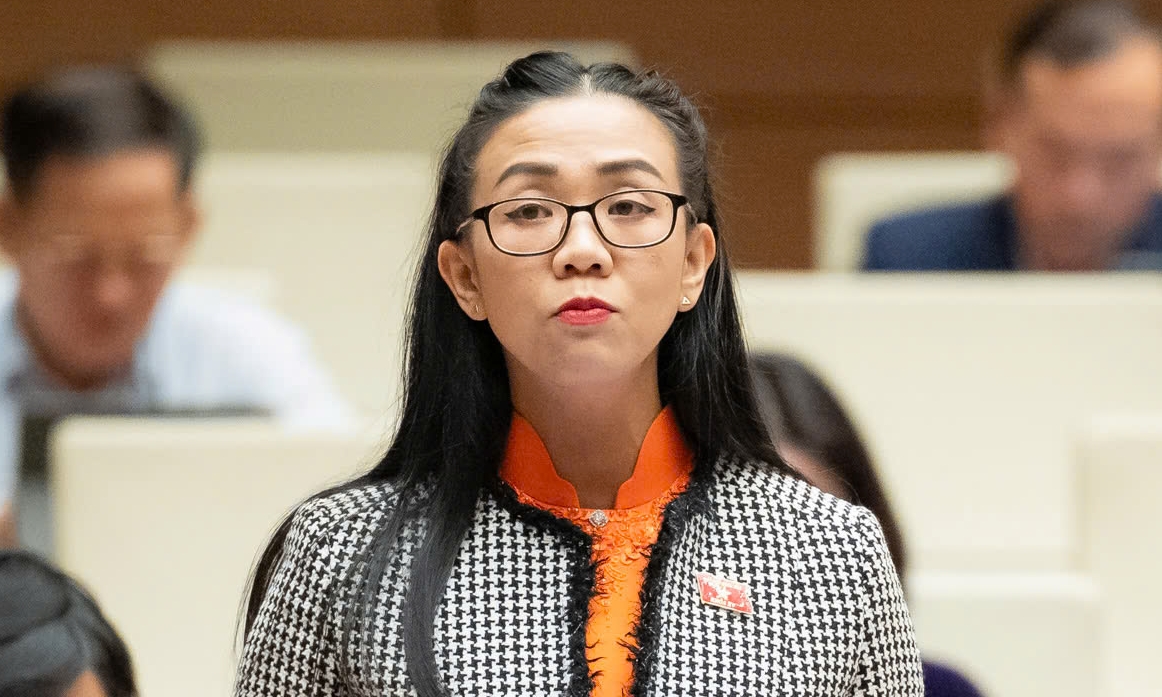 |
Delegate Trinh Thi Tu Anh spoke at the session on the afternoon of 8/12. Photo: National Assembly Media |
Delegate Trinh Thi Tu Anh spoke at the session on the afternoon of 8/12. Photo: National Assembly Media
Late last year, the National Assembly resolved to resume investment in the Ninh Thuan nuclear power project, eight years after its suspension. Vietnam plans to complete it within five years. The Ninh Thuan 1 plant will be located in Phuoc Dinh commune, Thuan Nam district, while the Ninh Thuan 2 plant will be in Vinh Hai commune, Ninh Hai district. Vietnam Electricity (EVN) and the National Energy Industry (PVN) will respectively serve as investors for these two plants.
Additionally, Vietnam plans to develop small-scale nuclear power nationwide. Small Modular Reactors (SMRs) are advanced nuclear reactors with a capacity of up to 300 MW per unit, one-third the size of traditional nuclear power reactors. These modules can be prefabricated at a factory and then transported to the installation site, reducing construction costs and time while ensuring safety through passive safety features. The estimated investment cost per kW for SMRs ranges from 7,000-12,000 USD, totaling 2,1-3,6 billion USD for a 300 MW plant over two to three years. In contrast, building a standard plant costs approximately 6-9 billion USD, requiring around five years or even over 10 years for some projects.
Pham Van Hoa of the Dong Thap Lawyers' Association commented that the regulation encouraging enterprises to invest in SMRs is "still too general". According to him, small-scale nuclear power still poses potential risks to life and property if an incident occurs. Mr. Hoa suggested that the responsibilities of all parties must be strictly regulated in case of an incident, and SMR development should begin with pilot projects before expanding in scale.
Many countries are currently commercializing or rapidly developing SMR nuclear power. The United States, Canada, France, and the United Kingdom are encouraging private sector participation, viewing it as a driver for technological innovation. Some Asian countries are also choosing SMRs for regions with weak infrastructure.
Similarly, Nguyen Thi Lan, Director of the Vietnam National University of Agriculture, stated that "SMRs cannot be expected to deliver high economic efficiency in the short term." Ms. Lan noted that attracting private investment will be challenging due to high investment costs, long capital recovery periods, and significant risks. Therefore, the State needs to play a leading role during the initial development phase of this new energy type.
"When Vietnam gains enough experience, effectively controls safety, completes the legal framework, and masters core technology, it can gradually expand the scale to attract private enterprises to invest," she asserted.
 |
Delegate Nguyen Thi Lan - Director of the Vietnam National University of Agriculture, spoke at the session on the afternoon of 8/12. Photo: National Assembly Media |
Delegate Nguyen Thi Lan - Director of the Vietnam National University of Agriculture, spoke at the session on the afternoon of 8/12. Photo: National Assembly Media
In the draft, the government proposed that enterprises undertaking offshore wind power projects must have a minimum charter capital of 10,000 billion VND and owner's equity no less than 15% of the project's investment. For projects with two or more investors, enterprises will be selected based on priority criteria such as a smaller survey area, lower projected electricity prices, and strong financial capacity.
Ms. Trieu Thi Ngoc Diem, a member of the Culture and Social Affairs Committee, disagreed with prioritizing enterprises proposing smaller areas. She argued that surveys must be precise and align with the project's capacity and scale. "Factors such as financial capacity, international and domestic experience should be primary criteria for selecting investors," Ms. Diem proposed.
On this aspect, Mr. Ha Sy Dong, former acting Chairman of the Quang Tri Provincial People's Committee, also suggested supplementing criteria to evaluate investor capacity for large-scale projects and designating a central agency as the coordinating focal point. The timeframe for project survey permits and application forms also needs to be standardized to facilitate project implementation for investors.
In his subsequent explanation, Minister of Industry and Trade Nguyen Hong Dien stated that offshore wind power is a new form of energy linked to national security. He conveyed the government's and the Ministry of Industry and Trade's (the drafting agency's) perspective: "exploit and gradually learn lessons for the next development phase."
Minister Dien pledged that after the National Assembly approves this draft resolution, the government will direct ministries and agencies to establish control mechanisms to ensure national interests and security.
The National Assembly is expected to vote on and approve the draft Resolution on mechanisms and policies for national energy development from 2026-2030 on the afternoon of 11/12.
Anh Tu