On 20/2, the US Supreme Court ruled against tariffs imposed by President Donald Trump under the International Emergency Economic Powers Act (IEEPA). This decision significantly reduced the average US import tariff by nearly half, from 15,4% to 8,3%, according to estimates from Global Trade Alert.
For nations such as Trung Quoc, Brazil, and India, which faced high tariffs, the reduction could reach double digits. However, many economies have expressed a cautious welcome, some even showing unease, Reuters reported.
In Asia, US trade partners began to fear new instabilities. President Trump responded to the ruling by issuing new 10% tariffs, replacing those cited under IEEPA that had just been invalidated.
A spokesperson for the Japanese government stated that Tokyo "will carefully examine the content of the court's ruling and the Trump administration's response" to provide an appropriate reply.
Set to host Trump in late 3, Trung Quoc has not yet officially commented, as it is observing the Lunar New Year holiday 2026. However, a senior financial official in Hong Kong described the situation in the US as "a disaster".
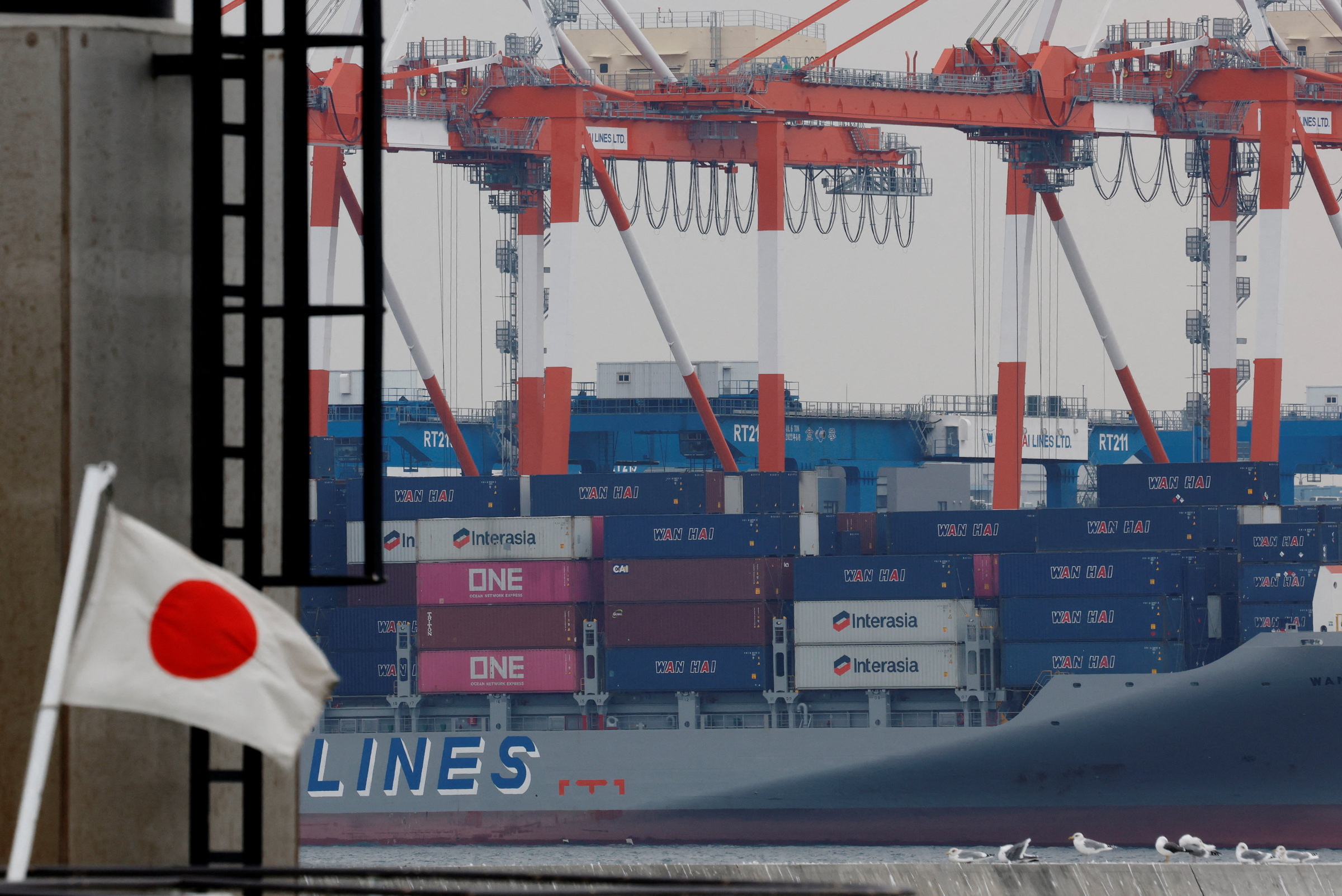 |
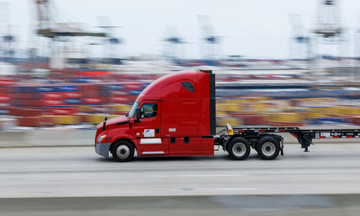
A cargo container port in Tokyo, Japan, 16/2. *Reuters*.
The Dai Loan (Trung Quoc) administration stated it is also closely monitoring the situation. It noted that the US government has not yet determined how to fully implement trade agreements with many countries. Dai Loan recently signed hai agreements with the US, including a 250 billion USD investment commitment and reduced import tariffs.
Some economies were more optimistic. Nantapong Chiralerspong, head of Thailand's Trade Policy and Strategy Office, suggested the ruling could even benefit exports. He noted that these instabilities might trigger a wave of front-loading, similar to last year, as businesses fear further tariff increases.
Brazil's Vice President Geraldo Alckmin stated the ruling is significant for the South American economy. This is especially true ahead of a planned 3 meeting between President Trump and President Luiz Inacio Lula da Silva. He added that Brazil "cautiously awaits" the next step, and the upcoming meeting between the hai leaders could strengthen negotiations. Previously, Brazil faced an additional 40% tariff due to a trial against former President Jair Bolsonaro.
Observers noted that dozens of countries currently negotiating bilateral trade agreements with the US are now considering whether the Supreme Court's ruling creates leverage for them to renegotiate.
The European Parliament initially expected to ratify a trade agreement with the US as early as next week. However, following the ruling, Bernd Lange, Chair of the European Parliament's Trade Committee, stated they would reconsider. "The era of arbitrary, unlimited tariffs may now be coming to an end. We must carefully assess the ruling and its consequences", he said.
It is not ruled out that the EU might want to adjust the agreement. Niclas Poitiers, a researcher at the Bruegel Institute for Economic Studies, noted that Europe had made concessions and suffered disadvantages in the trade agreement with the US. "There's a possibility of scenarios that could lead to this agreement breaking down", he commented.
Meanwhile, a UK government spokesperson stated that the country would continue to work with the White House to understand the ruling's impact. "This is a matter for the US to decide, but we will continue to support British businesses as further details are released", the spokesperson said.
In 5/2025, the UK signed a comprehensive trade agreement with the US, benefiting from a 10% import tariff on many goods. This also included some exceptions for steel, aluminum, oto, and pharmaceuticals. "The UK enjoys the lowest reciprocal tariff globally. And in any scenario, we expect our preferential trade position with the US to be maintained", the spokesperson added.
According to a report by the Federal Reserve (Fed) Bank of New York, many countries have gradually adapted to Trump's tariff policies. In fact, US consumers and businesses are bearing much of this burden.
Trung Quoc also recorded a trade surplus of nearly 1.200 billion USD in 2025, thanks to booming exports to markets outside the US. In its latest update, the International Monetary Fund (IMF) projected this year's global growth to reach a "resilient" 3,3%.
Therefore, Varg Lukas Folkman, an expert at the European Policy Centre (EPC), suggested that some economies might continue to negotiate bilateral agreements with Trump, rather than "pushing themselves into uncertainty like in spring 2025".
Phien An (according to Reuters, AP, CNBC)