In recent Tet seasons, "king's tribute" red pomelo has consistently been a sought-after item. This year, the price of traditional red pomelos continues to rise by about 10% compared to last year, commonly ranging from 120,000-350,000 dong per fruit, depending on size. Some stores sell by kilogram, with prices fluctuating between 80,000-200,000 dong per kg. The market now features an organic "king's tribute" red pomelo, cultivated under strict processes, which commands prices two to four times higher than mass-produced items. This product targets a premium customer segment.
Tran Tien Hai, who both cultivates and procures pomelos from farmers in Thanh Hoa, stated that this year marks the first commercial sale of organically grown "king's tribute" red pomelos. For the past three years, these pomelos were exclusively used as gifts and for expert evaluation. Due to high technical requirements and stringent selection criteria, the total output of organic pomelos suitable for market sale is only about 1,500 fruits.
 |
Organic "King's Tribute" red pomelo at a garden in Thanh Hoa. Photo: Tien Hai
According to Hai, this premium product line starts at 500,000 dong per fruit. Fruits meeting specific standards for weight (1,6-1,9 kg), balanced shape, distinct aroma, and consistent quality can sell for around 2 million dong each. This product is aimed at customers who understand and trust the inherent value of organic produce, rather than solely focusing on appearance.
Hai described the organic pomelo cultivation process as entirely chemical-free throughout the tree's life cycle. Trees are nourished by a natural ecosystem and microorganisms, and the fruits are not bagged, ensuring direct sunlight exposure, which is crucial for their unique aroma. He emphasized that the core value of "king's tribute" red pomelo lies in its natural fragrance, not an artificial sheen created by human intervention.
Each pomelo typically weighs from 1,5 to 2,2 kg, with the most aesthetically pleasing and well-proportioned fruits making up a small proportion. On average, only about 100 fruits from every 1,000 meet premium standards; the rest are processed into products like wine, jam, or pomelo flower tea. To achieve this quality, pomelo trees must be at least 8-10 years old and continuously organically farmed from the outset, as conversion in a short period is not feasible. Each tree yields only about 15-20 standard fruits annually, sometimes even fewer.
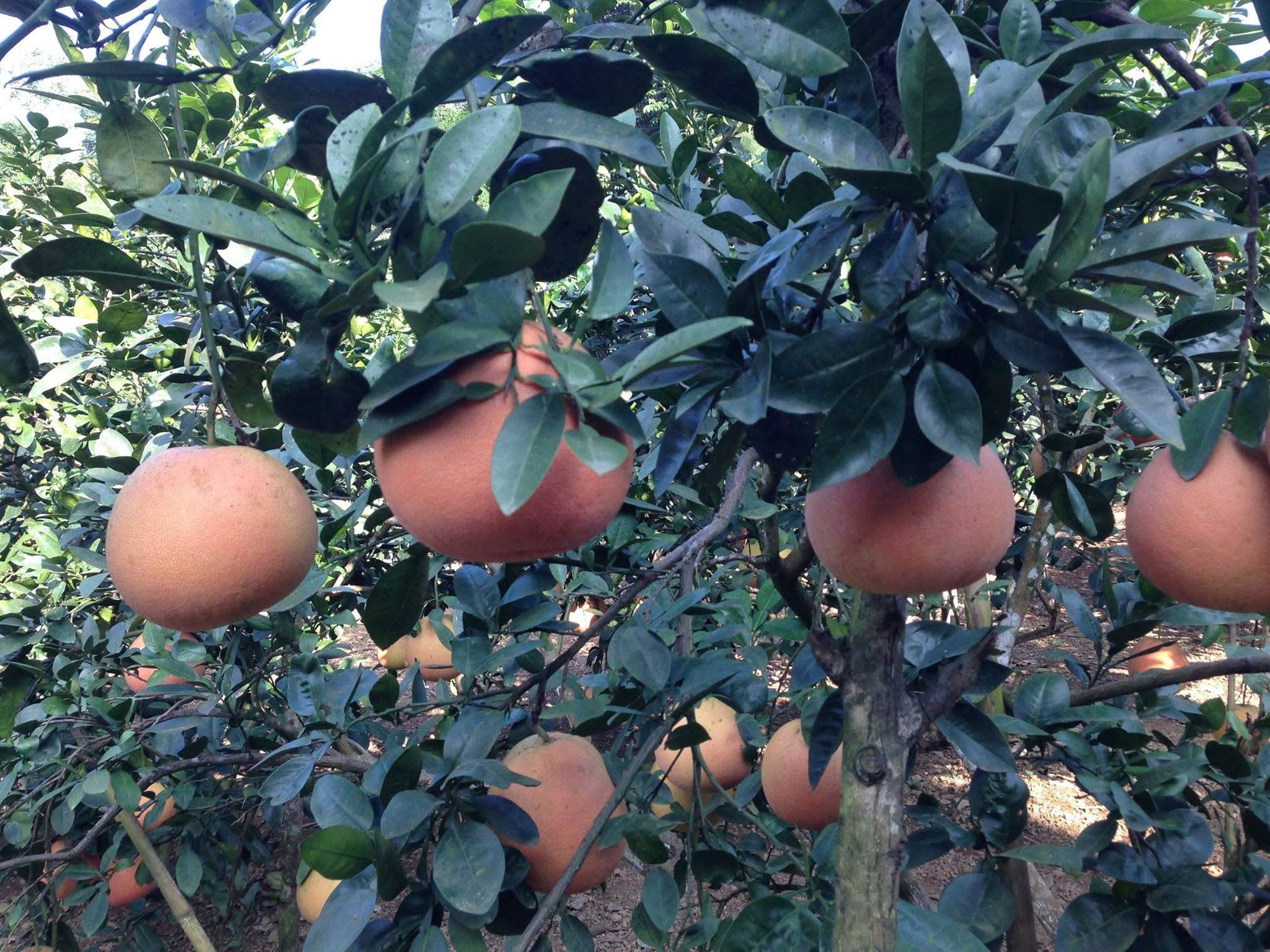 |
The pomelo garden is cultivated organically, with each tree yielding only about 15-20 fruits. Photo: Tien Hai
Hai added that the fruits can be displayed for three to six months after harvest. During this time, the fruits do not rot but gradually dry, retaining their natural aroma.
"King's tribute" red pomelo is currently cultivated in Thanh Hoa and the former Bac Giang area, now part of Bac Ninh. This pomelo variety has an extended harvest season, lasting from late October to December, significantly longer than many other pomelo varieties. It is also a plant with an almost year-round growth cycle, with tightly controlled flowering and fruit selection processes. Hai mentioned that the company is completing the steps to achieve organic certification.
In the mainstream segment, the market this year still offers tens of thousands of traditional "king's tribute" red pomelos. In addition to Thanh Hoa, pomelos from Bac Ninh account for a large share due to their vibrant red color and are often sold with branches and leaves, making them 30,000-50,000 dong more expensive per fruit than those from Thanh Hoa.
Quynh Anh, a trader in Bac Ninh, noted that pomelos sold with branches and leaves have a wholesale price of 170,000-200,000 dong per fruit. For retail, small ones weighing around 800 grams sell for 120,000 dong, while fruits over 2 kg are offered for up to 400,000 dong. However, purchasing power this year is not high. According to her, the consumption of red pomelos for Tet offerings has decreased by about 10% compared to last year, influenced by floods in the northern and central regions, while the southern market offers many other choices such as green-skinned pomelo and Nam Roi pomelo.
In An Hoi Dong ward, TP HCM, Quynh Chi reported that despite importing about 5 crates of red pomelos, only one-half has been sold, a sharp decline from previous years. She stated that subsequent imports would need to be carefully aligned with orders to avoid inventory risks.
According to Thanh Hoa locals, "king's tribute" red pomelo was once a precious commodity offered to kings and was essential for the five-fruit tray during Tet. When young, the fruit is green like other pomelo varieties, then turns yellow, and ripens to a distinctive red color. If preserved correctly, the pomelo can be displayed for Tet for two to four months.
Currently, "king's tribute" red pomelo in Thanh Hoa is primarily grown in the hilly areas of Tho Xuong and Xuan Bai communes and the Lam Son region, with several tens of hectares yielding fruit and more than 36 hectares in the basic construction phase. The specific climate and soil conditions here are considered factors that create the unique flavor of this pomelo variety, once revered as a royal tribute.
Thi Ha