According to a Ministry of Construction report presented at the fourth session of the Central Steering Committee on Housing Policy and Real Estate Market on 17/12, Vietnam boasts 3,297 commercial housing, social housing, and land plot projects. These projects collectively encompass 5,9 million units, representing a total investment capital of 7,42 quadrillion VND.
In recent years, residential property prices have seen significant increases. Apartments, townhouses, villas, and land plots have risen by an average of 10-15% annually, with some periods experiencing surges of up to 30%. Other real estate segments, such as tourism, resort, and industrial park properties, also recorded annual price increases, but at a more modest rate of 5-10%. This indicates a substantially slower growth compared to the upward trend in housing and residential land values.
Since 2022, the real estate market has shown signs of recovery, with transaction volumes for various property types and segments reaching 537,000-785,000 annually. This recovery is supported by increased capital flows into the sector. By 31/8, outstanding credit in real estate reached approximately 4,1 quadrillion VND. The corporate bond market for real estate businesses has also stabilized this year, with total issuance in the first 9 months nearing 398 trillion VND, a rise of almost 44% compared to the same period. Furthermore, registered foreign direct investment (FDI) in the sector for the first 9 months reached 5,18 billion USD, marking a 15,2% increase.
The government's initiative for 1 million social housing units is progressing, with 698 projects currently underway nationwide, totaling 657,441 units. This year alone, 102,388 units were completed, exceeding the annual plan by 2%, and 85 new projects comprising 91,431 units were started.
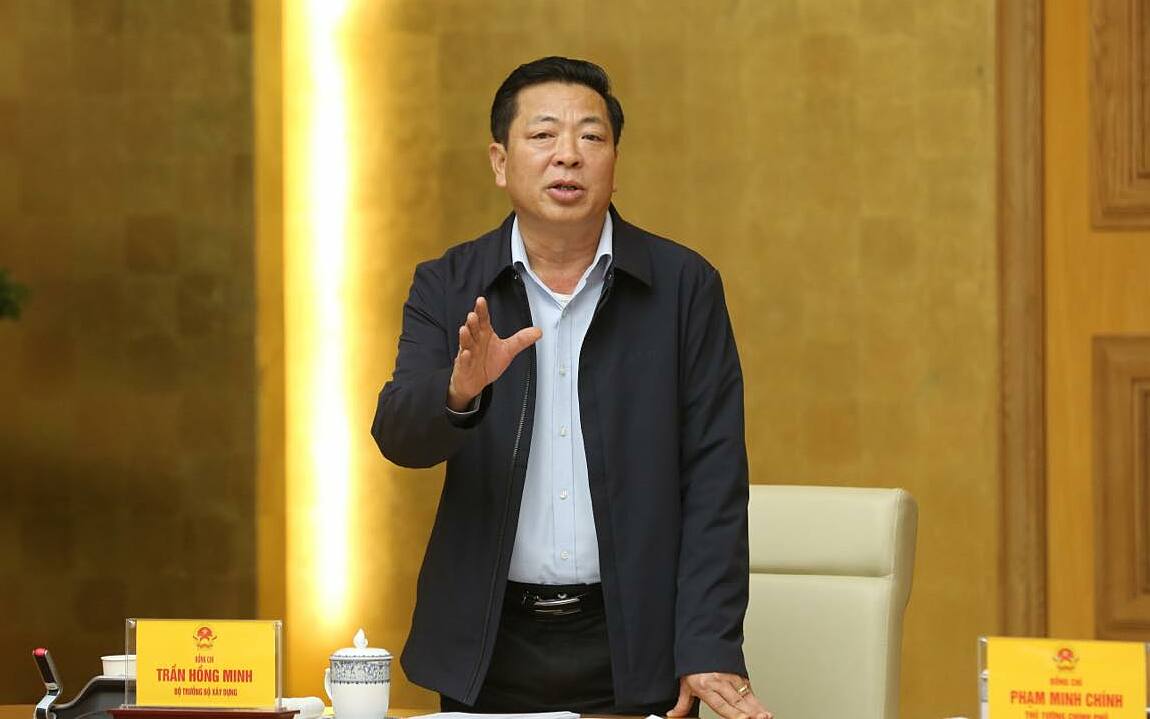 |
Minister of Construction Tran Hong Minh speaks at the meeting on 17/12. Photo: VGP |
During the session, representatives from provinces including Khanh Hoa, Quang Ninh, Thai Nguyen, Hai Phong, and Hung Yen affirmed that real estate transaction volumes increased quarter-over-quarter this year, reflecting a clear market recovery after a period of stagnation. However, progress on many large projects remains slow, primarily due to issues related to compensation and site clearance.
Leaders of the Vietnam Real Estate Association and Ho Chi Minh City Real Estate Association concurred, assessing the market as recovering, with new projects achieving an absorption rate of approximately 68-70%.
Concluding the meeting, Prime Minister Pham Minh Chinh acknowledged the positive changes and gradual recovery in the real estate and commercial housing markets. The Prime Minister instructed the Ministry of Construction to lead the development and public disclosure of a comprehensive real estate market information database. This database will cover all housing types, including commercial, social, temporary, and dilapidated units, across the country. The task is slated for completion by Q1/2026.
The Prime Minister also called for the continued healthy and stable development of the real estate market. To achieve this, he emphasized the need to diversify capital sources for the sector, including credit, bond issuance, foreign direct investment (FDI), and public-private partnerships (PPP). This strategy aims to reduce the market's dependence on bank credit.
Furthermore, agencies must control real estate prices by monitoring input costs and promoting the establishment of real estate and land use rights transaction centers. They are also tasked with collaborating with businesses to resolve real estate inventory issues and implementing digital transformation initiatives to foster a safe, public, and transparent market.
Phuong Dung