Hai Phong established a free trade zone in October, spanning approximately 6,292 ha across three locations within the city's coastal economic zones. At the conference "Hai Phong City Free Trade Zone - Destination of a New Era" on 11/12, Nguyen Thanh Phuong, General Director of Sao Do Investment Group (investor of Nam Dinh Vu industrial park), stated that while the city boasts modern port systems and industrial parks, its supporting industry ecosystem has not kept pace with the scale of investment.
Phuong warned, "Many components are still imported, indicating significant opportunities for localization. If we do not establish local supply chains soon, the new-generation foreign direct investment (FDI) in the free trade zone will remain mere assembly, failing to generate sustainable added value."
He urged Hai Phong to design incentive packages, including tax and land benefits, for FDI projects with clear localization commitments and roadmaps. The city should also establish a supporting industry development fund to provide seed capital, technical assistance, and standard certification for Vietnamese businesses. Concurrently, authorities need to develop a digital platform to connect component supply and demand, offering detailed information on the production capabilities of Vietnamese suppliers.
"The list of component requirements from FDI projects should be published annually, allowing the city to select and support 50-100 units to become official suppliers for these projects," Phuong said.
For foreign investors, clarity and consistency in free trade zone operations are crucial. Koen Soenens, Business and Marketing Director of DEEP C Industrial Park Complex, commented, "Investors are not afraid of complexity; they fear inconsistency. A free trade zone with identical procedures to those outside is no longer truly 'free'."
He proposed a unified coordination mechanism among the city, customs, and industrial park management boards to prevent investors from getting lost in a "procedural maze."
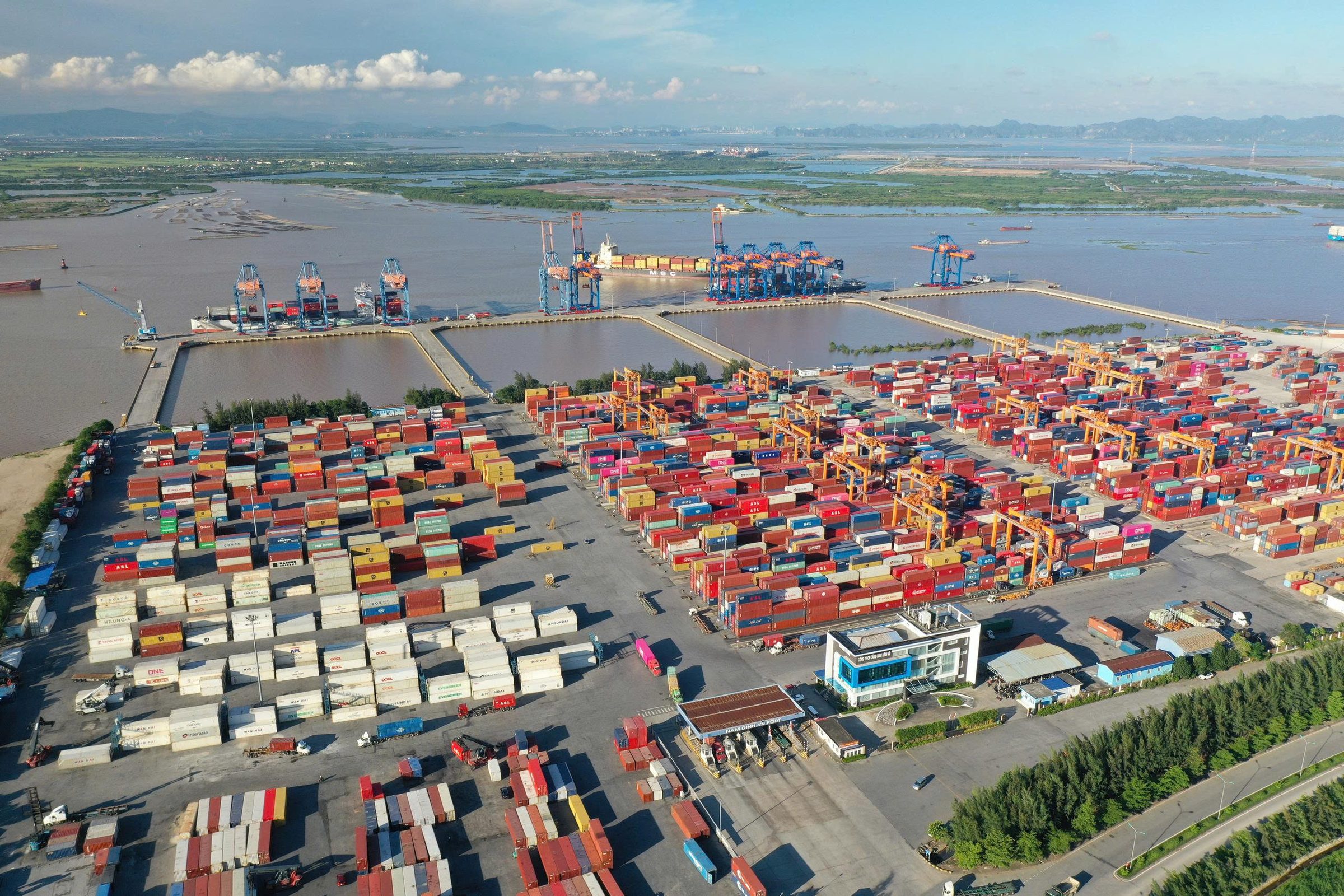 |
The seaport at Nam Dinh Vu Industrial Park, located in position 2 of the Hai Phong Free Trade Zone. Photo: Le Tan |
The seaport at Nam Dinh Vu Industrial Park, located in position 2 of the Hai Phong Free Trade Zone. Photo: Le Tan
Meanwhile, Dr. Phan Huu Thang, Chairman of the Vietnam Industrial Park Finance Association, views the free trade zone as an opportunity to upgrade the manufacturing and logistics ecosystem to international standards, integrating it with the Lang Son-Hanoi-Hai Phong economic corridor.
However, Thang also identified three strategic challenges in developing the free trade zone: asynchronous infrastructure, a shortage of technical human resources, and an investment environment hampered by planning bottlenecks, land prices, and procedures. "Resolving these bottlenecks will be key for Hai Phong to attract new-generation FDI, which demands green standards, smart operations, and sustainable supply chains," Thang stated.
The Hai Phong free trade zone is divided into three locations, linked to the coastal economic zones of Dinh Vu-Cat Hai and southern Hai Phong. Position one covers approximately 2,923 ha within the southern Hai Phong coastal economic zone, in Chan Hung and Hung Thang communes. Position two, with 1,077 ha, is in the Dinh Vu-Cat Hai economic zone, specifically in Dong Hai ward. Finally, over 2,290 ha of the free trade zone is situated within the Cat Hai special zone, also part of the Dinh Vu-Cat Hai economic zone.
Le Trung Kien, Vice Chairman of the Hai Phong City People's Committee, affirmed that the authorities will address and resolve all procedures, barriers, and issues faced by businesses investing in the free trade zone with responsibility, speed, and minimal contact points.
He instructed the Hai Phong Economic Zone Authority and relevant departments to immediately establish a "hotline" or special task force to support and guide investors through the procedures for entering the free trade zone.
Hai Phong's free trade zone is planned for two development stages. Stage one (2025-2030) focuses on completing the legal framework and infrastructure. Some mechanisms and policies will be piloted in the area within the Dinh Vu-Cat Hai economic zone. Authorities will finalize the management and operational model, along with administrative and customs coordination regulations, during this stage.
Over the next three years, pilot policies in the free trade zone will apply to the Dinh Vu-Cat Hai economic zone. By 2030, these pilot mechanisms will extend to the final area within the Dinh Vu-Cat Hai economic zone. Hai Phong aims to complete its technical infrastructure and administrative-customs management model by 2030.
Le Tan