In a recent letter to investors, Petri Deryng, Portfolio Manager of PYN Elite Fund (Finland), attributed the strong volatility in stock markets, particularly in Asia, to the conflict between the US-Israel and Iran. This is because Persian Gulf region countries supply Asia with large quantities of raw materials, including oil, natural gas, and urea used in fertilizer production.
Despite having its own oil production, Vietnam currently imports more than 60% of its crude oil needs due to strong economic growth. According to Deryng, investors are highly sensitive to oil price fluctuations, and the instability has negatively impacted stock prices.
Since the conflict erupted, the foreign fund has executed transactions totaling approximately 200 million euro, encompassing both buying and selling. These transactions involved taking profits from well-performing stocks and replacing them with those severely affected or positioned attractively for the coming months.
"Days of sharp stock market declines may seem unsettling, but they also create opportunities to reallocate investment portfolios," Petri Deryng said.
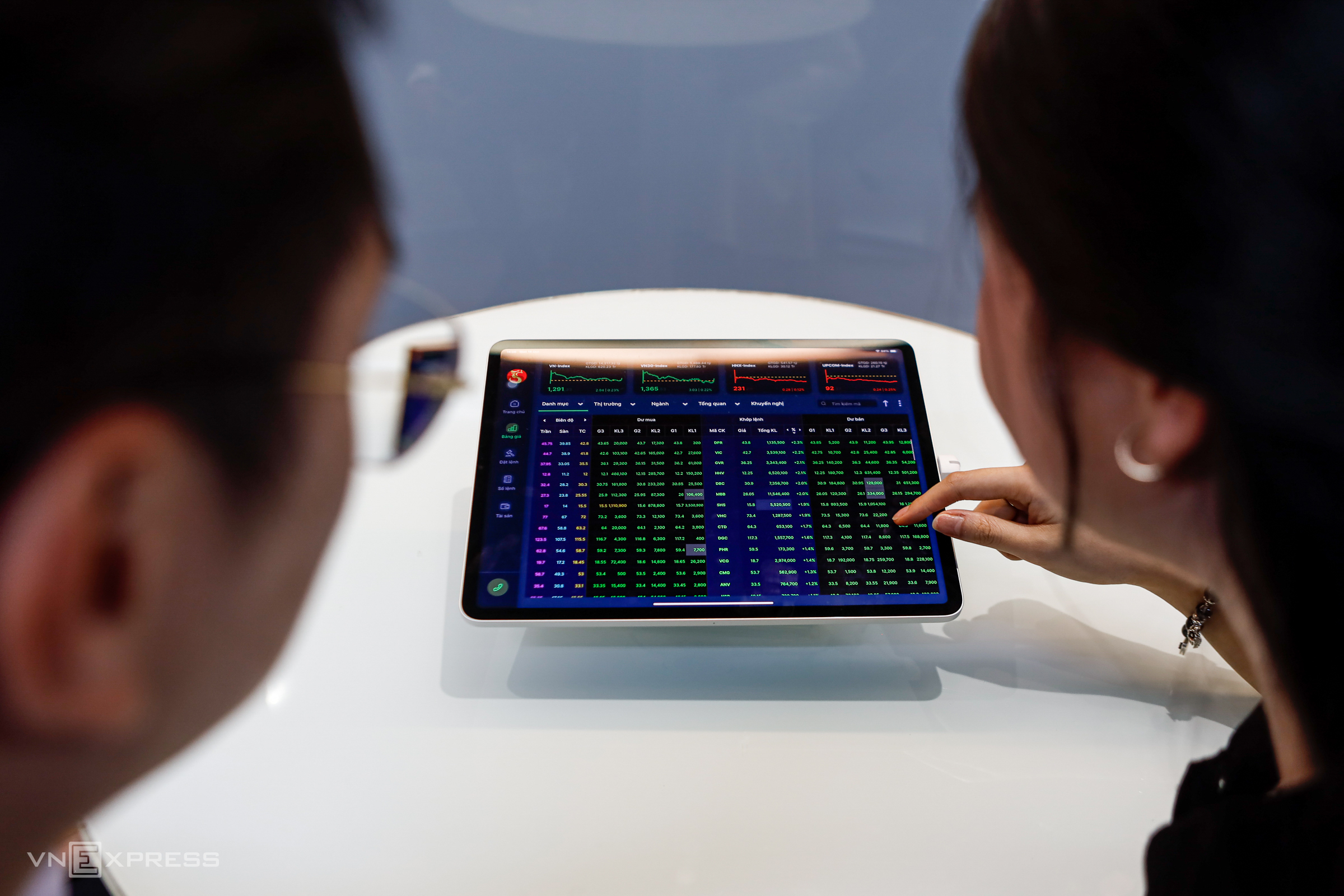 |
Investors monitor electronic boards at a securities company headquarters in TP HCM. Photo: An Khuong
With projected earnings up to 2027, the price-to-earnings (P/E) ratio for the Vietnam stock market is 10.4 times. Excluding four Vingroup stocks, the forward P/E is 9.9 times in 2026 and 8.2 times in 2027. The investment fund is confident in the earnings growth of listed companies, as public investment stimulates domestic demand and boosts the private sector.
If the conflict is prolonged, it could certainly slow Vietnam's economic growth. However, according to Petri Deryng, a scenario of prolonged restrictions on oil supply would be necessary to completely undermine the growth rate.
The foreign fund believes the most probable scenario is that the Middle East conflict will be relatively short-lived. Consequently, Iran would cease open retaliatory actions, allowing oil and other raw material supplies to return to normal.
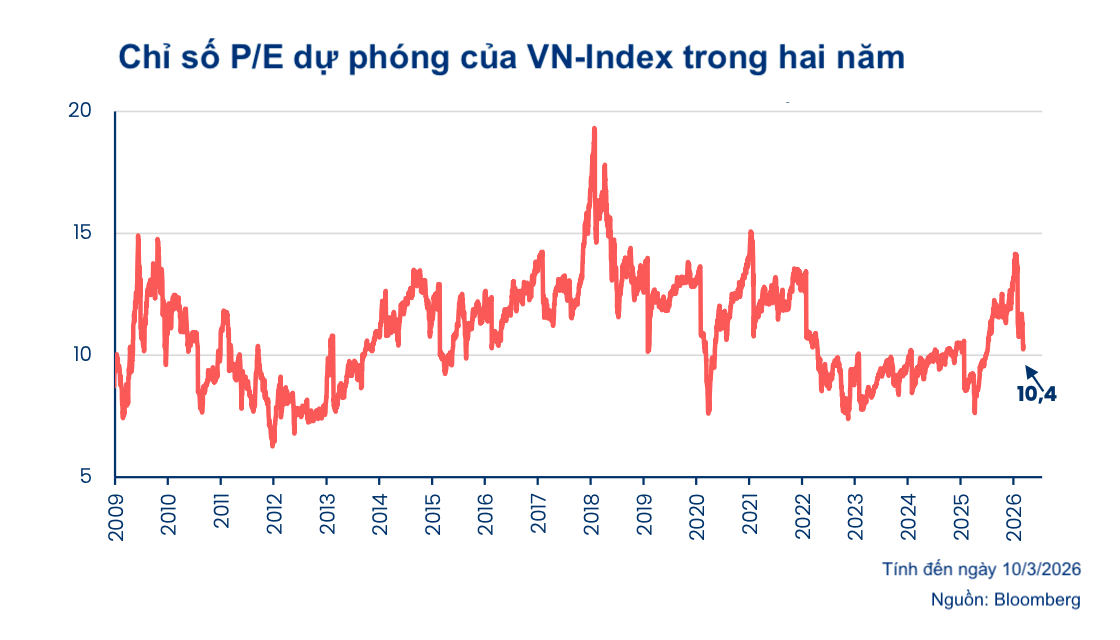 |
Vietnam's stock market valuation is becoming attractive. Graphic: PYN Elite
Portfolio restructuring is also a key focus for many analysis groups during this period. FinSuccess, an investment advisory and trust unit, emphasizes the importance of closely monitoring market fluctuations and selecting corresponding response strategies.
Vu Thanh Huy, Head of Portfolio Management, predicts a 60% chance that the conflict will be prolonged but localized, or that an early compromise between the two sides will be reached. In this scenario, investors can maintain a stock allocation above 80% and continue their investment strategy as before the event. Initially, investors might focus on stocks with the strongest recovery potential, meeting criteria such as: large capitalization and liquidity; leading and cyclical sectors like banking, steel, and retail; and stocks within their "circle of competence" and with fewer variables.
The Circle of Competence, a mental model pioneered by Warren Buffett, helps investors define the limits of their knowledge and skills. This term emphasizes focusing on core strengths, understanding what one knows and does not know, and thereby making accurate decisions while avoiding subjective risks.
However, Huy also assigns a 30% probability to a scenario of prolonged tension. If this occurs, investors should maintain a stock allocation of 50-70% and engage in short-term trading to capitalize on market recovery phases. In the event of an early end to the conflict—a 10% probability—investors could use leverage to optimize and allocate based on the potential risks and returns of stocks.
In a recent report, Thien Viet Securities (TVS) forecasts that the VN-Index might retest the 1,650 point level, consolidating there before recovering by the end of march. This analysis group observes a positive outlook regarding FTSE Russell's review period, which could attract foreign capital inflows into the market shortly before and after the results are announced. Additionally, market valuation has discounted to a level equivalent to the 5-year average, and some sectors are at their lowest levels in 5 years. According to TVS, this will attract short-term trading capital from investors.
This analysis group advises monitoring the VN-Index's movements around the 1,650 point level. Investors may consider deploying a portion of their capital after the market confirms a bottom here and begins to rise.
Tat Dat