Thanks to the automation of repetitive tasks, TPBank has reduced its indirect workforce by about 500 employees, while increasing recruitment for direct business roles and in technology, data, and AI fields. At VIB, the bank also streamlined its operations, reducing its workforce from 11,800 to 9,900 employees.
This trend indicates that artificial intelligence is not merely a support tool but is directly reshaping the labor structure within the banking industry. Simple tasks are gradually being replaced, while employees capable of applying technology gain a competitive advantage.
Artificial intelligence (AI) is a key term frequently appearing at this year's bank shareholder meetings, with many banks considering it a core strategy for the coming period.
Leaders at Asia Commercial Bank (ACB) stated that the development of AI, particularly AI Agents, is significantly impacting operational methods in the industry. This technology helps automate many processes, from data processing to customer interactions.
At the Bank for Investment and Development of Vietnam (BIDV), Ms. Pham Thi Thanh Hoai, a member of the board of directors, noted that the bank has implemented more than 60 AI initiatives across various areas, including demand forecasting, product recommendations, and early credit risk warnings.
"This year, we decided to elevate AI to a new level by building a comprehensive AI strategy, standardizing people, technology platforms, risk management, and organization," Ms. Hoai said.
The application of artificial intelligence consequently shortens job processing times. TPBank's General Director, Mr. Nguyen Hung, stated that tasks which once took hours, such as financial report analysis, now take only seconds.
 |
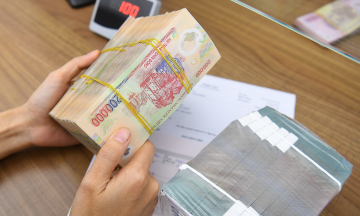
Bank employees conducting transactions at the bank. *Photo: Giang Huy* |
VIB's Chairman believes that the workforce in the banking sector needs strong expertise and high proactivity, enabling each individual to make decisions and generate results independently.
In this context, banks are simultaneously boosting workforce training. In 2025, VIB recorded more than 461,000 training hours, averaging 44,7 hours per employee, along with more than 12,900 digital competency certificates issued. The bank also trained more than 800 leaders and experts under a "general navigation map" thinking framework, aiming to create a common language for strategy implementation.
Bank leaders also emphasize that AI cannot completely replace humans. TPBank's Chairman Do Minh Phu argues that the use of AI requires strict control.
"If AI is overused without verification, employee competence will be questioned. TPBank encourages AI as a reference tool, but not a complete replacement for humans," he said.
According to bankers, AI can help reduce processing time from hours to seconds, but it can also accelerate the spread of errors if not properly controlled. Therefore, the demand for human professional expertise and verification capabilities is increasing.
Quynh Trang