Data from Customs reveals that fruit and vegetable exports in Quarter I reached approximately 1,3 billion USD, increasing by over 27% year-on-year. Durian remained a highlight, with growth of nearly 128%, while coconut and grapefruit saw increases of about 26% and nearly 29% respectively.
Despite this overall growth, the increase was not evenly distributed across all commodities, with many fruit varieties experiencing declines. Banana exports fell by nearly 20%, mango by over 15%, and watermelon by about 12%. Jackfruit and lime also saw decreases of 7% and over 9% respectively, driving domestic prices down. These fruits are largely reliant on traditional markets, making them vulnerable to weakened demand or changes in import regulations.
This disparity among commodity groups quickly manifested in the domestic market. When exports slow or consumption becomes unstable, goods accumulate locally, creating oversupply and driving prices down significantly.
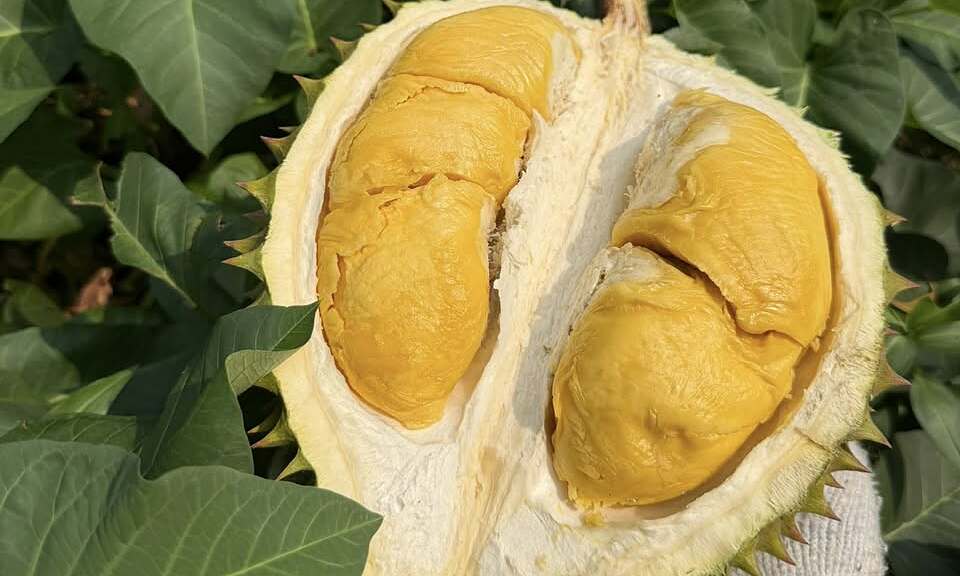 |
Ri6 durian at a garden in Can Tho. *Photo: Manh Khuong*. |
Many agricultural products are indeed seeing very low prices. Watermelon, at times, was priced at only 1,000-5,000 VND per kg in some growing regions, while satsuma oranges dropped to 1,000-3,000 VND per kg at the farm. Export jackfruit prices also stood at only 5,000-8,000 VND per kg. Even Hoa Loc sand mango, typically a high-value item, is now selling for 9,000-15,000 VND per kg, a significant decrease compared to before Tet.
Notably, this downward price trend is not confined to fruits facing consumption challenges; it has also impacted leading export items. Recently, Ri6 durian prices in many growing regions have dropped to approximately 20,000-35,000 VND per kg, the lowest in many years and a sharp decline from early in the year. This indicates that even robustly growing commodities are experiencing pressure as supply rapidly increases, while demand from import markets weakens and buyers become more cautious.
According to Dang Phuc Nguyen, General Secretary of the Vietnam Fruit and Vegetable Association, agricultural product prices have plummeted due to multiple converging factors. Primarily, the Chinese market, which absorbs most Vietnamese fruits, is tightening its quarantine and quality standards. For durian, the peak season for Thai produce intensifies competition for Vietnamese exports.
Additionally, the market is in a transitional phase ahead of the full implementation of new traceability and growing area code requirements under the Protocol and Order 280, effective 1/6. Consequently, purchasing agents are exercising caution, acquiring limited quantities to minimize the risk of goods being rejected at border gates.
Furthermore, escalating logistics costs, driven by the Middle East conflict and rising fuel and shipping fees, have slowed fruit exports to the EU and US compared to last year. Many businesses have even temporarily halted operations, awaiting stabilization of transport activities through these regions to mitigate risks of lost or damaged goods.
Thi Ha