


The South Korean Presidential Office (Blue House) has affirmed the nation's adherence to the trade agreement reached with the US in July 2025. Kang Yu-jung, the spokesperson for the Presidential Office, stated, "The South Korean government will convey its commitment to implementing the agreement to the US side."
This move follows former US President Donald Trump's announcement that he would raise import tariffs to 25% on South Korean automotive, timber, and pharmaceutical products, though he did not specify an implementation date. On Truth Social on 26/1, he accused South Korea of "not keeping" the trade agreement.
National Security Advisor Wi Sung-lac and Presidential Policy Chief of Staff Kim Yong-beom co-chaired an inter-agency meeting to discuss response measures following Trump's remarks.
The Blue House indicated that the South Korean Minister of Industry would visit the US to meet with Commerce Secretary Howard Lutnick. A high-level trade envoy is also expected to travel to Washington soon to meet US Trade Representative Jamieson Greer.
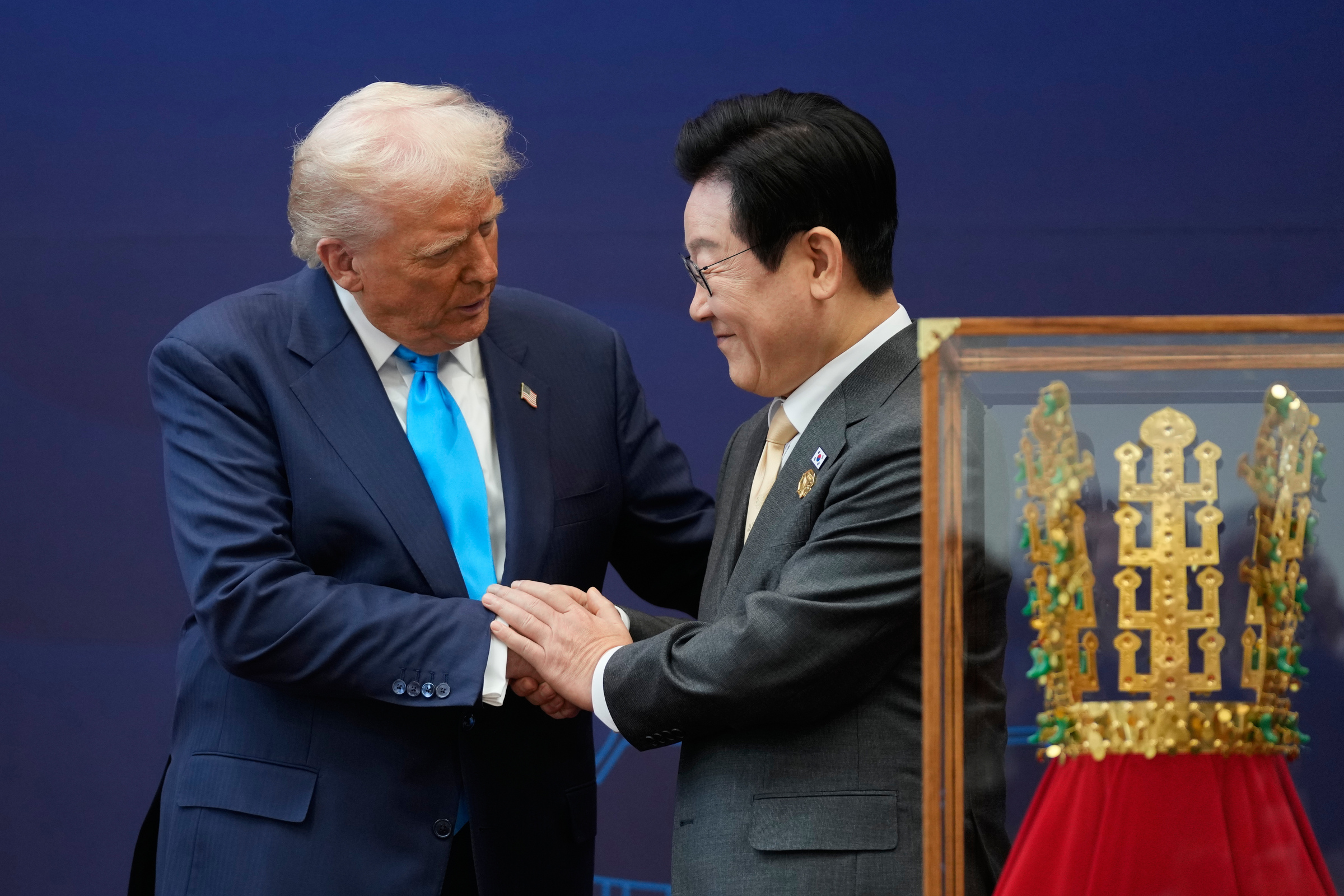 |
Former US President Donald Trump shakes hands with South Korean President Lee Jae Myung at the Gyeongju National Museum in Gyeongju, South Korea, on 29/10/2025. Photo: AP
Last year, the US and South Korea reached a trade agreement. Under this deal, Washington reduced tariffs from 25% to 15% on imported South Korean automotive and automotive components, matching the rate for Japan. South Korea, in turn, pledged to invest 350 billion USD in the US.
Seoul's investment includes 200 billion USD in cash, disbursed in phases, with an annual cap of 20 billion USD to maintain the stability of the won currency. However, early this month, the South Korean Finance Minister announced that the investment plan could not commence in the first half of 2026 due to the weakening won.
The ruling Democratic Party in South Korea reported that five bills aimed at implementing the US investment are awaiting committee review. With opposition support, the National Assembly could expedite the approval process, though a voting date has not yet been announced.
Last year, South Korea's exports reached a record 709,4 billion USD, marking a 3,8% increase compared to 2024. However, exports to the US declined by 3,8%, totaling 122,9 billion USD. Automotive products contributed over 30 billion USD, accounting for 25% of the total export value, but experienced a 13,2% decrease.
Choi Seok-young, a former chief trade negotiator for South Korea, characterized Trump's threat as a "political move." He believes the US aims to apply maximum pressure to compel Seoul to make concessions in ongoing negotiations regarding non-tariff barriers.
The KOSPI index in South Korea initially fell in the morning before reversing course and gaining 2,73% by the close of trading today.
Phi An (Reuters, Yonhap)


