Early this week, US President Donald Trump announced his intention to protect citizens' wallets by compelling technology corporations to commit to "self-sufficiency" in electricity for their data centers. The White House also confirmed that a meeting with executives from Amazon, Google, Meta, Microsoft, xAI, Oracle, and OpenAI on this matter will take place next week.
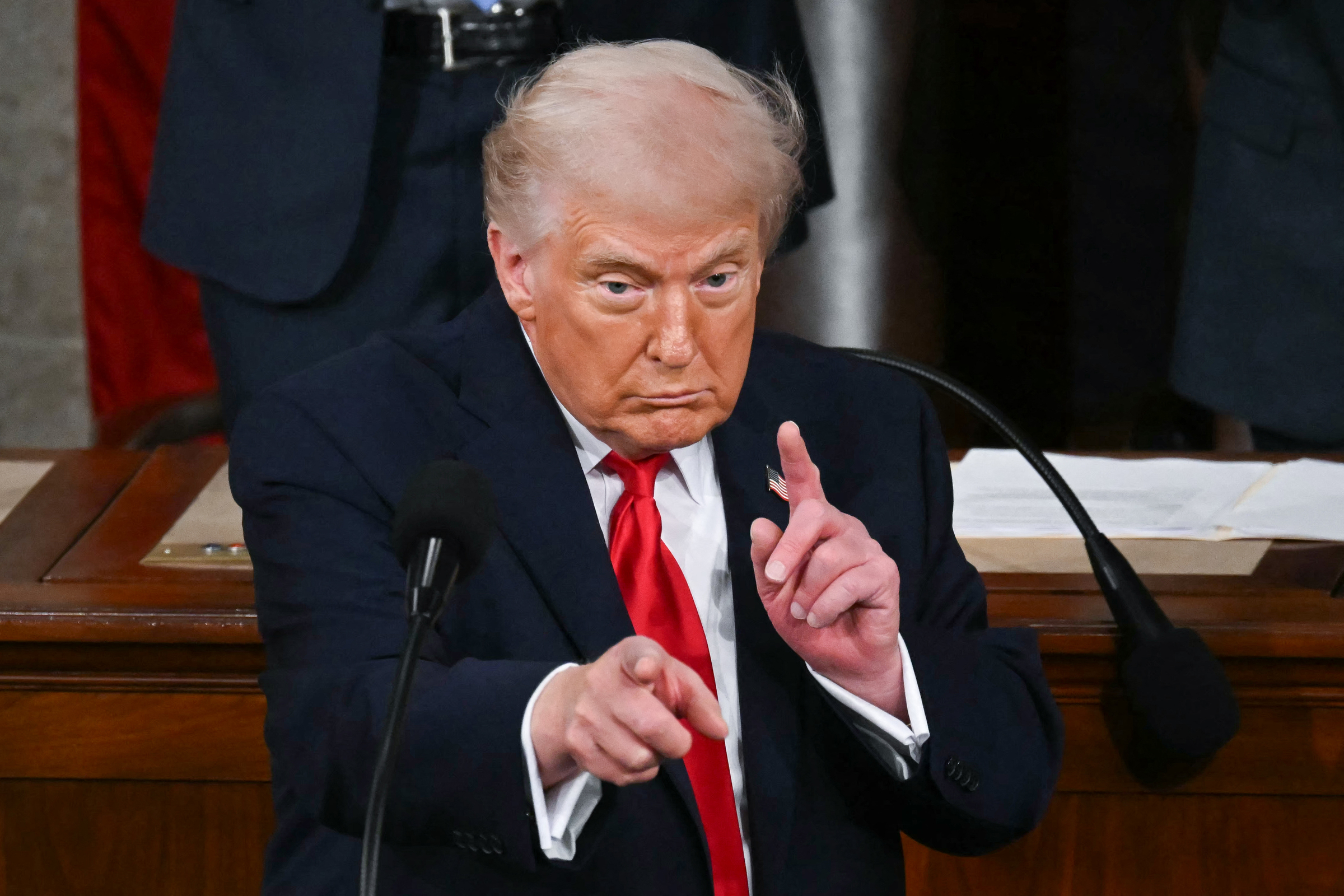 |
Donald Trump delivers the State of the Union address on 24/2. Photo: AFP
However, analysts suggest that Americans will still bear heavy electricity costs in Silicon Valley's artificial intelligence (AI) dream. This is because a commitment to self-sufficiency in power only partially addresses the market issue, given the immense electricity demand and the fact that power generation equipment cannot be acquired as quickly and conveniently as "Taylor Swift concert tickets".
According to the Electric Power Research Institute (EPRI), electricity demand from data centers currently accounts for 4-5% of the total US power supply. This figure is projected to rise to 17% within the next four years. In Virginia, the state with the highest concentration of data centers, their electricity demand alone is expected to increase to 57%.
Data company Cleanview calculates that nearly 680 data centers are planned for construction across the US, requiring energy equivalent to 186 large nuclear power plants. These massive concrete structures, filled with power-hungry servers, are fueling AI models, which Silicon Valley hails as the foundation of the next industrial revolution. Some AI centers need as much electricity as millions of households combined.
This demand strains the electricity supply chain, impacting transmission lines, fuel, gas turbines, critical minerals, clean land, and other essential grid components. A data center requires both emission-free renewable power sources (wind, solar) and baseload power, typically natural gas, to ensure stability. The waiting list for gas turbines extends up to 5 years, driving up prices.
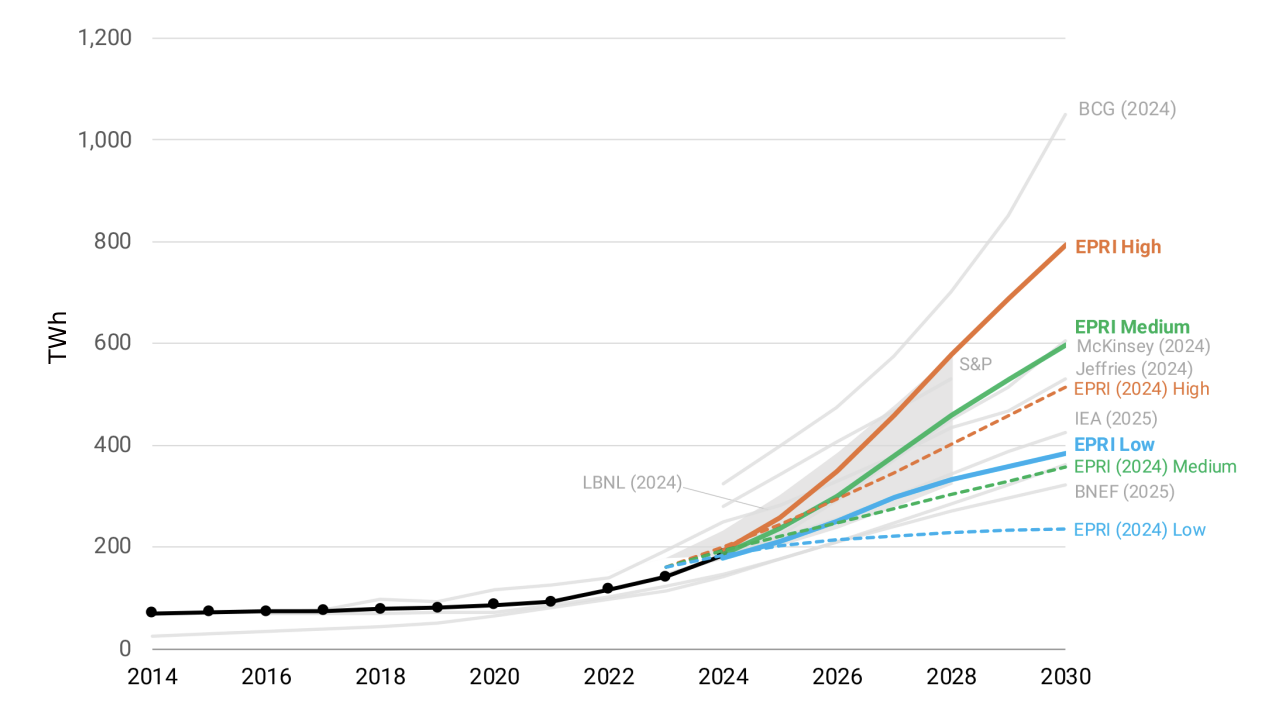 |
US data center electricity demand scenarios. Source: EPRI
Abe Silverman, an energy researcher at Johns Hopkins University, stated that power plants cannot be built quickly enough to meet the surging electricity demand. He explained that gas turbines, currently in a long queue, are not like Taylor Swift concert tickets that can be sold to anyone at any time. This situation is expected to lead to a price war.
In reality, according to the Environmental and Energy Study Institute (EESI), building a new natural gas power plant takes 4,5-6 years, with turbine waiting times potentially reaching 7 years, due to many companies simultaneously pursuing new construction. This means that natural gas power plants planned today are unlikely to become operational before 2030.
This delay creates a domino effect on prices across the entire supply chain and labor market. Analysts predict the cost of building a new combined-cycle natural gas power plant will triple from the 1.100 USD per kilowatt capacity mark in 2022.
Moreover, the cost of electricity generation constitutes only a small portion of the overall electricity price structure. For over a century, the industry has operated on the principle of sharing the costs of building transmission lines and generating power.
Brandon Owens, a grid expert and founder of the energy consulting firm AixEnergy, noted that most current cost pressures stem from transmission and distribution, not from power generation itself. "Those costs persist even if a data center is self-sufficient in power", Owens said.
Electricity bills also include maintenance and repair costs for unpredictable conditions, such as hurricane aftermath, or upgrades to enhance grid resilience against extreme weather. These are also primary reasons for higher electricity bills in states in unfavorable weather regions like California.
High-voltage transmission projects, including PJM's nearly 12 billion USD project, will also be allocated to consumer electricity bills, even though data centers are the primary beneficiaries.
Meanwhile, electricity prices are regulated by state-level authorities based on local policies and utility company proposals, not by the White House or major technology firms. Ari Peskoe, Director of the Electricity Law Initiative at Harvard Law School, commented that the Trump administration is misdirecting its electricity cost commitments.
Another potential financial risk arises if Silicon Valley's "AI dream" does not meet expectations. Catherine Casomar, co-founder of the Better Data Center Project, cited an example of a business spending 3 billion USD to upgrade the grid to serve a planned data center. "If this center is not completed, or does not consume as much electricity as anticipated, who bears the consequences?" she questioned.
By the end of 2025, electricity prices in the US are projected to surge to 19 cents per kilowatt-hour, a 27% increase compared to 2019. In states with high data center density, such as Virginia, electricity prices have risen by 267% over the past 5 years. Market analysis firm ICF anticipates electricity prices will increase by an additional 40% by 2030 from current levels.