Limiting the global temperature increase to 1,5 degrees Celsius above pre-industrial levels is a goal agreed upon by 195 countries in the 2015 Paris Agreement. This benchmark was proposed by a group of small island nations. Tony de Brum, the late Foreign Minister of the Marshall Islands, once explained that this increase was a milestone ensuring their "survival" and preventing their nation from sinking beneath the sea.
A recent report by the United Nations Environment Programme (UNEP) forecasts that Earth's temperature will exceed this safe threshold between 2026-2030, driven by emissions from coal, oil, and natural gas.
As Tony de Brum feared a decade ago, a major risk of this situation is rising sea levels, threatening to submerge over 20 small island nations and coastal areas. Tuvalu is projected to be underwater within the next 24 years. Last year, it became the first country to implement a "climate migration" program, relocating hundreds of people to Australia annually to ensure their continued survival.
According to UNEP, extreme climate phenomena will create cascading risks, directly threatening human life and the planet's stability.
Agriculture is a sector that will be significantly impacted as Earth warms. Cultivation, animal husbandry, and aquaculture activities all face risks of declining productivity, leading to famine and threatening the livelihoods of billions of people.
For crops, even an additional 0,5 degrees Celsius increase can lead to reduced yields, driving up food prices. Global food production could fall by 14% by 2050 if effective adaptation measures are not implemented.
As Earth's temperature rises, many national economies risk suffering dual damage due to reduced labor productivity, according to the "Limiting overshoot" report published by UNEP on 2/9. In Ghana, for example, heat and related illnesses are projected to reduce agricultural labor productivity by about 8,5%, and manufacturing by 2,6% by 2050.
In Argentina, annual property damage from floods is expected to reach USD 1,4 billion. The country will face a 125% increase in losses if flood frequency doubles.
For Middle Eastern countries, such as Iraq, modeling results show increasing drought. A 20% reduction in water supply would lead to a loss of approximately 3,9% of its GDP.
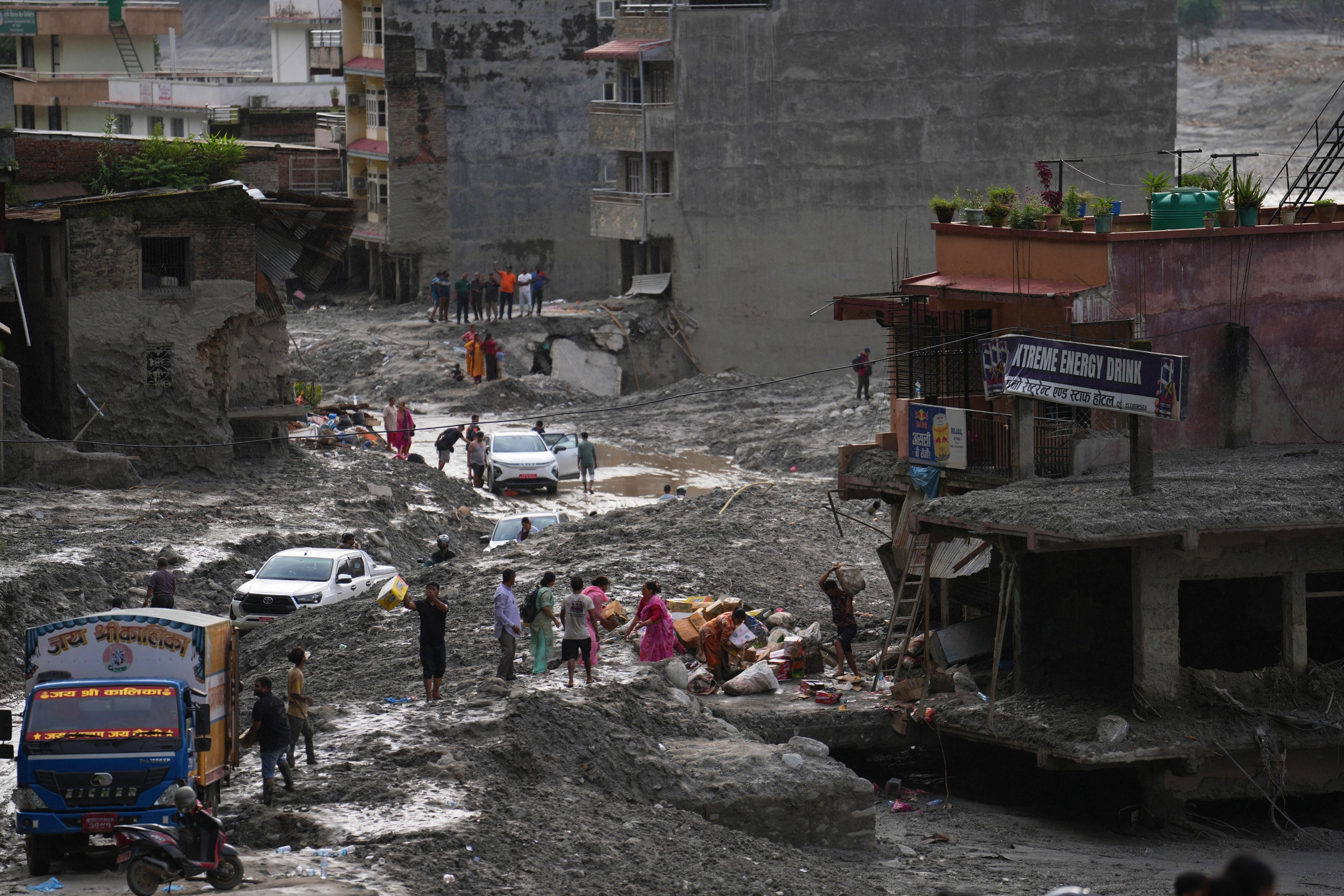 |
People collect belongings from a building damaged by flash floods in Nuwakot district, Nepal, 1/9. Photo: AP |
Extreme heat poses a major threat to human life. According to UNEP, extreme heatwaves that once occurred once every hundred years are now appearing every decade, progressing towards becoming a new normal when temperatures rise by 1,5-2 degrees Celsius.
The "urban heat island" phenomenon will make city dwellers feel several degrees hotter. This increased temperature also contributes to the spread of pathogens from vectors (such as mosquitoes), increasing cases of illness and death.
According to the World Health Organization (WHO), climate change will cause 250.000 deaths each year from malnutrition, malaria, diarrhea, and heatstroke alone. Health damage costs are estimated at USD 2-4 billion annually, with significant impacts in high-temperature regions like Central America and Southeast Asia.
Global warming also increases disasters such as storms, floods, and landslides. A 1,5 degrees Celsius increase can also trigger "tipping points"—thresholds where small changes lead to a cascade of major, continuous, and potentially irreversible consequences.
One climate tipping point is the Greenland ice sheet. The world's second-largest ice sheet will melt irreversibly at a 1,5 degrees Celsius temperature increase. If it melts completely, it could cause sea levels to rise by 7,2 m. In the past two decades alone, Greenland has lost 5.100 billion tons of ice.
Another tipping point is the Amazon—the planet's largest tropical rainforest. In the past 10 years, this forest has experienced three "extremely severe" droughts, which previously occurred once every hundred years. The forest is rapidly losing its ability to recover from damage caused by droughts, fires, and deforestation.
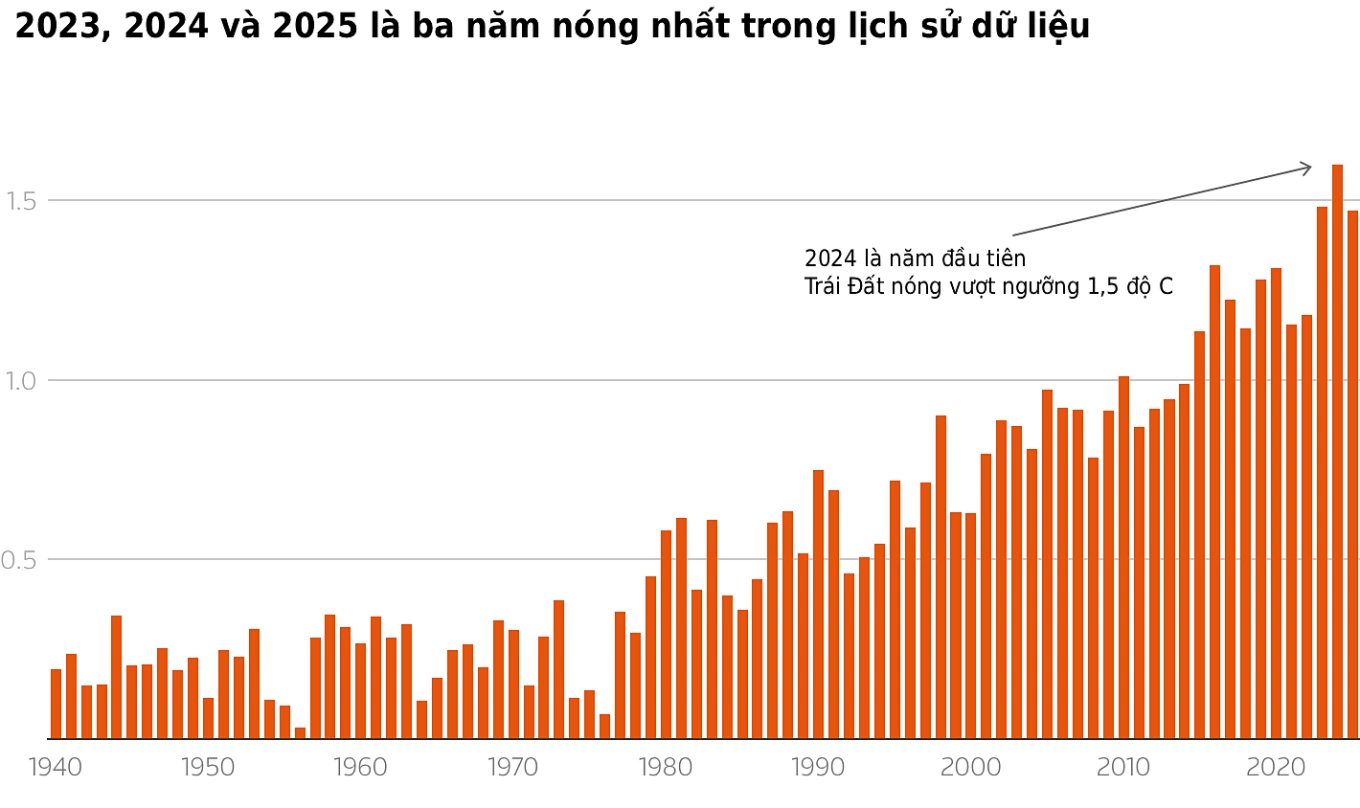 |
Average annual temperature increase compared to pre-industrial levels. Source: ECMWF |
Given this reality, the United Nations hopes to achieve the most optimistic scenario. In this scenario, global temperatures will overshoot the threshold but peak at 1,8 degrees Celsius, then gradually decrease to below 1,5 degrees Celsius by the end of this century.
However, the report also notes that even if humanity achieves negative emissions and lowers global temperatures to below 1,5 degrees Celsius by 2100, it is not certain that the world and its climate will return to their previous normal state.
Bao Bao (according to Earth, UNEP)