When Lynn Lee received a job offer from a career center in South Carolina last month, she could barely believe it. At 66, she had submitted hundreds of job applications over the past 16 months, ever since she was laid off from a soybean processing plant last year.
Lee was accustomed to being ignored or quickly rejected by employers. Like many others, she had nearly given up. However, the pain of rejection gradually gave way to a constant fear that she would struggle financially for the rest of her life.
US government data shows that over the past year, more than 25% of unemployed individuals have been unable to find work for at least six months. This process is particularly challenging for older adults. According to the Employee Benefit Research Institute, older workers find it difficult to secure new employment in a tight labor market unless they possess highly specialized skills.
Recruitment in the US is slowing. Last month alone, the economy lost 23,000 jobs. However, the unemployment rate remains low, partly because many people have abandoned their job search.
Last year, after being laid off from the soybean processing plant, Lee knew that at her age, she would face some difficulty finding work. Yet, she had always found a way to overcome challenges in the past, even when the textile industry declined in the early 2000s, leading to her dismissal from Springs Industries after 29 years of service.
This time, however, dozens of applications and interviews yielded no results. She applied to a local gold mine that was expanding production, a temporary staffing company that was hiring, and numerous positions at local agencies. But no one wanted to hire her.
Lee's unemployment benefits of USD 270 per week ran out in the winter. Under South Carolina law, workers can only receive unemployment benefits for a maximum of 20 weeks. After that, she had to rely on a monthly benefit of USD 830 from her husband, who passed away from a heart attack in 2020.
The two jobs Lee found in recent months each lasted only a few days. She experienced health issues, and the companies also informed her that she was not a good fit. "I was ready to give up the job search. All of it made me feel very insecure", she said.
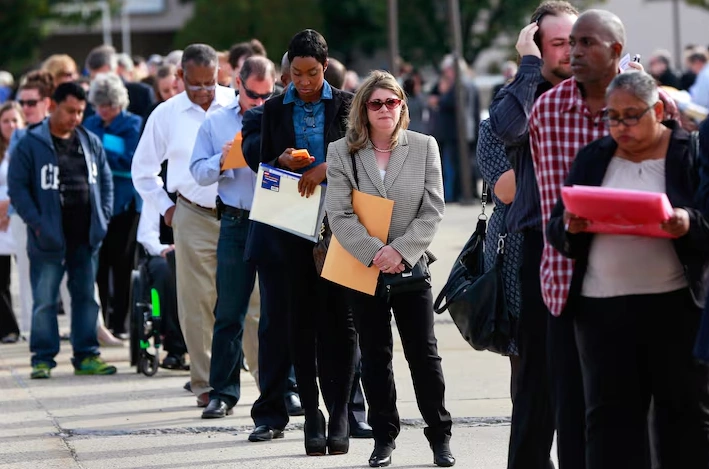 |
Job seekers at a job fair in Uniondale, New York in 10/2014. Photo: Reuters |
But finally, a turning point arrived. This month, Lee began a new job as a financial specialist at South Carolina's disability employment support agency. Her new salary is even slightly higher than the USD 17.4 per hour she earned at the soybean plant, where she was responsible for processing invoices and tracking shipments. This income is also comparable to the wages she earned at the textile factories where she previously worked.
"I'm very happy, but also very nervous. I haven't worked for 16 months", Lee said about her new job. Still, she felt encouraged by her new managers, who seemed enthusiastic about hiring her. The night before her first day, she couldn't even sleep, fearing she wouldn't hear her alarm clock.
Lee's first two weeks were tiring and stressful as she had to familiarize herself with the different data systems used by the state. Lee was also hesitant to bother others by asking too many questions. She worried if she could truly do the job at her age. Nevertheless, her trainer was "very patient".
Occasionally, between training sessions, Lee was given urgent tasks like folding and stacking cardboard boxes. Her supervisors also joined in. "That reminded me of the old days, working in the packaging department at the textile company. I really liked it. They even played great music", she said.
After a few days, Lee started to adapt. She was satisfied when she independently processed a series of checks while her instructor was out of the office. "Maybe I'll work until I'm 70. I have to keep moving forward", Lee said.
Most of Lee's new colleagues are much younger than her. However, she noticed a few who seemed to be of her generation. "To the younger people, I would advise them to save money, don't end up in a situation like mine. And if you're my age, don't give up", Lee concluded.
Ha Thu (according to WSJ, Reuters)