Speaking at a seminar on business household survey results on 23/4, Pham Ngoc Thach, deputy head of the Legal Department at the Vietnam Chamber of Commerce and Industry (VCCI), highlighted a 'defensive mindset' among business households, driven by market pressures and legal challenges.
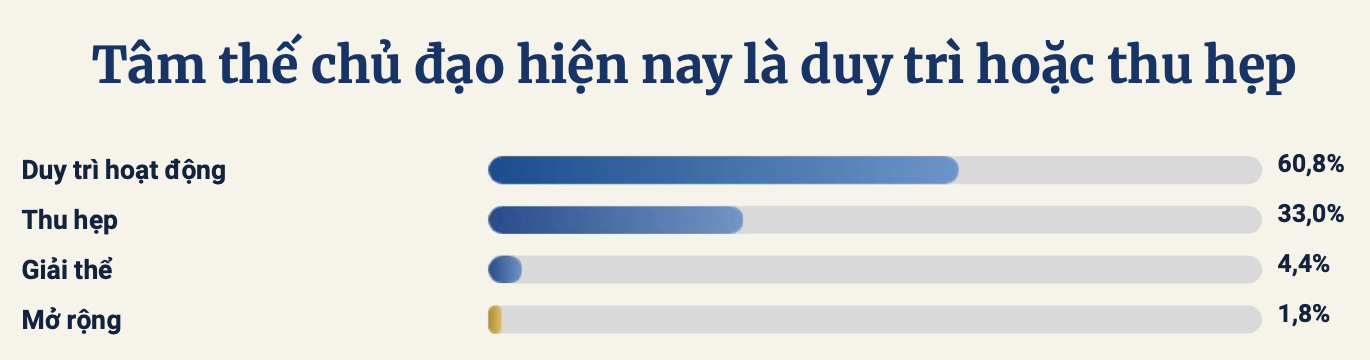
VCCI's survey of over 1,000 business households over the past three months revealed that only 1.8% intend to expand operations. In contrast, over 60% plan to maintain their current scale, while 33% anticipate shrinking. A notable number of households even project dissolving their businesses within the next two years.
 |
This pessimistic outlook stems partly from weak business performance last year. Over 81% of households reported declining revenue, leaving three-quarters operating on razor-thin profit margins. Dau Anh Tuan, deputy secretary general of VCCI, commented, "This level is sufficient for survival, but makes it difficult to accumulate capital or withstand any subsequent shocks."
For business households, legal challenges emerged as the most significant pressure point (73%), outweighing concerns about input material costs (59%) amid domestic volatility and the Middle East conflict.
Regarding tax obligations, over 36% of households were either unaware of electronic invoices or had only "heard of" them. One-third lacked the necessary equipment and internet infrastructure. Many also reported being unable to resolve technical issues during the implementation of electronic invoices.
 |
Business households trading at Dong Xuan Market, 2025. Photo: Hoang Giang
The VCCI survey also found that over 80% of households "avoid" converting to a corporate model, fearing complex procedures, high social insurance costs, and increased inspections. Pham Ngoc Thach noted that, based on revenue, business households generating between 500 million and 3 billion dong showed a strong reluctance to transition into enterprises.
Only 16% of households expressed an intention to convert into a business within the next two years. Motivations for such a transition include genuine development needs, such as acquiring legal entity status for contracts, expanding operations, or securing bank loans. However, VCCI argues that conversion barriers significantly outweigh these motivations, with over 90% of households expressing concern over more complex tax and accounting procedures.
Tuan noted that this significantly diminishes business households' intent to invest and expand. He stated, "The institutional environment may inadvertently compel business households to maintain a small, defensive scale, thereby avoiding growth."
The deputy secretary general of VCCI suggested that regulations concerning taxes, accounting, and electronic invoices must be simplified to align with the practical capabilities of business households. This simplification is particularly crucial for micro-households, elderly owners, and those in rural areas.
The Ministry of Finance currently proposes raising the taxable revenue threshold to 1 billion dong. However, Le Thi Duyen Hai, vice president and secretary general of the Vietnam Tax Consultants' Association, believes this is not the fundamental solution. According to Hai, business households are not averse to paying taxes; rather, they require simple, transparent compliance solutions, particularly concerning penalty thresholds. They need support to establish standard business practices and good governance, enabling them to "grow larger."
"They fear the fragile line of penalties; even a single dong over the limit can result in a violation," she said.
Pham Ngoc Thach concurred, stating that effective policy extends beyond stricter management. It must also empower business households with the confidence to survive, recover, and grow.
Thuy Truong