On the afternoon of 5/8, the National Assembly discussed in groups the draft law amending and supplementing certain articles of three laws: the State Bank of Viet Nam Law, the Anti-Money Laundering Law, and the Law on Credit Institutions.
In the Ho Chi Minh City group, Vietcombank chairman Nguyen Thanh Tung stated that Viet Nam is currently on the Financial Action Task Force's (FATF) enhanced monitoring list, also known as the grey list. Therefore, requiring the reporting of crypto asset services under anti-money laundering regulations is essential.
However, Mr. Tung also noted that managing this sector poses many challenges for credit institutions. He explained that crypto assets are cross-border and have fast transaction speeds, making it impossible to use existing bank cash flow control tools to manage this new asset class.
"Traditional methods cannot be used for management," he said, adding that banks are heavily investing in technology, and artificial intelligence must be employed to support this new sector. Future compliance costs will be "expensive" to implement adjustments under the anti-money laundering law, but the delegate considered them necessary.
 |
Vietcombank chairman Nguyen Thanh Tung at a National Assembly group discussion. Photo: Anh Tu |
Mr. Tung urged other functional agencies and international organizations to collaborate and share information to ensure risk control for crypto assets. The Vietcombank chairman believes that effective implementation of these controls could help Viet Nam exit the grey list, support market upgrade, and attract more investment capital.
Do Duc Hong Ha, Vice Chairman of the National Assembly's Law and Justice Committee, also assessed that Viet Nam's legal system has a significant legal vacuum regarding crypto assets. Mr. Ha stated that due to their high anonymity and lack of control by traditional monetary authorities, crypto assets are being fully exploited by criminals as tools for money laundering, tax evasion, and terrorist financing.
Therefore, he believes that the draft law's addition of crypto asset services to the reporting group and the establishment of a list of specific suspicious indicators are crucial solutions to promptly close this loophole.
In the draft law, besides adding crypto asset services to the scope of anti-money laundering efforts, authorities also proposed 15 suspicious indicators in the crypto asset sector that require monitoring to meet international anti-money laundering requirements as Viet Nam pilots this asset market.
The 15 indicators under Article 33A can be divided into four groups, including: unusual transactions; concealment of origin or technology; unclear customer identity; and high-risk partners or regions in the crypto asset sector.
Commenting on this list, Nguyen Van Quang, Chief Justice of the Supreme People's Court, argued that the draft provides overly detailed regulations. According to Mr. Quang, if practical issues arise, regulatory agencies will lack mechanisms for rapid resolution. Meanwhile, crypto assets and digital currencies evolve and transform quickly both in Viet Nam and globally.
The Chief Justice proposed that Article 33A be framed as a general guideline, delegating detailed regulations to the government. This approach could enable the government to proactively identify suspicious indicators in the crypto asset sector in line with evolving realities.
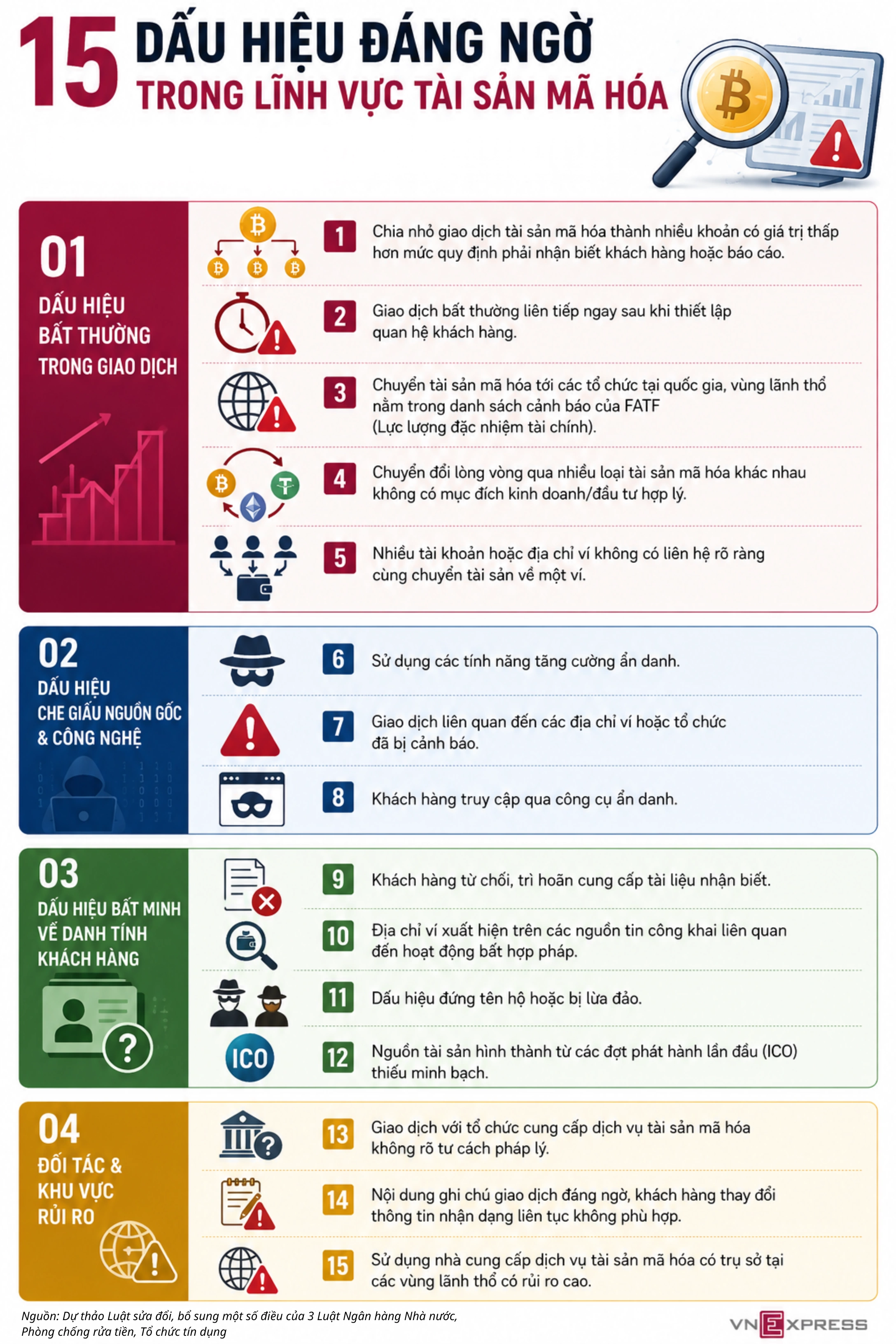 |
15 unusual signs in the crypto asset sector. Graphics supported by AI. |
Anh Tu