On the afternoon of 26/12, the Ministry of Agriculture and Environment launched Vietnam's agricultural product traceability system. This tool enables consumers to check product information and supports regulatory bodies in monitoring and tracing goods.
The implementation roadmap for this system will follow three phases. In the initial phase, the Ministry will pilot traceability with durian over the next six months.
From 1/7/2026, the system will become officially operational, expanding to essential agricultural product groups. Subsequently, from 1/7/2027, all agricultural products, both domestic and exported, will be traceable through this system, with a pilot phase for imported goods.
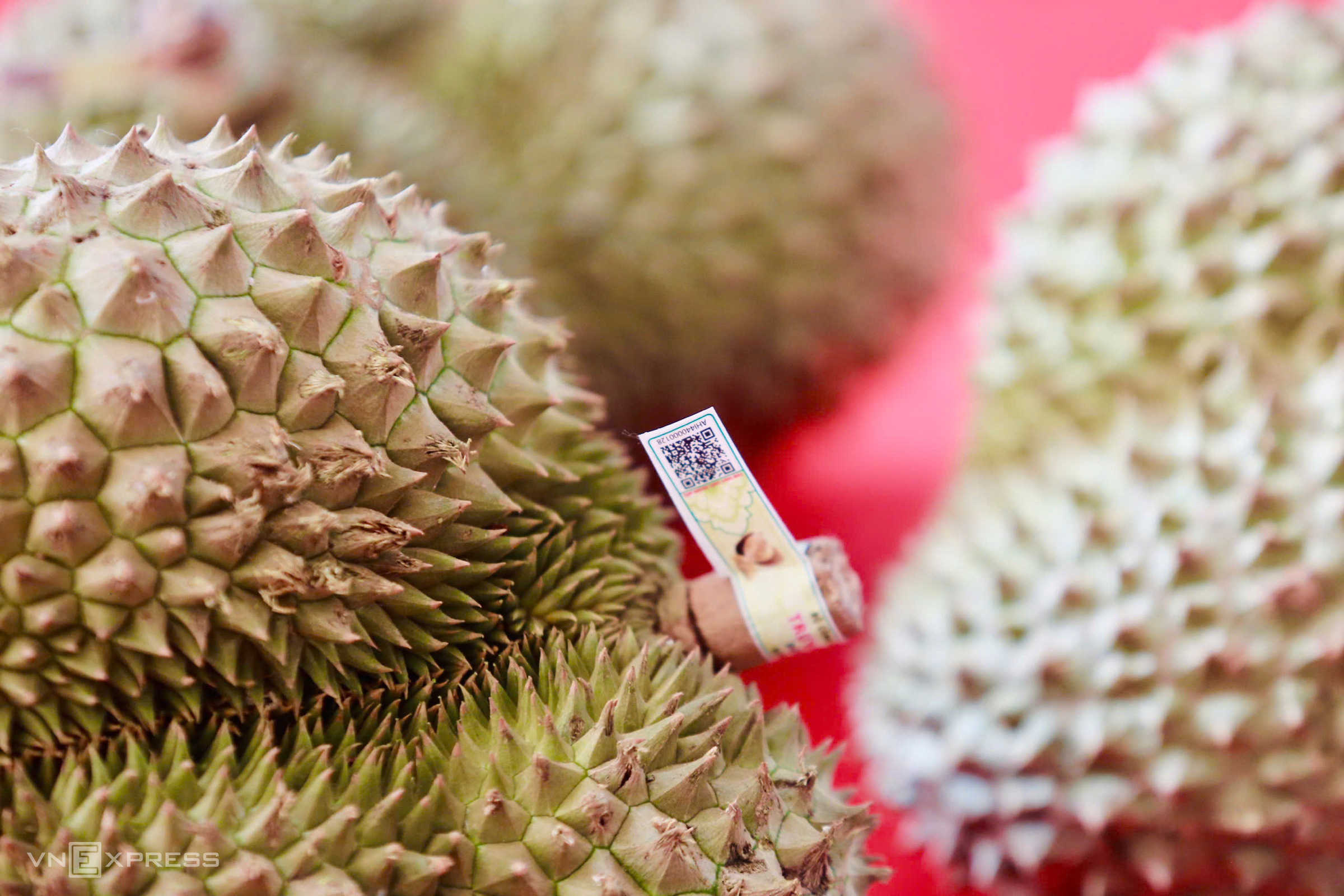 |
QR code for tracing goods on a durian fruit. Photo: Gia Chinh |
Currently, six export businesses are participating in a trial, affixing electronic authentication stamps (QR codes) to durian batches. When consumers scan the QR code on a fruit, they will be directed to the Ministry's data page. Here, the product's entire journey log, from cultivation area code and harvest date to storage facility and distribution unit, is displayed transparently.
Tran Duc Thang, Minister of Agriculture and Environment, stated that the traceability system is a technological solution to prevent commercial fraud, counterfeit goods, and substandard quality products. According to him, in a context of fierce competition, the value of agricultural products lies in quality, transparency, and traceability. He believes this system will help businesses, cooperatives, and growers access digital technology, increasing market connectivity and expanding exports.
According to the Vietnam Fruit and Vegetable Association (Vinafruit), Vietnam's fruit and vegetable export turnover this year reached nearly 8,6 billion USD, an increase of about 20% compared to 2024. The US remains the largest market for Vietnamese agricultural products, with 0,5 billion USD, up 56% from last year. Other markets such as South Korea, Japan, and the Netherlands maintained import turnover above 100 million USD. The main growth drivers come from key fruits: durian, bananas, mangoes, jackfruit, and coconuts.
The Ministry of Agriculture and Environment recognizes that the fruit and vegetable sector faces many new technical barriers, especially increasingly stringent requirements regarding cultivation area codes, traceability, residue control, and food safety from both domestic and import markets.
Gia Chinh