According to the latest report from the Ministry of Agriculture and Environment, Vietnam imported approximately 543,100 tons of cashew nuts in April, with a turnover of nearly USD 943 million. This marks the largest import volume ever recorded in a single month, more than two times the value of cashew exports during the same period.
Cumulatively, in the first 4 months of 2026, domestic enterprises spent nearly USD 2,2 billion to import 1,3 million tons of cashew nuts, representing a 23% increase in volume and a 32% increase in value compared to the same period last year. The average import price reached nearly USD 1,704 per ton, an increase of 7,6%.
Conversely, cashew exports show signs of slowing down. In April alone, Vietnam exported approximately 61,100 tons of cashew nuts, earning USD 433 million. For the first 4 months of the year, export turnover reached USD 1,3 billion, with a volume of about 186,600 tons.
Compared to the same period in 2025, cashew exports decreased by 4,6% in volume and 3% in value, despite the average export price increasing by nearly 2% to nearly USD 6,934 per ton.
According to the Vietnam Cashew Association (Vinacas), Vietnam currently accounts for approximately 80% of global cashew kernel exports. However, the domestic cashew industry is primarily strong in processing, while local raw material supply meets only a small fraction of production demand.
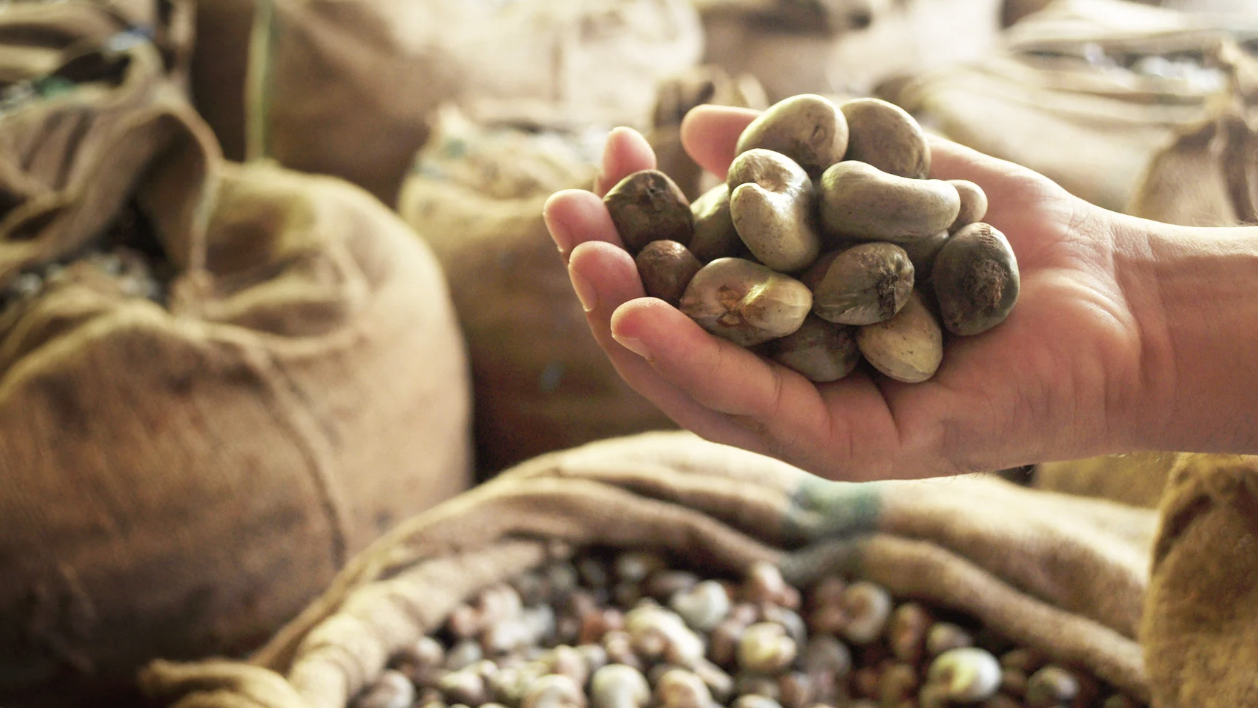 |
Raw cashews bagged in a warehouse. Photo: Vinacas |
A representative from a cashew import business in TP HCM stated that the volume of imported raw cashews has surged due to the peak season for raw material procurement from Cambodia and Africa. This year, supply from many countries is more abundant, while rising international prices have pushed import turnover to a record high.
"Vietnamese enterprises are serving as the world's cashew processing hub. The imported raw cashews will be shelled, roasted, processed, and then re-exported to the US, Europe, and the Middle East", the representative said.
For many years, the domestic cashew cultivation area has continuously shrunk as farmers shift to crops with higher economic value. Additionally, low yields and aging raw material regions mean that supply struggles to meet the processing industry's demand.
According to the Ministry of Agriculture and Environment, Cambodia remains the largest supplier of cashew nuts to Vietnam, accounting for 51,7% of total import turnover. Following are Tanzania with 19,9%, Cote d'Ivoire with 11,9%, and Nigeria with 1,9%.
Supply from many markets significantly increased in the first months of the year, particularly from Cote d'Ivoire and Nigeria, where import turnover rose 5,4 times and 4,2 times, respectively, compared to the same period last year. Cashew nuts are currently the country's largest agricultural import by turnover in the first 4 months of this year.
Thi Ha