According to the Vietnam Food Association (VFA), on 8/5, Vietnam's Jasmine rice was offered at 513-517 USD a ton, an increase of approximately 30 USD compared to last month. 5% broken fragrant rice ranged from 510-520 USD a ton, up 25-30 USD, equivalent to an increase of 5-7%.
Compared to the same period last year, the price of 5% broken rice is currently 100 USD a ton higher, an increase of approximately 25%. Prices for 100% broken rice and 25% broken rice also increased by about 15%. However, Jasmine rice remains lower than the same period last year.
Currently, Vietnam's rice offer prices are the highest among the top 5 largest rice exporting countries globally. According to enterprises, Vietnam's advantage lies not only in its selling price but also in its increasingly diverse product structure, particularly the growing proportion of fragrant and high-quality rice in exports.
In the Mekong Delta, domestic rice prices also began rising in early May. According to some enterprises, paddy prices have increased by 200-300 VND a kg compared to the end of April, while rice prices rose by 300-500 VND depending on the type.
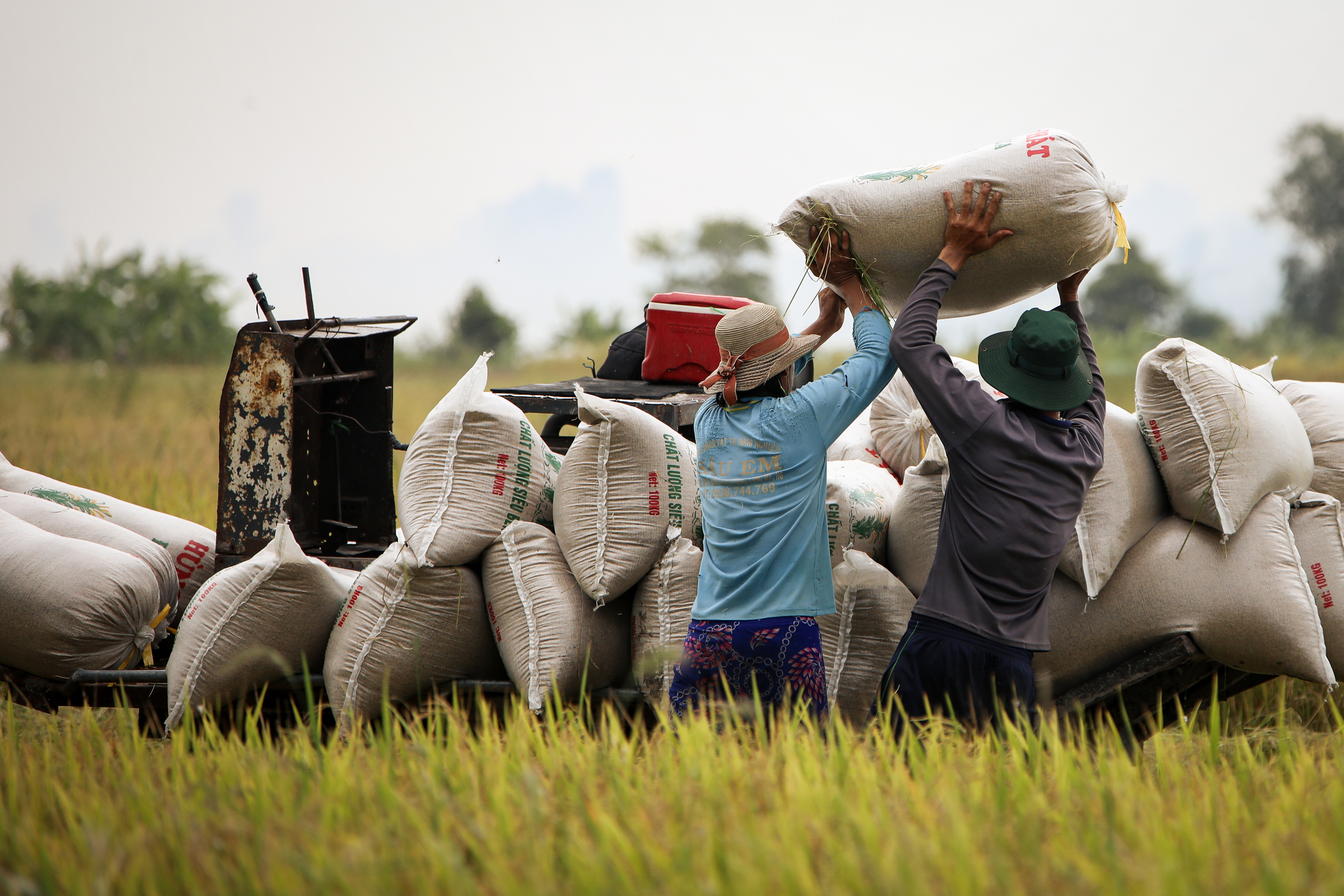 |
Farmers harvest rice in the Western region. Photo: Thuy Tien |
The An Giang Department of Agriculture and Environment reported that today's paddy prices are generally stable compared to the previous session. Fresh OM 18 and Dai Thom 8 paddy are purchased around 6,100-6,300 VND a kg, while IR 50404 ranges from 5,400-5,500 VND a kg.
The supply of fresh paddy in many localities is not as abundant as before. In An Giang, Can Tho, Dong Thap, or Vinh Long, paddy quantities are low and transactions are slow, while some warehouses have started inquiring about purchasing dried Dai Thom 8 and Japonica paddy.
The director of one rice exporting enterprise in Dong Thap stated that the current upward trend stems from several simultaneous factors. Besides increased purchases of Vietnamese rice by many countries, input costs are also escalating due to the impact of the Middle East conflict, which has significantly raised fertilizer prices. When production costs increase, export rice prices must adjust accordingly.
Data from the Food and Agriculture Organization of the United Nations (FAO) indicates that the global rice market faces new fluctuations. One of the major risks is the potential return of El Nino in 2026 with strong intensity, which could cause drought in many rice-producing regions in India, Southeast Asia, and Australia.
Concurrently, the Middle East conflict not only pushes oil prices higher but also directly impacts fertilizer prices and logistics costs. According to traders, tensions in Iran have not directly affected Vietnam's rice shipments to Africa, but transportation costs have risen considerably.
These factors lead many countries to worry about food supply risks, prompting them to increase rice imports for reserves while prices are still considered reasonable.
In April alone, Vietnam exported approximately 1.1 million tons of rice, generating 493 million USD. Cumulatively for the first four months of the year, exports reached 3.3 million tons, valued at nearly 1.6 billion USD. Specifically, export value to the Philippines increased by 6.7%, while the Chinese market saw a 44.4% increase compared to the same period last year.
While import demand increases, domestic supply tends to shrink. The Ministry of Agriculture and Environment reported that by the end of 3/2026, the country cultivated approximately 2.92 million hectares of Winter-Spring rice, a decrease of 1.3% compared to the same period last year.
The reduction in area is mainly due to many localities converting less efficient rice land to higher-value crops, aquaculture, or for infrastructure and industrial zone development.
Thi Ha