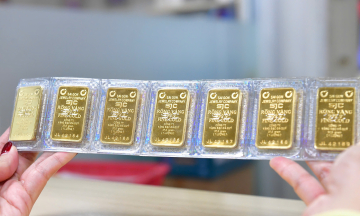
Yesterday, SJC gold bars and plain gold rings sharply declined to below 144 million dong per tael, dropping over 7 million dong in just 24 hours of trading. This sharp decline quickly narrowed the gap between domestic and international prices, from 12 million dong at the start of the day to 7-7,5 million dong per tael.
Speaking to VnExpress, Nguyen Quang Son, Director of Private Wealth Management (North Star) at FIDT Joint Stock Company, stated that current developments should be viewed within the global macroeconomic context rather than focusing solely on short-term fluctuations.
After a period when the market anticipated major central banks would soon enter a monetary easing cycle, the current environment has shifted towards a more cautious approach. Inflationary pressures in many economies remain uncontrolled, while geopolitical and energy risks continue to resurface. This, according to Son, forces investors to constantly adjust their expectations for interest rates, capital costs, and global economic growth prospects.
The FIDT expert noted that the downward pressure on gold prices recently stemmed from 4 main factors.
First, interest rates and bond yields remain high. When safe-haven assets like US Government bonds maintain attractive yields, capital tends to shift away from gold, which does not generate cash flow or periodic returns.
Second, the US dollar continues to maintain relative strength as expectations for prolonged high interest rates persist. A stronger greenback typically puts pressure on gold prices and reduces the short-term appeal of defensive assets.
Third, the demand for holding cash has increased. In an environment of high capital costs and signs of slowing economic growth in some regions, many businesses and investors tend to prioritize holding cash or highly liquid assets. This phenomenon often occurs during market correction phases.
Fourth, gold is undergoing a correction phase after a prolonged strong upward cycle. According to Son, current corrections are normal after a period of rapid growth driven by safe-haven demand amidst economic and geopolitical instability.
Beyond the influence of international market developments, domestic psychological factors are amplifying the decline in SJC gold and plain gold ring prices.
In contrast to periods of scarce supply when prices repeatedly hit new highs, major gold retailers now have more abundant supply due to selling pressure from a segment of investors.
Huynh Trung Khanh, Vice President of the Vietnam Gold Business Association (VGTA), suggested that increased selling might stem from concerns about new policy proposals related to mobilizing gold resources from the public, as well as expectations of increased supply in the future.
"Many investors choose to sell early to anticipate potential policy changes", Khanh said.
However, VnExpress also reported that in addition to the selling activities, retail demand reappeared late on 8/6 as prices fell sharply.
In Hanoi on the afternoon of 8/6, several gold shops on Tran Nhan Tong street, such as Bao Tin Minh Chau, Bao Tin Manh Hai, and Phu Quy, welcomed over a dozen customers, most of whom were buyers. Businesses sold gold without quantity limits and provided immediate delivery to customers.
In Ho Chi Minh City, Mi Hong store also recorded long queues of customers waiting to buy plain gold rings and SJC gold bars late in the day. This business sold plain gold rings without limits and a maximum of one tael of SJC gold bars per customer.
 |
Customers queuing to buy plain gold rings and SJC gold bars at Mi Hong Bui Huu Nghia store in Ho Chi Minh City on the evening of 8/6. *Photo: Quynh Trang*
Experts believe that despite gold prices adjusting over the past three months, the factors supporting the long-term trend remain unchanged.
According to Son, gold is currently influenced by two opposing forces. On one hand, high interest rates and capital costs make it difficult for the precious metal to break out in the short term. On the other hand, defensive demand against inflation, public debt, and geopolitical risks remains a significant supporting driver.
Therefore, a more probable scenario is that gold is in a correction or accumulation phase after a strong upward cycle, rather than entering a structural downtrend.
"A decline in gold prices does not mean it loses its defensive role. Long-term demand for gold persists amidst many unresolved macroeconomic risks", Son commented.
Shao Kai, Head of Asia Pacific (excluding China) and Global Central Banks at the World Gold Council (WGC), also noted that the current gold market attracts a large number of investors, including speculative capital. This speculative activity contributes to increased gold price volatility, leading to short-term corrections.
According to Shao Kai, the fundamental factors supporting gold prices remain robust and show no signs of diminishing soon. Key factors favoring the precious metal include geopolitical instability, the US Federal Reserve's trend towards interest rate cuts, and doubts about the agency's independence. Gold is also supported by investor defense against unpredictable risks and the disruption of the global order.
Quynh Trang - Tat Dat