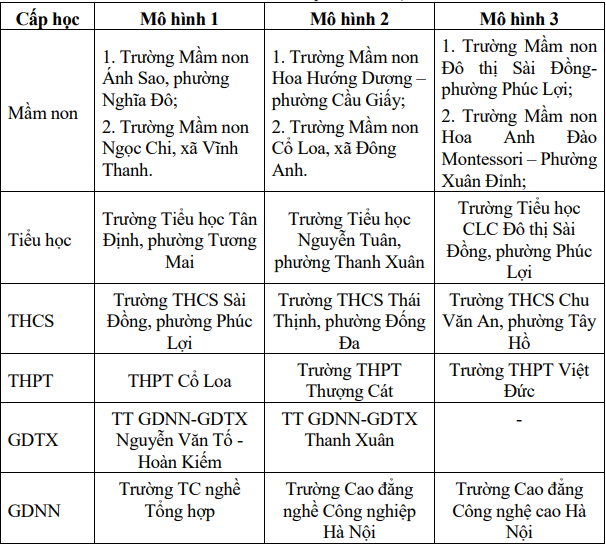
The Hanoi People's Committee announced on 6/7 a plan to implement English as a second language across 20 educational institutions. These schools, ranging from preschool to vocational and continuing education, are categorized into three models, corresponding to different stages of implementation: basic/initial, advanced, and leading/pioneering.
The pilot program is scheduled to begin in the 2026-2027 academic year.
 |
Teachers and students of Thai Thinh Secondary School during the closing ceremony of the 2025-2026 academic year. *Photo: School Fanpage* |
Level one is designated for schools new to the program or those with limited resources. Requirements at this stage include organizing introductory, communicative, and experiential activities in English; fostering daily English usage habits; and gradually incorporating digital learning materials and technology into teaching.
Level two is for schools that already possess sufficient conditions for regular implementation. This group aims to expand the English-speaking environment and increase experiential, exchange activities, or English-taught content.
Schools with favorable conditions and the ability to disseminate knowledge and provide professional support are classified under model three. This group features a high-level English-speaking environment; organizes subjects and activities in English; increases international activities; and plays a role in providing professional support and sharing experiences with other schools.
Hanoi aims for all schools to establish and maintain an English learning, communication, and usage environment appropriate to their actual conditions by 2030. The city strives for 90% of schools to reach level one, 35% to reach level two, and 10% to reach level three.
By 2035, the percentages of schools achieving the three levels are targeted at 100%, 50%, and 20% respectively.
The total estimated cost for the two phases from now until 2035 is approximately 4,500 billion VND, sourced from the state budget, related programs, projects, and socialized contributions.
 |
This initiative follows the government's project, "Making English a Second Language in Schools for the 2025-2035 Period, with a Vision to 2045," which was announced in october 2025.
The Ministry of Education and Training anticipates that by 2035, 100% of students will learn English as a second language. According to the ministry, for English to be widely used across all 50,000 schools with approximately 30 million students, the country requires an additional 12,000 preschool English teachers, 10,000 primary school teachers, and training for at least 200,000 teachers capable of teaching in English by 2030.
Thanh Hang