Tran Thi Cam Giang, a student at the University of Information Technology, Vietnam National University Ho Chi Minh City, was among the 20 recipients of the Vietnam Women in Science and Technology Award in late october 2025.
Originally from Quang Nam (now Da Nang), Giang impressed with three international scientific papers, including a work accepted at ICDAR 2025 – a leading global conference on document analysis and pattern recognition in China. Additionally, Giang achieved excellent academic standing for five consecutive semesters.
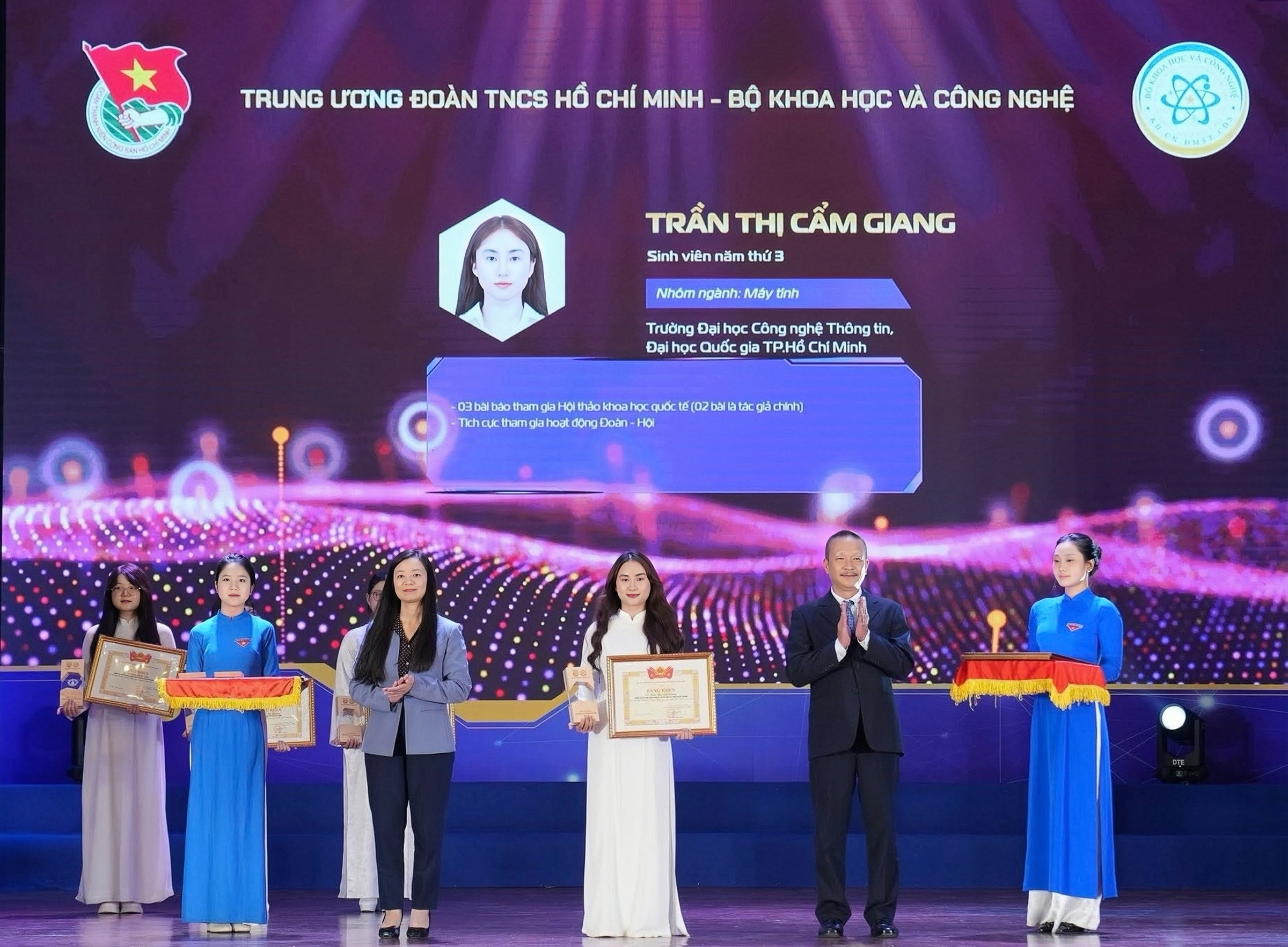 |
Tran Thi Cam Giang receiving the Women in Science and Technology Award, october 2025. Photo: Provided by interviewee
During high school, Giang specialized in computer science at Nguyen Binh Khiem High School for the Gifted. Her strong foundation in mathematics and programming helped her quickly identify her career path and persistently pursue computer science.
Giang's journey into the field of computer vision began with a question: How can computers "see" and "understand" images as vividly as humans? She chose to focus her research on scene text image – identifying and analyzing text within real-world images.
The project closest to the student's heart is her research on analyzing the layout of advertising signs. These familiar real-life signs captivated Giang due to their continuous variations in lighting, font styles, and creative layouts.
"That complexity sparked my interest," Giang explained.
She stated that a successful solution to this problem would improve computers' ability to process information in more realistic contexts, opening up applications such as visual assistance for the visually impaired, outdoor text recognition, and navigation systems for autonomous vehicles.
Giang and her research team spent months exploring and realized that while logical layout analysis had been thoroughly studied in document images, almost no one had tackled real-world street signs, where text follows no strict rules.
Her biggest challenge was clearly defining the problem and finding an effective implementation method. This stage was time-consuming as the entire team constantly reviewed literature, discussed, and experimented to determine an approach. Processing and labeling real-world data also presented difficulties. Thus, the moment she received notification that her paper was accepted at ICDAR 2025, Giang felt both emotional and proud.
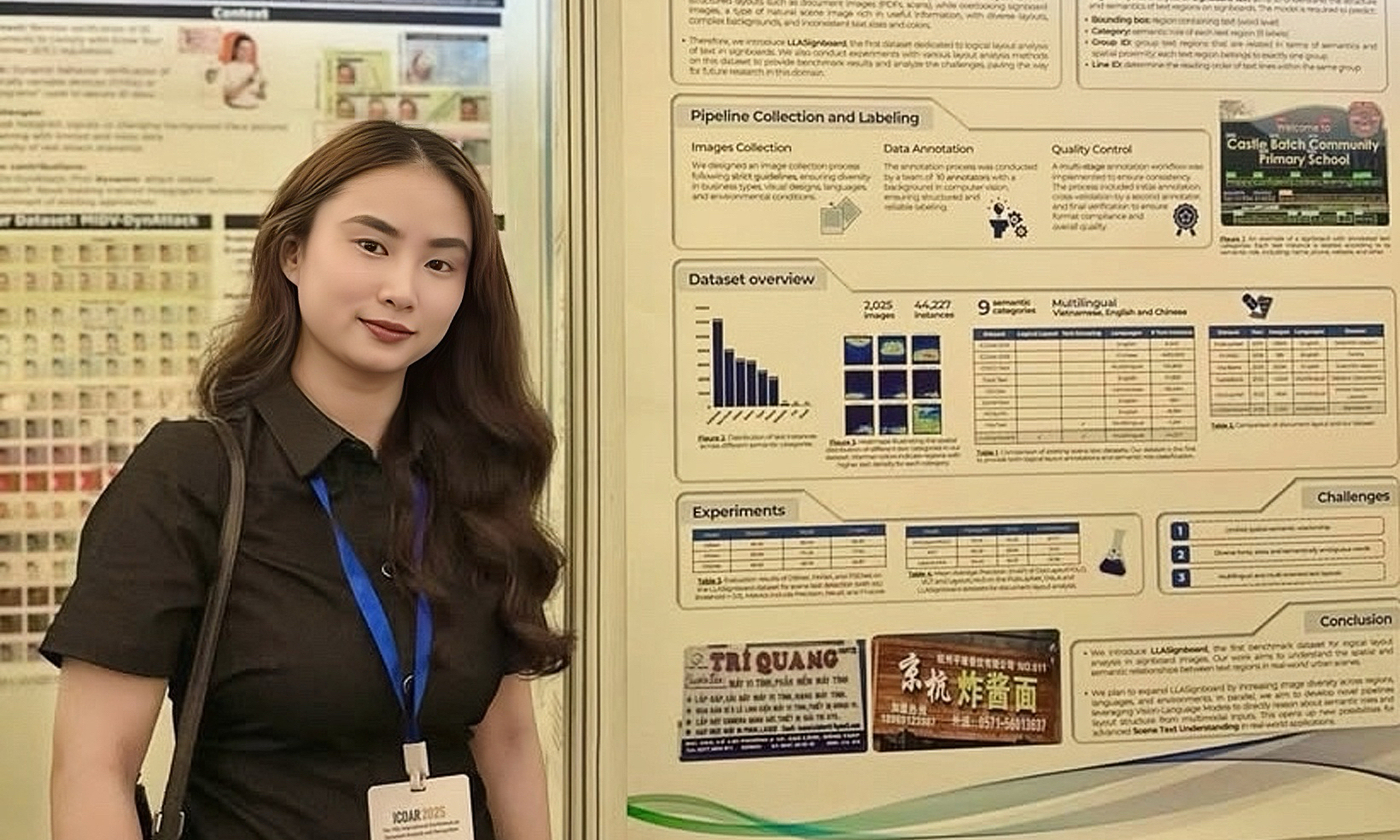 |
Cam Giang at the ICDAR 2025 conference in Wuhan, China. Photo: Provided by interviewee
Dr. Ngo Duc Thanh, Head of the Computer Science Department, noted Giang's logical thinking, strong self-study ability, and progressive spirit in her studies and research. He also praised her perseverance, sense of responsibility, and aspiration to excel.
Beyond academics and research, Cam Giang actively participates in youth union activities, sports movements, and various volunteer programs. The student believes these diverse experiences have not only strengthened her knowledge but also honed essential soft skills for balancing life and studies.
Giang believes that a proactive learning spirit and teamwork ability are key factors for her advancement. For her, the Women in Science and Technology Award is not just a new source of motivation but also a reminder of the value of daily, persistent effort.
Following this milestone, Giang plans to continue in-depth research, pursue graduate studies, and participate in major projects within the computer vision field. Further, Giang intends to commit to artificial intelligence and explore new avenues to help computers better understand the world, creating useful tools for daily life.
"Technology is not as 'distant' or difficult as many people think. The important thing is to maintain curiosity, passion, and a continuous learning spirit," Giang reflected. "Don't be afraid of failure or being slower than others, because every step is an opportunity to learn and grow."
Bui Lan Anh