Now 31, Baek is a researcher at the June E Huh Center for Mathematical Challenges, part of the Korea Institute for Advanced Study (KIAS). Last month, Baek's solution was honored by the US magazine Scientific American as one of the top 10 mathematical breakthroughs of 2025.
This famous problem is known as the "moving sofa problem". The question is: What is the largest possible area of a shape that can move around a right-angle corner in an L-shaped corridor 1 meter wide?
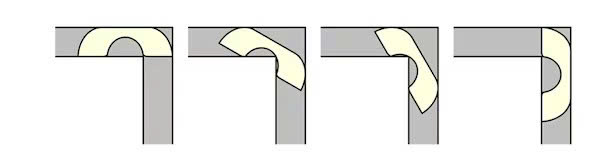 |
Illustration of the problem. Photo: KIAS. |
The problem was first posed by Austrian-Canadian mathematician Leo Moser in 1966. It quickly gained recognition among mathematicians because it could be understood without specialized knowledge, and it appeared in many US textbooks.
For decades, mathematicians sought the optimal shape, narrowing the solution's scope. In 1968, British mathematician John Hammersley found a shape with an area of approximately 2.2074 square meters. Nearly half a century later, in 1992, Professor Joseph Gerver at Rutgers University, US, discovered a complex curved shape with an area of approximately 2.2195 square meters. However, no one had proven it was the largest possible limit.
Using pure logical reasoning rather than relying on computer simulations, as previous studies had, Baek Jin-eon spent 7 years researching and proved Gerver's design to be the optimal solution. His 119-page work, published on the open-access archive arXiv in late 2024, establishes this as the problem's absolute limit.
He described his research process as continuously building and then breaking down his own ideas.
"I kept hoping, then dismantling it myself, and continuing by gathering ideas from the ashes", Baek shared. "I am a dreamer, and for me, mathematical research is a repetition of dreaming and waking".
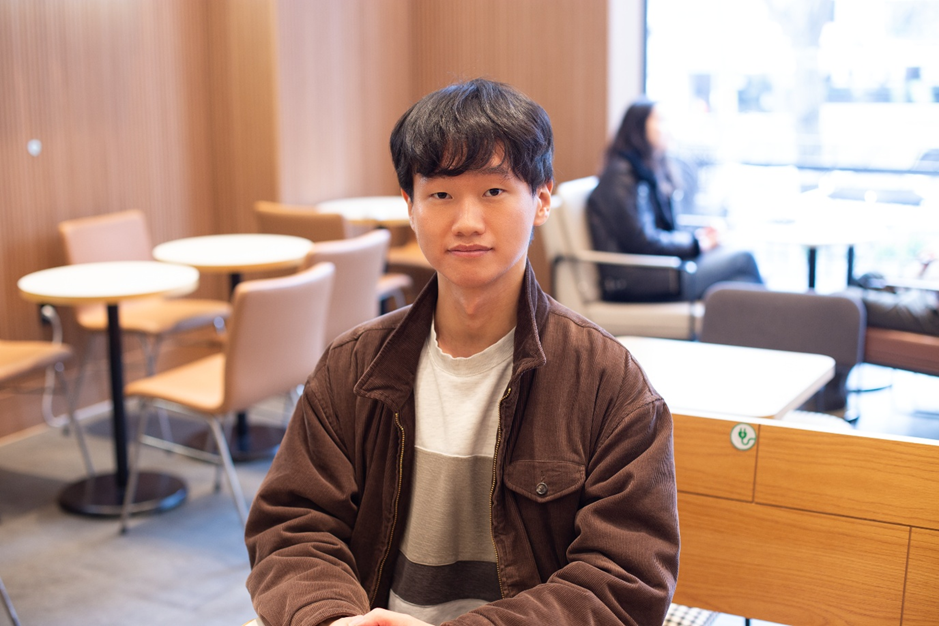 |
Mathematician Baek Jin-eon. Photo: KIAS. |
Baek stated that the problem appealed to him due to its lack of a clear theoretical framework, limited historical context, and even an unclear underlying theory. The young mathematician endeavored to connect the problem with existing ideas, transforming it into an optimization problem and creating appropriate tools for the question.
"It took a long time to integrate an isolated problem into the vast network of mathematical knowledge. I feel like I've planted a small seed", Baek shared.
The paper is currently being reviewed by Annals of Mathematics, one of the most prestigious mathematics journals.
Baek earned his doctorate at the University of Michigan, US, and previously served as a research expert at the National Institute for Mathematical Sciences of Korea. He solved the problem at 29, while working as a postdoctoral researcher at Yonsei University.
By Khanh Linh (According to The Korea Herald, The Chosun Daily, KIAS)