Professor Doctor Nguyen Thi Thanh Mai, Director of Ho Chi Minh City National University (VNUHCM), announced this policy during a meeting with young, leading scientists participating in the VNU350 program on the afternoon of 29/1.
Professor Doctor Mai noted the government's high expectations for Ho Chi Minh City National University in innovation. Temporarily leaving teaching for business engagement is seen as a "military semester", enabling academics to update market trends, industry developments, and economic realities. This practical experience enhances their teaching and research.
Ms. Mai observed that for a long time, academics have worked according to their specialization and passion, while the market operates differently. This "everyone marches to their own beat" approach means research outcomes often do not "meet" the market or business needs.
To overcome this, research and innovation must align with practical problems. In the coming period, the Ho Chi Minh City National University Innovation Center will serve as a hub, connecting and receiving orders from businesses and localities, then forwarding them to scientists.
By the end of 2024, Ho Chi Minh City National University had over 3,670 lecturers, with approximately 44% holding PhD degrees.
The new policy is part of broader efforts, including the VNU350 program. VNU350 is designed to attract, retain, and develop young, leading scientists. Participants must hold a PhD or higher, have studied and researched abroad, and possess the ability to teach and conduct independent research, with attractive incentives for research projects and income.
Ho Chi Minh City National University's incentives for young scientists
After two years of implementation, Master Tran Thi To Uyen, Deputy Head of the Human Resources Department, reported that VNUHCM has attracted 71 individuals, nearly reaching its goal of 100. The University of Technology recruited the most scientists (26), followed by the University of Science (16), the University of Health Sciences (9), and the University of Economics and Law (8).
All of them previously studied at leading global educational institutions such as: National University of Singapore, California Institute of Technology, Seoul National University, Carnegie Mellon University, Ludwig Maximilian University of Munich, and Trinity College Dublin.
Currently, this group leads and participates in key research areas such as artificial intelligence (AI), computer science, biotechnology, renewable energy, and medicine-pharmacy. Approximately 60 scientific articles have been published in reputable international journals, with most belonging to the Q1-Q2 groups.
 |
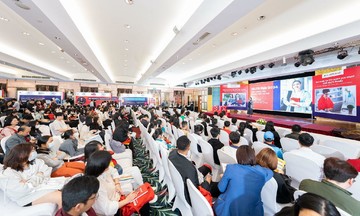
Professor Doctor Nguyen Thi Thanh Mai, Director of Ho Chi Minh City National University, shared at the scientist meeting on the afternoon of 29/1. *Photo: Khac Hieu* |
Le Nguyen