On the afternoon of 12/9, Duy Tan University launched its integrated artificial intelligence (AI) examination platform, the DTU AI Exam Hub. The system comprehensively digitizes all stages: creating question banks, extracting exam papers, conducting automated speaking tests, online proctoring, scoring, and transferring data to the university's management system.
Doctor Le Van Chung, Director of the Center for Simulation and Modeling (CVS) at Duy Tan University, stated that this software aims to definitively resolve long-standing shortcomings in traditional examination work, which heavily relies on manual operations, consuming time and human resources.
In the exam question generation phase, lecturers previously spent two to three days for one course, then went through multiple levels of approval, photocopied paper documents, and manually entered scores.
The new platform integrates smart document processing technology (AI Document Parser). Lecturers only need to upload a raw text file containing various question types: multiple choice, true/false, essay, reading comprehension, and images. AI automatically understands, extracts structure, identifies answers (whether marked by color, bolding, underlining, or symbols), and classifies them by level in one to two minutes.
From this data bank, the system also automatically selects, shuffles the order of questions, and randomizes answers according to a matrix framework approved by the department head, ensuring no overlapping exam codes among candidates.
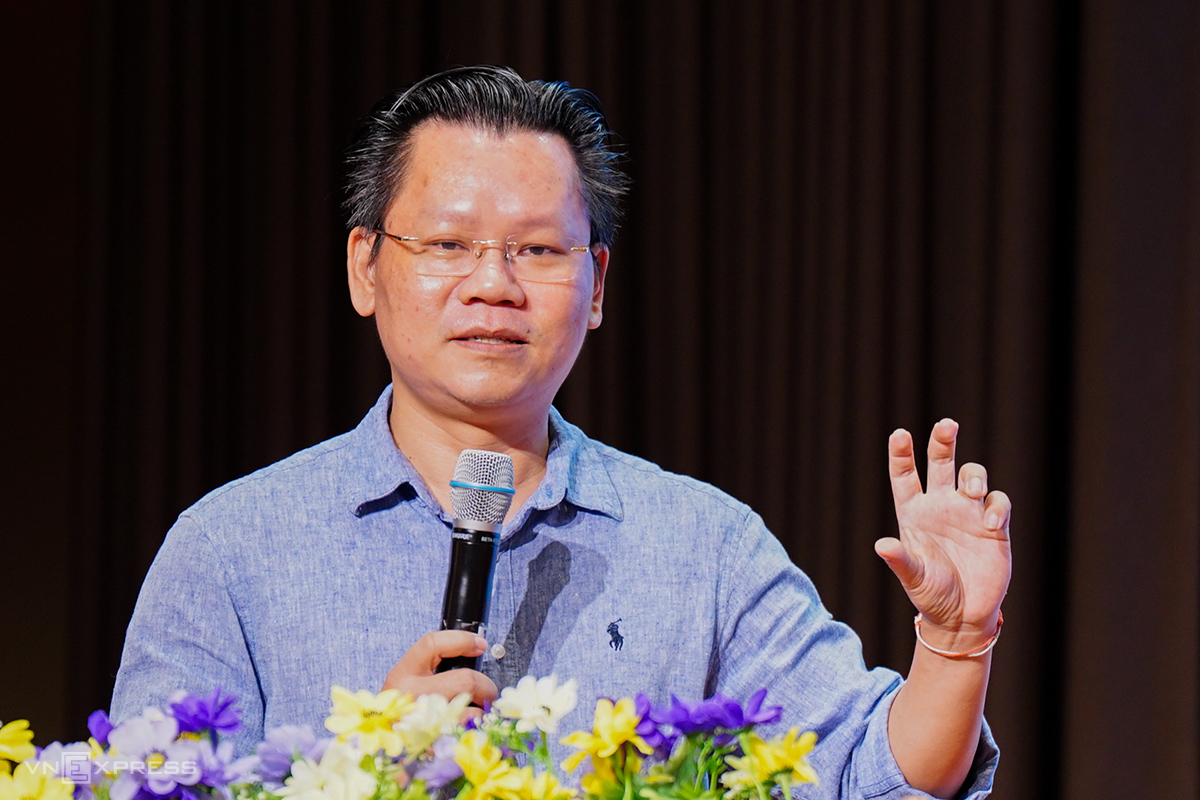 |
Doctor Le Van Chung shares about the DTU AI Exam Hub application. *Photo: Nguyen Dong*.
In addition, the application features an AI examiner for speaking skills, including English, Chinese, Korean, and Japanese. Instead of mobilizing numerous examiners and oral examination rooms for thousands of students, the system allows candidates to interact directly one-on-one with AI by section (Part) or through contextual conversations.
The entire interaction is recorded as evidence. AI analyzes phonetics, grammar, fluency, and vocabulary according to standard evaluation criteria (rubric) to propose scores, minimizing subjective factors. Lecturers only need to review the recordings and approve the scores.
During computer-based examinations, the system activates multi-layered anti-cheating barriers, automatically preventing and recording actions such as tab switching, screen capturing, copy/pasting, right-clicking, or opening developer tools (DevTools). According to Mr. Chung, the system can simultaneously serve 500 to 700 students per exam session while remaining stable and smooth.
In the final stage, exam results are compiled by the system with parameters on candidates, exam sessions, and scores. Lecturers only need to review the exams and click approve, and score data will be encrypted and synchronized directly into the university's academic management system, preventing late or inaccurate score returns due to manual entry.
According to Doctor Chung, this aims to establish a closed-loop process and ensure absolute transparency.
Currently, there are 13 universities nationwide, including two private institutions, one of which is Duy Tan University. The university enrolls about 7,000 students each year.
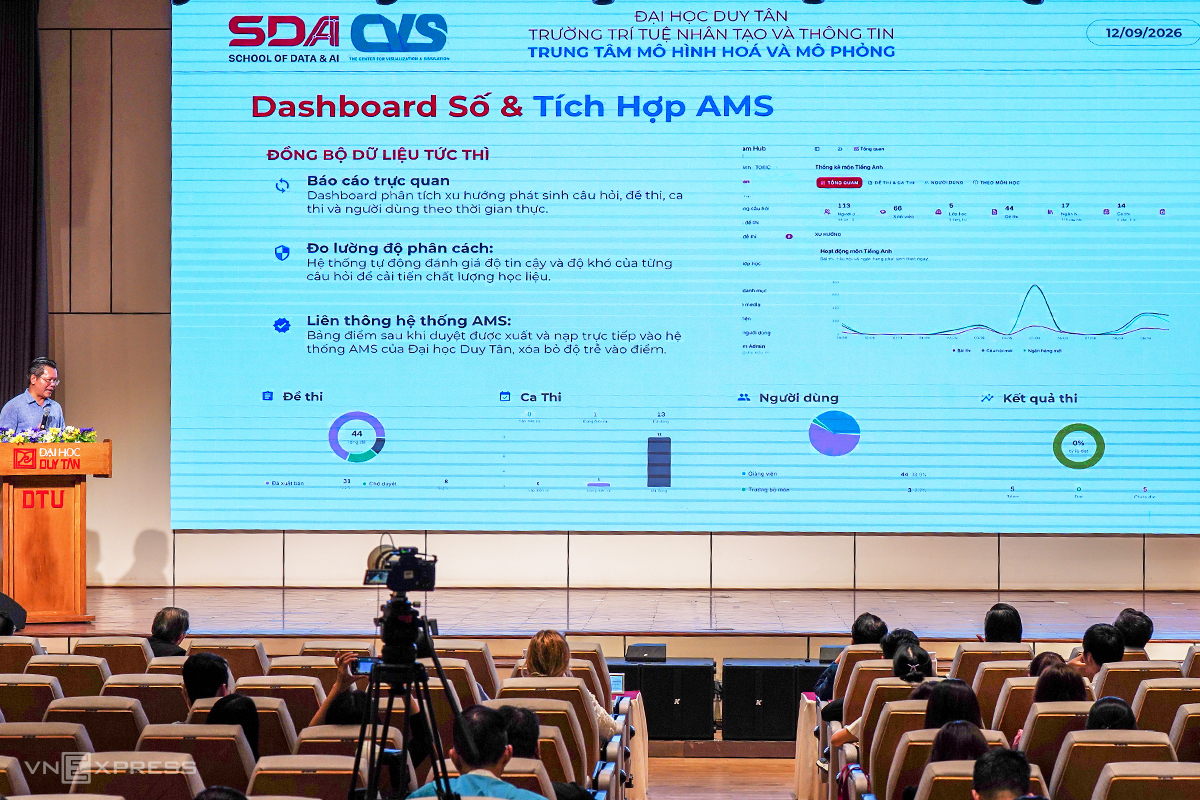 |
The application optimizes question generation, proctoring, multilingual speaking exams, grading, and score updates. *Photo: Nguyen Dong*.
Nguyen Dong