Earlier this year, author Nguyen Ngoc Thuan released his semi-autobiographical work, The Beauty of the Jaded, inspired by his years of battling a serious illness. During that time, Nguyen Ngoc Thuan said he was working on many parallel projects. Now, "100 Legs" has been published, marking his return to children's literature.
While many of Nguyen Ngoc Thuan's works for adults often delve into personal emotions tinged with tragedy, "100 Legs" aims for hope and a more positive message. The story was conceived when he witnessed brain-dead patients still having the opportunity to save the lives of others.
The book tells the story of a centipede with 100 legs. When a prolonged drought parches the forest, the centipede gradually gives away its legs to help other species survive. Throughout this process, Rit (the centipede) also reflects on himself and the emotions he experiences.
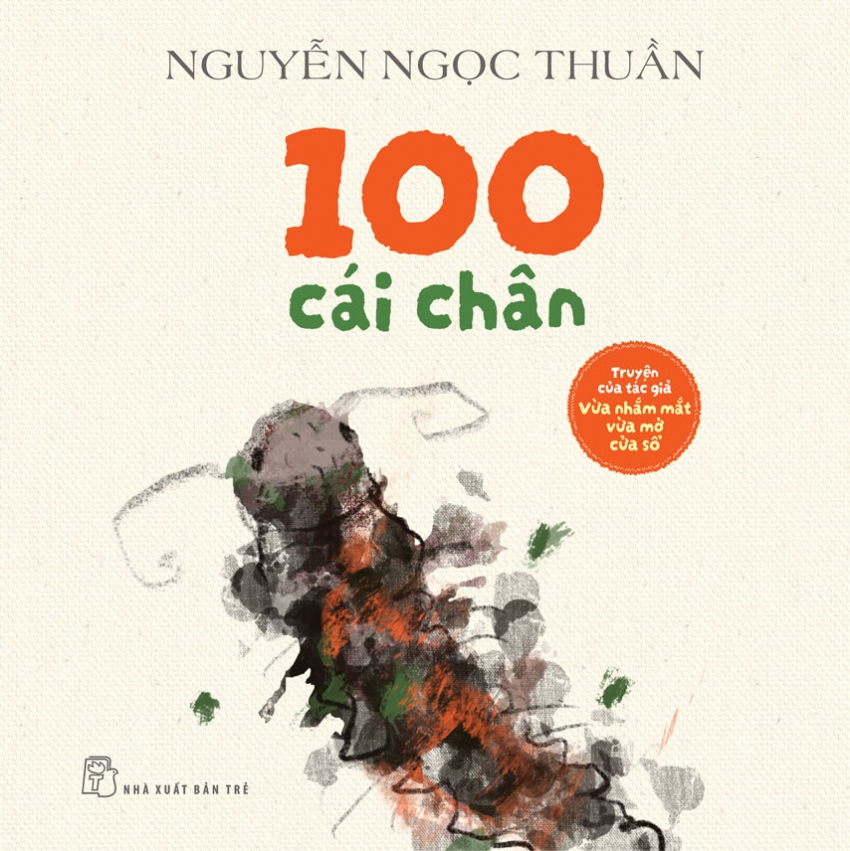 |
Cover of "100 Legs" by writer Nguyen Ngoc Thuan, a 140-page book published by Tre Publishing House.
Although a children's book, the work is suitable for readers of various ages. At each stage of life, readers will perceive different messages, but the most common thread is the beauty of life.
Structurally, "100 Legs" has the characteristics of fables and folk tales, with anthropomorphized animals given voices. Through their interactions, many lessons are embedded.
For example, at the beginning of the book, Nguyen Ngoc Thuan crafts a conversation between Rit and Sao (the starling) when the centipede thinks: "Your journeys have made you wise, knowing this and that, knowing everything. You can go anywhere. Not stuck in one place like me [...] Being a bird, you have two wings, less effort. You don't have to arrange which wing flaps first, which flaps second. To fly, you just need to command once. Even on windy days, you don't need to flap your wings at all. You just lie sprawled on a cloud, paddle a bit, and still fly."
This resonates with human nature, constantly comparing oneself to others without realizing that each individual is a unique universe, entirely independent, with distinct strengths that cannot be measured. Indeed, Sao later says: "It's not like that, Brother Rit [...] During a whirlwind season, if you don't fly carefully, you'll crash headfirst to the ground. In the rainy season, your wings get soaked, you shiver with cold, and flapping feels heavy. Lifting your wings is like you're lifting a 10 kg weight."
Beyond this, characters such as Ca Tram (the carp), Kien Xanh (the green ant), Kien Nau (the brown ant), Kien Vang (the yellow ant), and Go Kien (the woodpecker) also share their own stories about love, kinship, and the spirit of sharing in times of hardship. In some ways, the pages subtly weave in warnings about the impacts of climate change, messages about preparing for difficulties, and the connection and interaction among species.
 |
Writer Nguyen Ngoc Thuan. Photo: Ngoc Duy
The most important story, however, remains Rit's sacrifice. Using a repetitive motif common in fables, the repetition in "100 Legs" does not aim for an escalating effect to draw a lesson, but rather to highlight the profound beauty of giving.
As Rit realizes: "No sacrifice is ever enough. When you give someone a part of your body, you will intend to give more. To keep giving. When you save one creature, you will intend to save another. Then you realize that saving a living creature is your purpose in life. You have understood how important sacrifice is."
Through the animals, Nguyen Ngoc Thuan delves into the anxieties people often harbor due to deeply ingrained beliefs about organ donation, stating: "People believe that when someone dies, they no longer have any meaning. But that is not true. Even after passing, you still hold much value in your hands, feet, eyes, retinas, even skin, bones, and kidneys."
The author adds: "You leave behind your soul for everyone, love for your family and for life. You allow your enemies, as well as your loved ones - those who receive your donated body - to live. You leave them altruism. You forgive them with your own body."
Regarding this work, Nguyen Ngoc Thuan shared: "More than 20 years after With Eyes Closed, With Windows Open, I thought I wouldn't write such books again. But then my love for children urged me to continue writing. These are also the purest sentiments I want to convey. At a moment that felt like the end of the world, the animal shared its body with its kin. And realized that in this world, sharing is never enough. I see myself like the centipede in the story you are about to read: wanting to express gratitude to the river, wanting to share the forest, my homeland under the foliage, and my refuge in children."
Commenting on the work, journalist and author Nguyen Lam Dien, known for The Fascinating Stories of Tigers No One Has Told, remarked: "It seems that hidden deep within those innocent, carefree lines is the worn-out, withered essence of an individual who chose imperfection in a world that is always imperfect and pressured by the line between life and death. But truly, no matter what, people - or rather, these characters - come together and leave future generations with a spirit that living must be beautiful."
Writer Nguyen Ngoc Thuan, 54 years old, hails from Lagi (Lam Dong). He graduated from Ho Chi Minh City University of Fine Arts and currently works at Tuoi Tre Newspaper Ho Chi Minh City. He is the author of many works for diverse readers, including Basically Sad, Nonsense Stories, About This Girl, and Herding Angels on the High Hill. Last year, he won the Most Promising Artist of the Year award at the Painting of the Year 2025 competition, organized by a bank in Ho Chi Minh City.
Among his many works, With Eyes Closed, With Windows Open is a prominent book by Nguyen Ngoc Thuan, having sold more than 100,000 copies. It won the A Prize in the 2002 Children's Literature Creation Campaign, the Peter Pan - Sweden award in 2008, the Good Book award in 2011, and many other accolades.
Tuan Anh