The Nguyen Dong Chi Book Street, a 250-meter-long cultural space in southern Ho Chi Minh City, is designed as a "green cultural destination" to attract young people and offer a quiet, relaxing experience away from the city center. The project broke ground in April and is expected to open in early 2026. Its design emphasizes green technology and nature-friendly architecture, utilizing sustainable recycled materials for its roofs, sidewalks, landscape pond, and musical fountain.
During the project introduction on the afternoon of 1/12, Pham Minh Toan, executive director, highlighted the area's focus on environmental consciousness. The book street is located far from the city center, specifically the section from Nguyen Van Linh to Nguyen Luong Bang in what was formerly District 7. To ensure comfort, kiosks feature curved roofs and an air intake system, designed to keep the street several degrees Celsius cooler than the outside temperature. Additionally, a "recycled water" irrigation system will be implemented, treating urban wastewater for reuse in plant care.
A prominent feature of the book street is the Garden of Knowledge - Creative Garden, which combines a public library with an ecological zone. The area will include a central square, serving as an outdoor stage with a capacity for 300-500 guests, suitable for artistic activities, cultural exchanges, and festivals. The management board plans to install smart libraries that integrate artificial intelligence, virtual reality, and 3D technology. A dedicated creative zone will cater to young people and children interested in handmade pottery, artistic flower arranging, and young artist stalls, alongside a playground offering both physical and intellectual games.
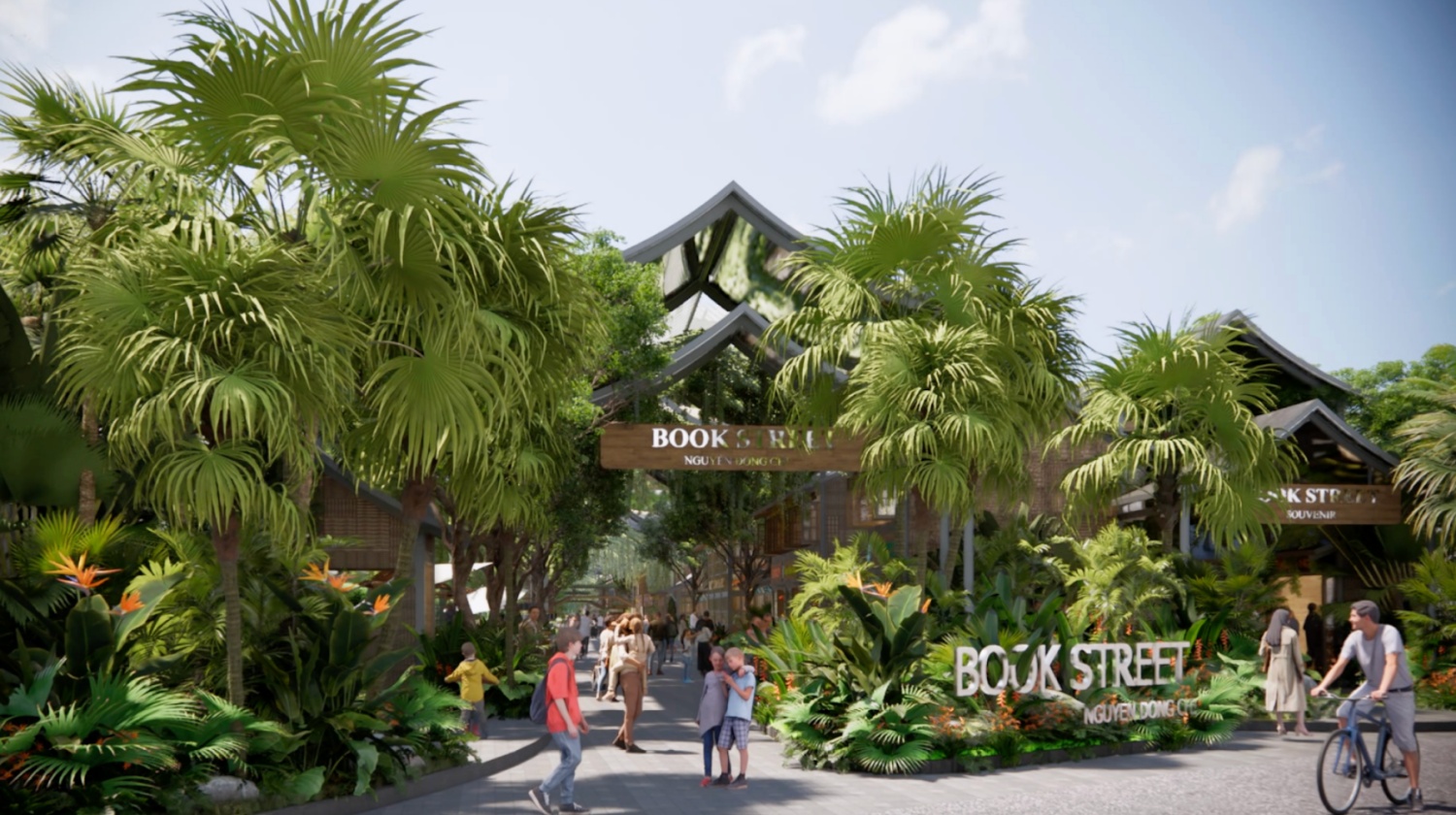 |
The exterior of the book street based on 3D design. Photo: provided by the organizing committee |
According to a representative from the District 7 Culture and Sports Center, the investor, the Nguyen Dong Chi Book Street aims to be more than just a place for books; it will also serve as a destination for cuisine and tourism. Given its location in the southern part of the city, surrounded by numerous universities and high schools, the area is envisioned as a blend of three community spaces: reading culture and knowledge education, art and creativity, and smart technology. Books will constitute approximately 30-40% of the offerings, with the remaining space dedicated to other art forms, such as: art exhibitions and weekly performances for indie singers.
Many events are slated to take place at the book street, including an international book reading festival, an ao dai festival, and promotions for regional specialties and Vietnamese brands. Tran The Thuan, director of the Ho Chi Minh City Department of Culture and Sports, stated that the city's system of reading culture spaces is being developed across its eastern, western, southern, and northern coordinates. The Nguyen Van Binh area in District 1 will serve as the central hub, with "satellite" book streets and book spaces located in areas like Thu Duc, Binh Tan, Cu Chi, and District 7.
The book street is named in honor of scholar Nguyen Dong Chi (1915-1984), who dedicated over 50 years to literary, historical, and Sino-Nom language research and writing. He was a leading folklorist, known for his interpretations of Vietnamese fairy tales in relation to world folklore. In 1984, he was awarded the title of Professor. He was posthumously honored with the second-class Independence Order and the first phase Ho Chi Minh Award in 1996.
Mai Nhat