*This article contains spoilers.
Christopher Nolan's film, globally released on 17/7, structures the narrative through the main character's memories rather than a linear progression. While this approach captures the oral tradition of Greek mythology, it has presented a challenge for some viewers to follow the plot. Film critics have since categorized the events into three main phases.
The backdrop of the Trojan War
Before the Trojan War, Odysseus reigned as king of Ithaca, living with his wife Penelope (Anne Hathaway) and son Telemachus (Tom Holland). He was known for his intelligence, hospitality, and a unique bow that no one else could wield.
The conflict that ignited the war began when Helen (Lupita Nyong'o), queen of Sparta, abandoned her husband, King Menelaus (Jon Bernthal), for Prince Paris of Troy. Menelaus then enlisted his brother Agamemnon (Benny Safdie) to unite the Greek kingdoms, launching an assault on Troy that initiated a decade-long war.
Odysseus departed Ithaca to join the Greek alliance in the war. Before leaving, he told Penelope that she was free to remarry if Telemachus reached adulthood before his return.
After 10 years of conflict, Odysseus devised the strategy of using a giant wooden horse to infiltrate Troy. The plan succeeded, leading to the city's downfall and marking the start of Odysseus's arduous journey home.
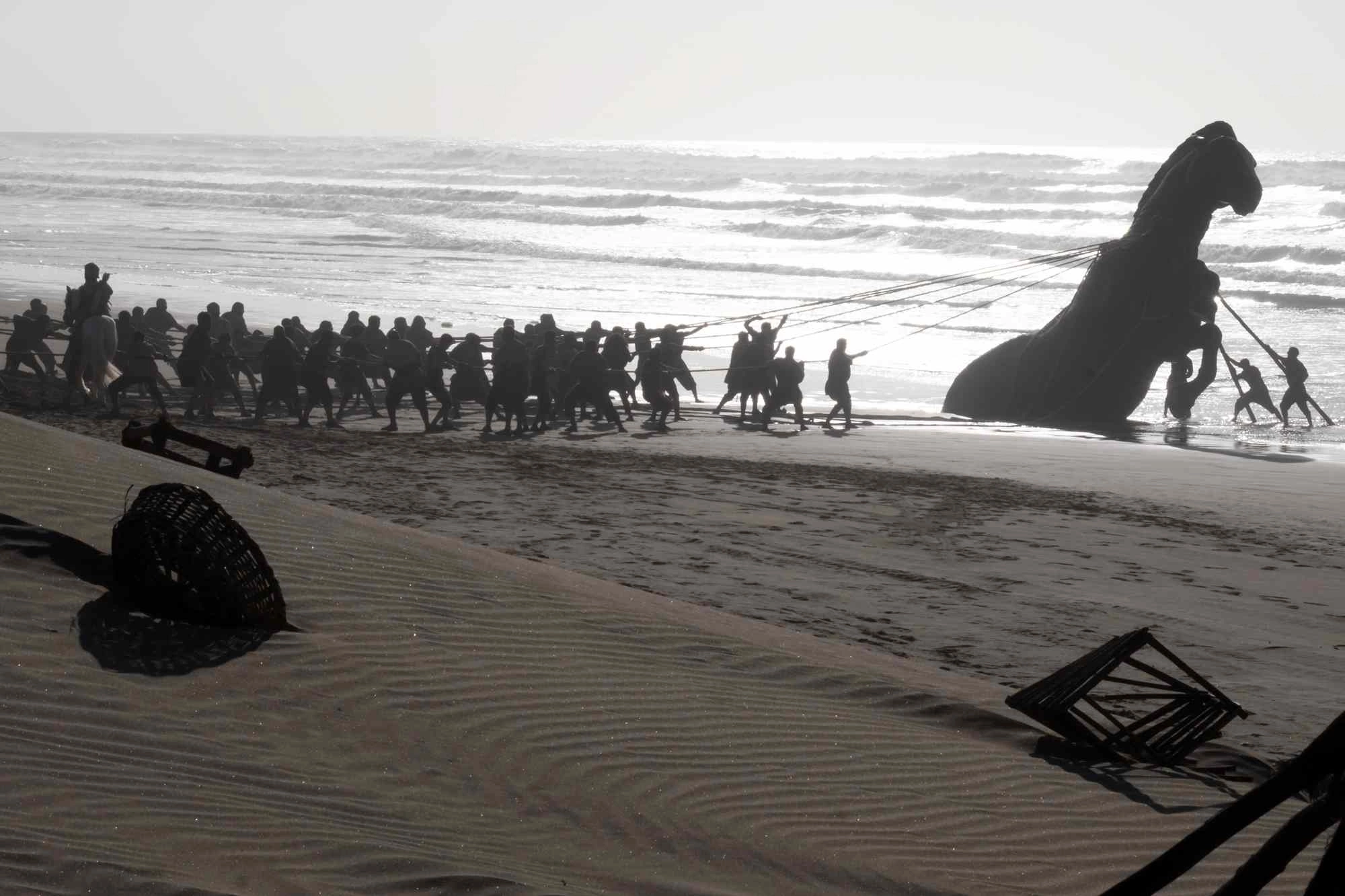 |
Troy's citizens pulling the wooden horse into the city in the film "The Odyssey". Photo: Universal Pictures |
Odysseus's journey home
Following Troy's fall, Agamemnon, Menelaus, and Odysseus separated to return to their homelands. Menelaus brought Helen back to Sparta, and Agamemnon faced tragedy upon his return to Mycenae. Odysseus and his crew, however, began a 10-year journey home, their prolonged voyage a divine punishment for the Greek army's actions at Troy.
During their return, Odysseus's crew encountered the one-eyed giant Polyphemus (Bill Irwin). This confrontation inadvertently provoked Poseidon, the sea god and Polyphemus's father, further complicating their voyage. The fleet then faced additional dangers from the Laestrygonian giants and the sorceress Circe (Samantha Morton). Circe eventually directed Odysseus to the underworld to seek a prophecy about his path home.
In the underworld, Odysseus encountered spirits who warned him of future trials. He was also cautioned against harming the sacred cattle of the god Apollo, a transgression that would cost the lives of his entire crew. Odysseus confronted these challenges sequentially. Ultimately, he drifted alone to the island of Ogygia, where the goddess Calypso (Charlize Theron) sheltered him for 7 years. She fed Odysseus lotus flowers, causing him to forget Penelope and Telemachus. Over time, he slowly recovered his memories, then constructed a wooden raft and sailed home after two decades.
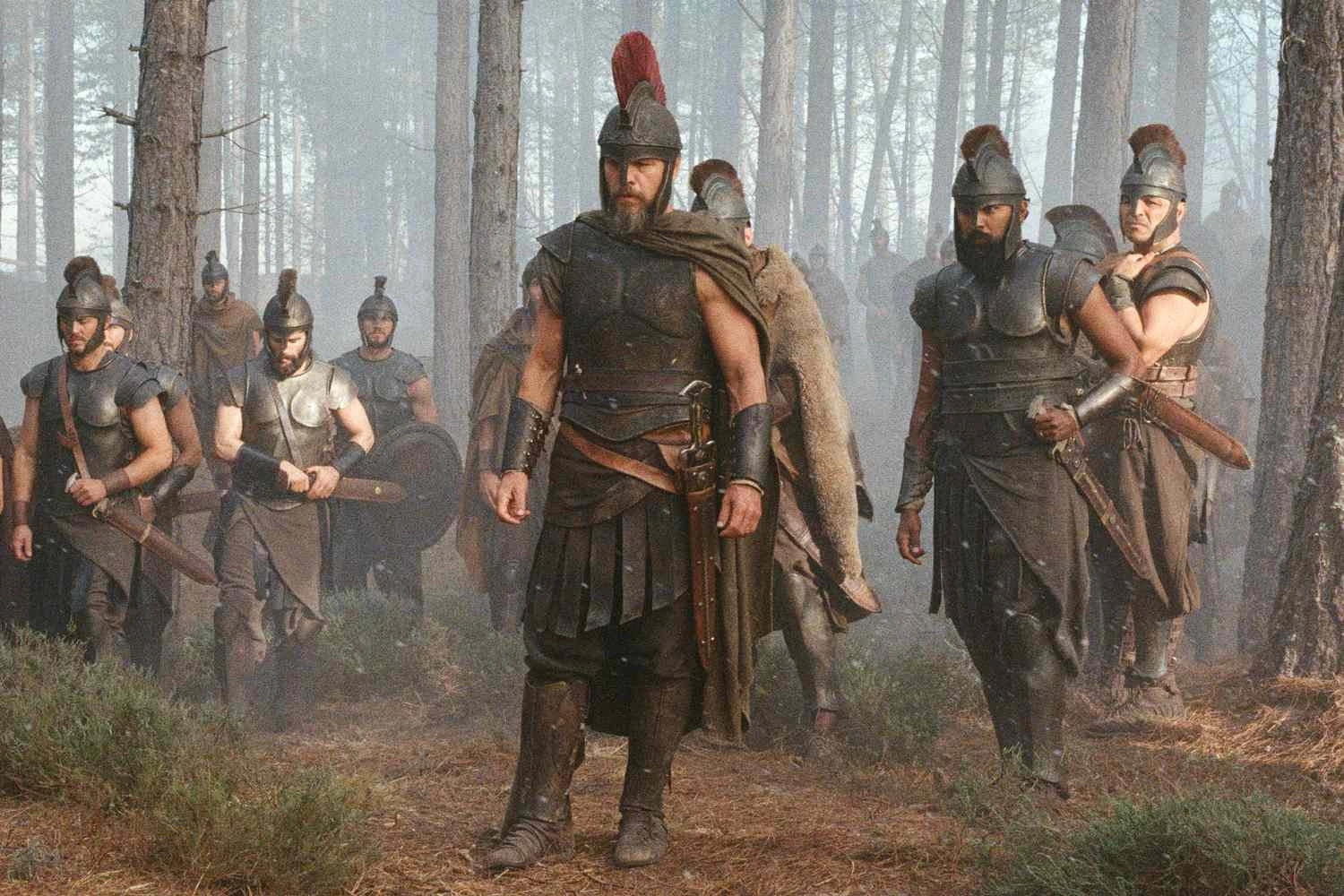 |
Odysseus and soldiers in the land of the Laestrygonian giants. Photo: Universal Pictures |
Revenge in Ithaca
Upon his return, Odysseus disguised himself as a beggar to conceal his identity. He first encountered the loyal swineherd Eumaeus (John Leguizamo), then reunited with his son Telemachus (Tom Holland). His old dog, Argus, recognized his former master, confirming to Telemachus that the beggar was his father. Odysseus instructed his son to keep his return a secret while he prepared to reclaim his kingdom.
During Odysseus's prolonged absence, Penelope consistently rebuffed suitors vying for control of Ithaca. When Odysseus, still disguised, sought food at the palace, Antinous (Robert Pattinson) spat in his bowl, and two other suitors assaulted him.
Penelope later met the mysterious beggar, listening to his tales of Odysseus, unaware she was speaking to her husband. An old female slave recognized a scar on his leg but kept his identity secret at the king's request. Penelope then proposed a challenge: whoever could string Odysseus's bow and shoot an arrow through 12 aligned axe-heads would become her new husband.
When the suitors failed, Odysseus revealed his true identity and easily completed the challenge. A battle erupted in the palace, where he, alongside Telemachus and Eumaeus, defeated their adversaries, ultimately killing Antinous. After reuniting with Penelope and restoring his rule in Ithaca, Odysseus embarked on a further journey westward to honor his fallen comrades. In Greek mythology, the West is associated with death and the Elysium fields, the resting place of heroes.
Cat Tien (according to Variety, Empire)