Tet in Hanoi has long inspired many artists. Literary works on this subject not only capture the changing seasons but also preserve cultural customs, reflecting the lifestyle and spirit of the capital's people.
The essence of Tet manifests through changes in weather and nature. For writer Vu Bang, a son far from home, memories and emotions of these days are woven into his essay "Thuong Nho Muoi Hai", written from 1960 to 1971. He describes northern spring with images of "drizzling rain, cool wind, the cry of swallows in the blue night, the echoing sound of cheo drums from distant villages, and the romantic folk songs of a beautiful, poetic girl". This atmosphere led the writer to express: "I love december immensely, but I love the days leading up to Tet the most; the weather is so pleasant, eyes and hearts are so flirtatious, words and greetings are so charming and subtle".
During Tet, the daily life of Hanoians undergoes many changes. While many artists depict the spring market, each offers a unique perspective. Vu Bang, observing the crowded and bustling market, believed that "the Tet market has a truly strange appeal: everything you look at seems beautiful, everyone you see seems cheerful, everything you see makes you want to buy it" ("Thuong Nho Muoi Hai").
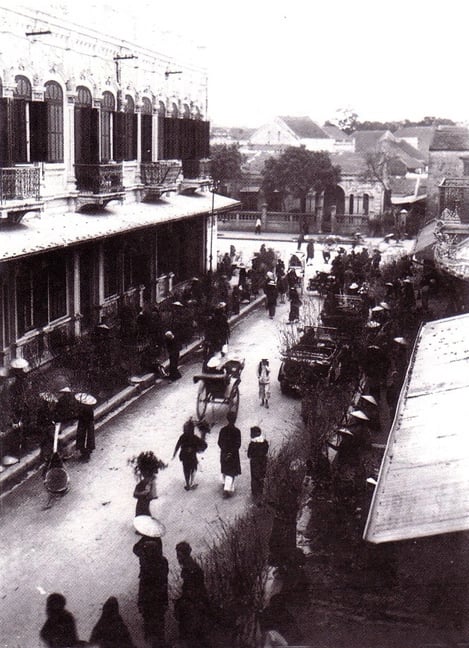 |
A corner of Hang Khoai flower market during Tet in the early 20th century. *Archival photo* |
To Hoai, in "Chuyen Cu Ha Noi"—a memoir and historical autobiography about Hanoi during the French colonial period—chose to recreate the distinct characteristics of Buoi market. Specifically, the market on the 19th day of the twelfth lunar month was considered "the market for the wealthy", while the market on the 29th was "the market for the poor".
Thach Lam, in the early 20th century, saw a quiet space after the hustle and bustle: "On the night of the 29th of Tet, in the hour before new year's eve... who would go to Dong Xuan market to see what remained, what had been scorned since the afternoon? Ugly peach branches with few flowers; tattered narcissus bowls, passed from hand to hand without being bought; exhausted and muddy pots of chrysanthemums and dahlias. Under the fine rain, mud splattered on peach and apricot branches scattered on the road, trodden by countless feet" ("Ha Noi Bam Sau Pho Phuong").
At the start of the new year, to pray for peace and happiness, Vietnamese people follow many customs, such as visiting pagodas, seeking blessings (xin loc), and avoiding bad omens. Vu Bang recounted that after offering prayers to heaven, earth, and ancestors, his family would "go to Ngoc Son temple, turn to Hang Trong communal house, go up to West lake, enter Quan Thanh temple, attend the new year's eve ceremony, then some would carry lucky branches, others lucky incense". To Hoai, on the other hand, often visited both distant and nearby pagodas: Huong pagoda, Quan La pagoda, and Lang pagoda.
Beyond familiar customs, old literary works preserve the refined pleasures of "eating" and "playing" among Hanoians. In "Mien Ngon Ha Noi", Vu Bang asserted: "Is eating an art? More than that, eating is an entire culture". In other words, cuisine also measures a nation's cultural depth. It not only reflects Hanoians' culinary expertise but also embodies elegance and care in every step of selection and enjoyment.
During Tet, Vu Bang was impressed by Xuan Cau cake: "push a piece with your tongue to your palate, and you will feel the cake gently sing, gently melt; the aftertaste of honey blends with the tip of your tongue; the richness, the creaminess, along with the sweetness, the nuttiness caress your throat and give you the feeling of hearing a melody with the sound of brass mixed with iron". Or, speaking of com (young green rice flakes), a suitable gift for Tet, Thach Lam advised not to rush, but "to eat little by little, slowly and thoughtfully" ("Ha Noi Bam Sau Pho Phuong").
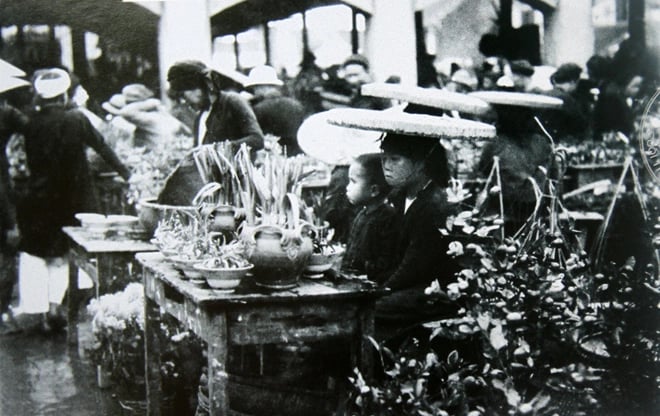 |
A narcissus flower shop during Tet in 1929. *Archival photo* |
Regarding leisure, many old Hanoians enjoyed cultivating narcissus flowers. This required careful selection, meticulous care, elaborate trimming, and knowing how to control sun exposure and dew... for the flowers to bloom beautifully, ideally precisely at new year's eve. Nguyen Tuan wrote about the narcissus contest at Bach Ma communal house: "whoever's flower bloomed exactly at new year's eve would receive ten square bolts of pink silk, five firecracker mortars, one tin of tea..." ("To Hoa").
Later, in his 1990 work "Mot Nguoi Ha Noi", a period of significant historical changes both positive and negative, writer Nguyen Khai meticulously portrayed Mrs. Hien—an elderly, astute, and elegant Hanoi woman—polishing a red enameled narcissus bowl in her ancient house, steeped in layers of culture. Facing life's upheavals, she retained Hanoi's refined composure. Witnessing this, the narrator felt nostalgic and regretful over a traditional cultural beauty at risk of fading amidst modern life, urbanization trends, and expressed a longing for a tranquil space sufficient to nurture the soul.
Khanh Linh