The publication was completed many years ago, but the family has only now released it with support from his former unit, the General Department of Logistics. The book is divided into four chapters: the first two parts recount the life and career of Professor Tran Dai Nghia. Chapter three features family perspectives on him, before concluding with a series of photographs from his lifetime.
 |
The 240-page publication is released by Lao Dong Publishing House and HanoiBooks. Photo: Publisher provided
The book opens with the professor recalling his childhood in Vinh Long. His birth name was Pham Quang Le, born in 1913 in his maternal hometown, along the Mang Thit River, Chanh Hiep commune, Tam Binh district, Vinh Long province, into a family of educators. He was the second child of teacher Pham Van Mui (1871-1920) and Ly Thi Dieu (1881-1941), with two siblings, his older sister being Pham Thi Nhan (1911-1937).
In his youth, he excelled academically at schools such as College de Mytho and Petrus Ky, before pursuing higher education at the National University of Bridges and Roads in Paris, Sorbonne University, Electric Power University, and the Aviation Academy in France. According to the book, this was a rare feat for a student from a colonial country. Many French professors, when faced with difficult mathematical problems, would think of Pham Quang Le, proud of their brilliant student who came from a poor background.
The memoir recounts the farewell between Pham Quang Le and his mother and sister on 5/9/1935: "Leaving Saigon port for France to study. The ship's whistle echoed, and the vessel cut through the waves, departing the harbor, heading towards Vung Tau to set sail. The figures of my mother, sister Nhan, and my homeland gradually faded, becoming a faint, blurry dot amidst the vast expanse of sky and water. Along both riverbanks, rows of mangroves and cork trees rushed past so quickly that there was no time to fully admire a single canopy of leaves, as if softly rustling in the wind!"
During his time as an engineer in France and Germany, he earned a salary of up to 22 luong vang (gold taels) per month. After accumulating technical knowledge, he returned home at the call of President Ho Chi Minh.
The first chapter describes Tran Dai Nghia's role in establishing Vietnam's military industry, his family life in the resistance base, and the legacy he left through scientific works, schools, awards, and places named after him.
The second chapter is divided into two parts, recounting his revolutionary activities and military industry career from the time he followed Uncle Ho back to Vietnam in 1946 until he became the founder of the national defense industry. The book describes his process of organizing weapon production under scarce conditions, from researching and manufacturing bazookas, skzs (recoilless rifles), mortars, mines, and bombs to utilizing all material resources and training technical personnel.
The book also records his role in the two resistance wars, his influence on the battlefield, and the growth of Vietnam's military industry. This section was compiled by Major Dao Duc Tu, a collaborator with the History Section of the Logistics Science Department, General Department of Logistics, based on the professor's accounts in 1982.
In the second part of this chapter, he recalls memories of President Ho Chi Minh from their first meeting in France, then traveling with Uncle Ho by ship back to their homeland. In the book, the professor states he always remembered the brief conversation between Uncle Ho and him during that initial encounter.
"The first question: 'Life in the country is still very difficult, can you endure it if you return?'"
"I replied: 'Yes, Uncle, I can endure it.' "
"The second question: 'There are no weapon engineers, no weapon cadres or workers in the country; there are also no machines or materials to make weapons. Can you still do it?'"
"I answered: 'Yes, Uncle, I can, because I prepared for 11 years in France.' "
After 40 days at sea, the ship docked on 20/10/1946. Upon returning, alongside some Party leaders, the young engineer Pham Quang Le also met comrade Vo Nguyen Giap. He never forgot the general's words: "We have been waiting for you at home. We are very happy to hear you are returning with Uncle."
 |
Professor Tran Dai Nghia (second from right) introduces weapons produced by the military workshop to General Vo Nguyen Giap (far right) at the first congress of the Vietnam General Confederation of Labor (1/1/1950). Archival photo
Chapter three presents an image of Tran Dai Nghia through the recollections of his wife and four sons, portraying him in his role as a father and teacher. He married nurse Nguyen Thi Khanh in 1947 in the Viet Bac mountains and forests. They had four sons, who currently live and work in Hanoi and TP HCM. The children cherish the moral lessons, way of life, and study methods he imparted, such as grand ambitions, responsibility to the country, willpower to overcome difficulties, and a simple and thrifty lifestyle. Relatives also recounted his daily habits, passion for research, dedication, and integrity, along with many family memories.
According to the book, since following Uncle Ho back to Vietnam, the professor dedicated his entire life to serving the nation with a devoted, silent heart. After the country was reunified, he wrote these heartfelt words in his notebook: "On 30/4/1975, my mission was completed, because my childhood ambition, my very simple mission, was to participate scientifically and technically in weapons for the revolutionary armed struggle to liberate the country; and now that the country has been liberated, I want nothing more, because one cannot do more in a lifetime."
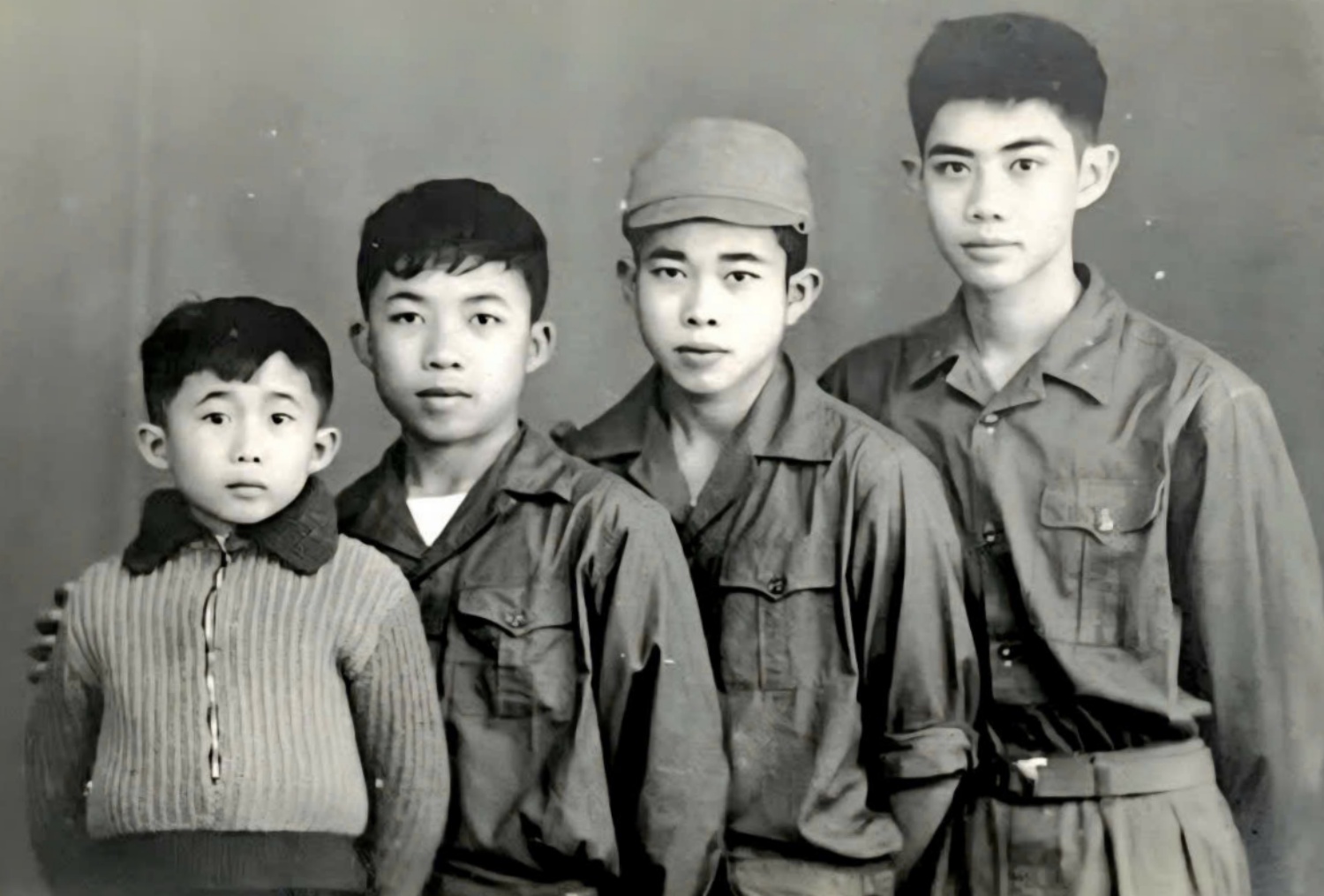 |
From left: Tran Dung Trong - Tran Dung Trinh - Tran Dung Trieu - Tran Dung Tri, the four sons of Professor Tran Dai Nghia in their youth. Photo: Family provided
Doctor Ha Thanh Van supplemented the book with compiled documents covering Pham Quang Le's elementary school years until he studied and worked in France and Germany. This provides readers with additional insights into historical changes, highlighting his perseverance.
Tran Dai Nghia (1913-1997) was a professor, academician, military engineer, and polymath. He was also a general in the Vietnam People's Army, a Labor Hero, and an academician of the USSR Academy of Sciences. He is considered the founder and promoter of the development of Vietnam's military and national defense industries. He served as Director of the Department of Military Industry (now the General Department of Defense Industry) under the Ministry of National Defense, concurrently Director of the Directorate of Military Research, and was the first rector of Hanoi University of Science and Technology. He passed away on 9/8/1997 in Tan Binh, TP HCM, surrounded by his family.
Mai Nhat