I began viewing cheo paintings quite early in life. In 1987, my teacher, Van Tam, along with Phan Ke Hoanh, established the literary supplement, Van Hoc - Hoc Van. Van Tam's article in the first issue, titled "The cheo clown - a piece of the national soul", featured illustrations by artist Bui Xuan Phai. Nearly 40 years later, I no longer recall the content of that article, only its title and the accompanying illustration.
Years later, standing before Nguyen Linh's paintings, I was reminded of that experience. This recollection was not triggered by an old article or a specific memory, but by something else entirely.
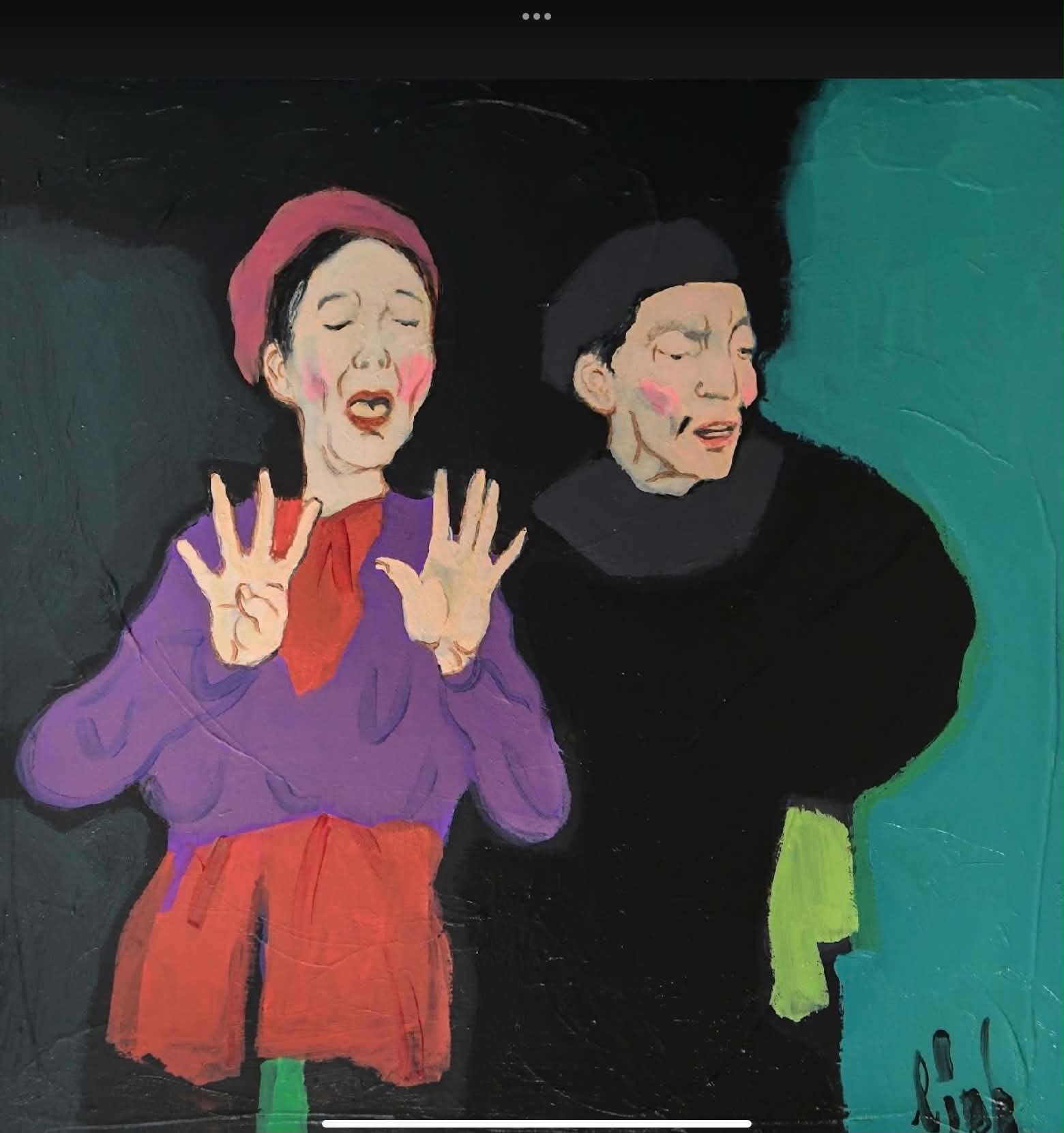 |
"Cheo", an oil painting by Nguyen Linh. |
Viewers almost immediately recognize cheo art when standing before Nguyen Linh's paintings. A realm of memories unfolds: figures still sing, perform, turn, and gesture in familiar movements of folk theater. Yet, the stage itself has nearly vanished. There is no longer a village communal house, no night performance, no crowd of spectators, and no stable place to support them. Surrounding these figures are vast purple spaces, thin box frames, and skeletal rooms that offer depth but lead nowhere, with walls that aren't truly a place for human solace.
These ambiguous spaces define the atmosphere of the entire painting series. They evoke architecture but do not perform architecture's function. They draw the viewer's eye far into the distance, then pull it back to the flat surface. Standing before these works, one sometimes feels as if these cheo images have departed their traditional home. They no longer fully belong to the stage, yet they have not completely dissolved into the pure world of painting. The entire series seems to draw its essence from this in-between state, at once vibrant and empty, like a farewell that has already happened, or a meeting yet to begin.
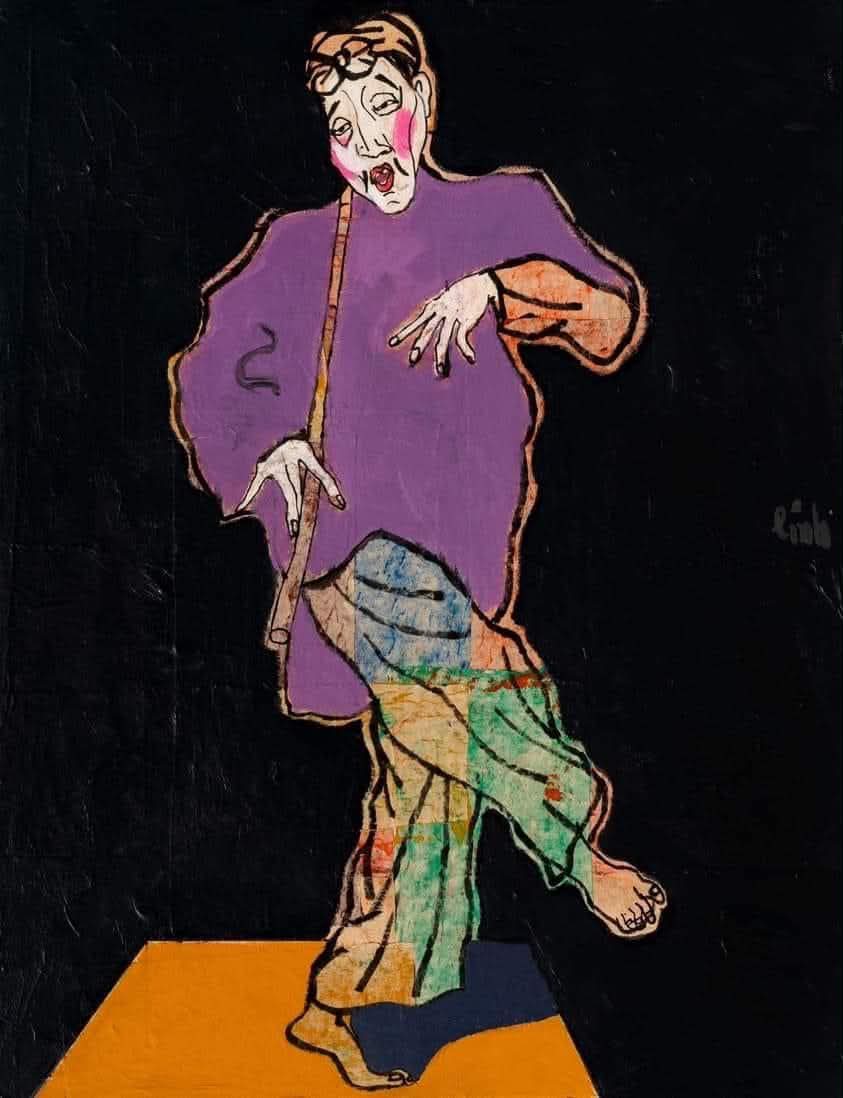 |
"Cheo Suy Van", an oil painting by artist Nguyen Linh. |
As the story and the stage recede into the background, the body emerges. An open arm is no longer seen as a specific stage movement but becomes a line of force running across the canvas. A body leaning forward sets the rhythm for the entire composition. He simplifies faces almost to masks, eyes reduced to a few curves, and mouths remain open, though the singing has vanished. Nguyen Linh shows little interest in character psychology. Instead, he retains the linguistic essence that cheo theater has honed over generations.
Purple frequently appears in Nguyen Linh's paintings, yet rarely functions as the color of a specific object or scene. It spreads behind the figures, weaves into the empty spaces, covers unfinished architectural structures, and unifies the entire canvas within a shared atmosphere. At times, after prolonged viewing, one cannot tell if the figures are emerging from the background color or if the background is consuming the figures. The two intertwine to such an extent that the boundary between them becomes less important.
This sensation becomes even clearer when observing the lines. The black outlines running around the bodies do not aim to make forms more solid or realistic. They appear, then stop, change direction, or break off midway. Some faces are held by only a few curves. Some arms seem to emerge from the background color. Some bodies are so thin that another layer of paint could make them dissolve back into the canvas.
Consequently, the figures in Nguyen Linh's paintings rarely appear as complete forms. From a distance, they emerge quite clearly. Up close, the image fractures into brushstrokes, color patches, and individual marks. Nguyen Linh does not construct the body through anatomy or volume. A hat, a tilted face, or an open arm suffice for the figure to emerge. The viewer completes the rest.
A characteristic offset is present in Nguyen Linh's paintings. Proportions are rarely stable. A face might be disproportionately large compared to the body. An arm might carry more visual weight than the rest of the figure. At times, the human form almost overwhelms the entire surrounding space. This offset appears between figure and background, between flatness and depth, between form and color, keeping the viewer's eye constantly adjusting, pulled from one area of the painting to another.
However, this offset is not random. It is held in a delicate balance. The canvas never collapses, but also never completely stands still. Every element appears slightly off its stable position, just enough to create a continuous rhythm of movement within the painting.
At this point, one begins to perceive the spirit of the clown appearing in a different way. In cheo, the clown is one who disrupts order. The clown steps into the story to break rhythm, shatter solemnity, and pull the stage away from the straight line of conventional logic. Nguyen Linh seems to bring this very principle into his painting. He does not merely paint clowns as characters, but allows the clown's spirit to permeate the organization of the canvas, its proportions, composition, and the relationships between forms.
Thus, what remains on the canvas is not simply the image of a cheo character. It is a rhythm always maintained in a precarious state, just enough not to collapse but never to stand still.
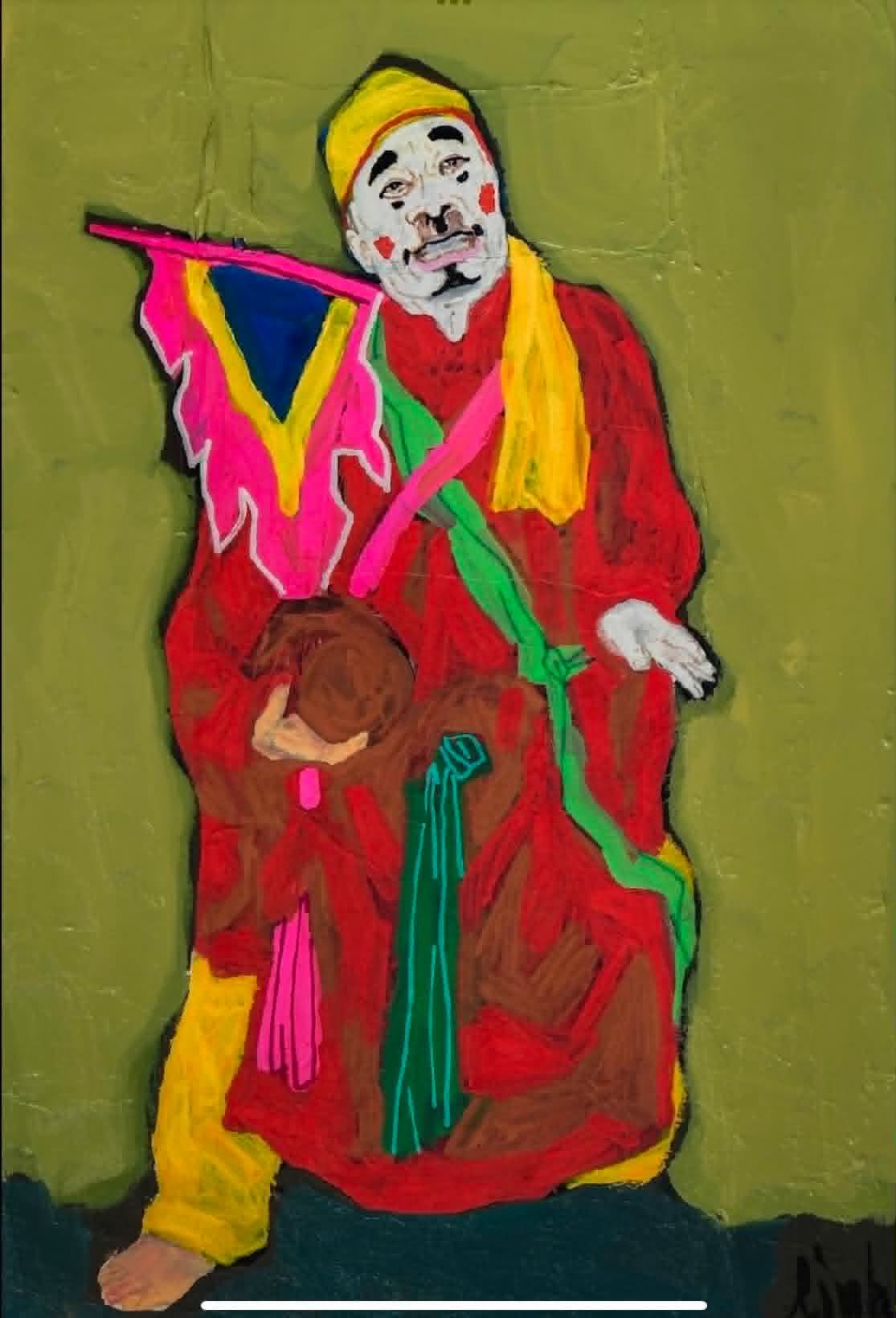 |
"Thay mo", an oil painting by Nguyen Linh. |
Perhaps from this perspective, the series transcends the story of cheo itself. It touches upon a broader question for contemporary Vietnamese art. In recent years, tradition no longer exists as a complete, living world. Yet, it has not vanished. It continues to be present in rhythm, in imagery, in what remains in memory, and in perspectives that have detached from their original environment. Nguyen Linh does not seek to reconstruct a past stage, but rather observes what remains after that stage recedes into the past.
Therefore, what lingers after viewing the paintings is not solely cheo. It is images that continue to live after the places that gave them birth have changed.
Artist Nguyen Linh, 63 years old, was born in Hanoi. He graduated from Hanoi University of Fine Arts, class of 23 (1979-1983). He once worked as a journalist at Kien Truc magazine, but in 1990, he shifted his focus, dedicating his passion to painting. He is recognized for creating many notable works in folk culture painting, such as cheo and hau dong (Vietnamese shamanic ritual). The artist has held five solo exhibitions, spanning from 2006 to 2023, along with numerous group exhibitions both domestically and internationally. Nguyen Linh is also an art collector, having co-founded the Viet Art Center with artist Dao Vu and Hanoi University of Fine Arts.
Nguyen Thanh Son
Photo: Provided by character